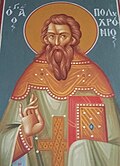
Venerable
Polychronius
Hermit of Syria
Monk near the city of Cyrrhus, personally known to Theodoret, who lived in strict asceticism; died after 444.
- Feast
- February 23old style March 8
- Era
- unknown
- Order
- Venerables
Life
Venerable Polychronius was a Syrian ascetic and hermit of the fourth century who was still living after the year 444. Theodoret of Cyrrhus, who knew him personally, writes of him in chapter twenty-four of the History of the Lovers of God. His commemoration is on 23 February, like that of his teacher Zebinas. He must not be confused with the Holy Hieromartyr Polychronius, the priest, commemorated elsewhere.
He was a monk in the neighbourhood of the city of Cyrrhus, where he led a strict ascetic life. He was a disciple of Zebinas and, like his teacher, a zealous man of prayer, spending the whole night in prayer. Having reached old age, he grew weak and, at Theodoret's request, received into his cell two monk helpers, Moses and Damian. But they, after a short time with Polychronius, wished to leave him, because they could not bear his all-night vigil. The elder Polychronius showed himself indulgent to the human weaknesses of his attendants and told them that he did not force them to spend the whole night with him in prayer, but asked them to lie down more often.
Conquering the chief sin, pride, Polychronius always sought to hide his labours. Fearing to harm his soul, which might fall into vainglory, he did not wear chains. But he ordered a heavy oak root to be brought, and at night, when no one saw, he put it on his shoulders and prayed so; sometimes he did this also by day, when he had time. When someone came to him and knocked at the door, Polychronius hid the root in a certain place. A man saw this by chance and told Theodoret of the labour. Theodoret wanted to know how heavy the root was and, finding a suitable moment, could hardly lift it with both hands. Polychronius, seeing it, ordered Bishop Theodoret to put it back. Theodoret's requests to Polychronius to carry the oak root out of the cell had no success.
Theodoret describes a miracle worked by Polychronius: in time of drought, an empty vessel, on which Polychronius had placed some crayfish, was filled with oil. Theodoret also describes a wonderful incident showing Polychronius's humility: Theodoret came together with the governor of the Cyrrhus region to the elder, Polychronius knelt, embraced the governor's feet and said he wished to ask him for something. The governor was displeased, thinking the elder would ask help for someone, but, respecting the ascetic, promised to fulfil the request. To his astonishment, instead of interceding for anyone, the elder asked the governor himself to pray earnestly to God for him. Although many brought him gold and gave it to him, Polychronius took nothing from anyone, for he loved poverty. At the time Theodoret wrote the History of the Lovers of God, in 444, Polychronius was still alive.
Commemorated the same day February 23
 Polycarp of SmyrnaHieromartyr · Bishop of SmyrnaFeb 23
 Matrona of MoscowFool-for-ChristFeb 23
 Serenus of SirmiumMartyr · Gardener, martyr of SirmiumFeb 23
 Alexander the UnsleepingVenerable · Founder of the Unsleeping OnesFeb 23
 GorgoniaRighteous · Sister of Gregory the TheologianFeb 23
 John TheristisVenerable · Monk in CalabriaFeb 23
 PolychroniusSaint · Bishop of BabylonFeb 23
- John, Antiochus, Antoninus and MosesVenerable · Syrian hermitsFeb 23
- Polycarp of BryanskVenerable · Founder of the Transfiguration MonasteryFeb 23
- ZebinasVenerable · Syrian hermitFeb 23
- 73 MartyrsHoly MartyrsFeb 23
- AntoninusVenerableFeb 23