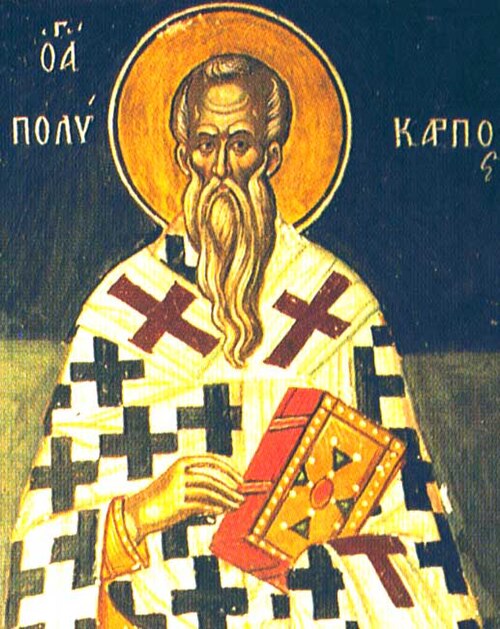
Hieromartyr
Polycarp of Smyrna
Bishop of Smyrna
Bishop of Smyrna and disciple of the Apostle John, burned at the stake for his faith around 155.
- Feast
- February 23old style March 8
- Reposed
- 1552nd century
- Place
- İzmir
- Order
- Martyrs
Life
The Holy Hieromartyr Polycarp of Smyrna was bishop of Smyrna in Asia Minor, a disciple of the Holy Apostle John and one of the three chief Apostolic Fathers, with Clement of Rome and Ignatius the God-bearer. He died burned at the stake around 155. The Church keeps his memory on 23 February (Menaion date; for the Churches on the old calendar that day falls on 8 March in the civil calendar).
Youth and discipleship
The Orthodox synaxarion says that Polycarp was orphaned young and, at the direction of an angel, was raised by a pious widow named Kallista. After her death he gave away his possessions and lived chastely, caring for the sick and the infirm. Saint Bucolus, bishop of Smyrna, grew fond of him and drew him close, ordained him deacon and entrusted him with preaching the Word in church, and later made him a priest. The Apostle John was still alive, and Polycarp was especially close to him and at times accompanied him on his journeys.
Shortly before his own death, Saint Bucolus wished Polycarp to succeed him on the throne of Smyrna. At his consecration as bishop, tradition says, the Lord Jesus Christ appeared to him. Saint Irenaeus of Lyons and Tertullian testify that Polycarp was a disciple of John the Apostle, and Jerome adds that John ordained him bishop of Smyrna. Some modern scholars doubt this link, but Irenaeus, who knew Polycarp as a boy, speaks of him warmly.
The year of his birth is not certain: Wikipedia gives 69, the Russian synaxarion about 80. From his words before the proconsul we learn that he had served Christ for eighty-six years, which may be his age or the time since his baptism.
Shepherd and writer
Saint Ignatius the God-bearer, on the road to Rome and death, wrote him an epistle, and at Smyrna he stopped to see Polycarp, once his fellow disciple. Ignatius told him that the age had need of him, as pilots need winds and a storm-tossed sailor needs a harbour.
According to Irenaeus, Polycarp wrote several letters to neighbouring churches and to individuals. The only one to survive is the Epistle to the Philippians, written at their request, since they wanted the letters of Ignatius that he possessed. It is a mosaic of quotations from the Septuagint and apostolic writings, and Jerome says it was read in the churches of Asia at divine service.
Against heretics he was unbending. Asked by Marcion whether he knew him, he is said to have answered that he knew him as the firstborn of Satan. Irenaeus recalls that when Polycarp heard false teaching he would stop his ears and lament that God had let him live in such times.
The visit to Rome
In the days of Pope Anicetus, Polycarp went to Rome to discuss differences of practice between the churches of Asia and of Rome. On some points they quickly agreed. On Easter, Polycarp kept the feast on 14 Nisan, the day of the Jewish Passover, whatever the day of the week, as he had received it from John, while Anicetus followed the custom of the West. Each held to his own rule without breaking communion, and Anicetus let Polycarp celebrate the Liturgy in his own church, which was regarded as a great honour. According to Irenaeus, his witness brought many followers of Marcion and Valentinus back to the Church.
Martyrdom
Persecution struck Smyrna under Emperor Marcus Aurelius. The pagan crowds demanded that Polycarp be found, calling him in mockery the father of all Christians. At the urging of his flock he withdrew to a village near the city. When the soldiers came, he went out to meet them, invited them to eat and asked for time to pray, preparing himself for death.
Brought to trial, he plainly confessed Christ and was condemned to be burned alive. He said that he had served Christ for eighty-six years and that Christ had never wronged him, so how could he blaspheme his King who had saved him. He told the proconsul that his fire burns for a season and is quenched, but that the proconsul did not know the fire of everlasting punishment. At his farewell he blessed God for judging him worthy of that hour, so that among the martyrs he might share the cup of Christ.
The executioners meant to nail him to the stake, but he said that God would give him strength to bear the flames, so he was only bound with ropes. According to the letter of the Church of Smyrna, the flames encircled him without touching him, closing above his head like a vault, and the faithful perceived a fragrance like incense. Seeing that the fire did him no harm, the pagans stabbed him with a dagger, and so much blood flowed that it put out the flames. His body was then burned.
The date of his death is disputed. Eusebius places it under Marcus Aurelius, around 166 or 167, but a later addition to the Martyrdom of Polycarp fixes it on Saturday, 23 February, in the proconsulship of Lucius Statius Quadratus, around 155 or 156, a date that fits better with his link to Ignatius and John.
Relics and veneration
The letter of the Church of Smyrna, called the Martyrdom of Polycarp, is one of the earliest genuine accounts of a Christian martyrdom, after the account of Stephen in the Acts of the Apostles. It tells that the faithful gathered his bones, more precious than costly stones and finer than gold, laid them in a fitting place, and met there each year to keep the birthday of his martyrdom. It is among the earliest testimonies to the veneration of relics and to the yearly commemoration of martyrs.
Relics of the saint lie under the main altar of the church of Sant'Ambrogio della Massima in Rome. His right arm was kept for over five hundred years at the Monastery of the Dormition of the Theotokos and Saint Polycarp at Ampelakiotissa near Nafpaktos in Greece, until it was stolen on 14 March 2013 and never recovered; a fragment taken from it earlier was found and returned to the monastery on 14 July 2019.
Saint Polycarp is honoured in the Orthodox and Catholic Churches, in the Oriental Orthodox Churches, and by Lutherans and Anglicans. The Coptic Church keeps him on 29 Amshir (8 March in the Gregorian calendar).
Commemorated the same day February 23
 Matrona of MoscowFool-for-ChristFeb 23
 Serenus of SirmiumMartyr · Gardener, martyr of SirmiumFeb 23
 Alexander the UnsleepingVenerable · Founder of the Unsleeping OnesFeb 23
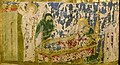 GorgoniaRighteous · Sister of Gregory the TheologianFeb 23
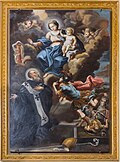 John TheristisVenerable · Monk in CalabriaFeb 23
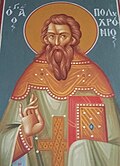 PolychroniusSaint · Bishop of BabylonFeb 23
- John, Antiochus, Antoninus and MosesVenerable · Syrian hermitsFeb 23
- Polycarp of BryanskVenerable · Founder of the Transfiguration MonasteryFeb 23
- ZebinasVenerable · Syrian hermitFeb 23
- PolychroniusVenerable · Hermit of SyriaFeb 23
- 73 MartyrsHoly MartyrsFeb 23
- AntoninusVenerableFeb 23