Venerable
Polycarp of Bryansk
Founder of the Transfiguration Monastery
Abbot, founder and first superior of the Transfiguration Monastery in Bryansk.
- Feast
- February 23old style March 8
- Reposed
- 162017th century
- Order
- Venerables
Life
Venerable Polycarp of Bryansk was an abbot, the founder and first superior of the Transfiguration Monastery in Bryansk. Very little is known of his life, and the sources do not agree even on the time he lived. He is venerated in the Russian Church as the wonderworker of Bryansk and is commemorated on 23 February.
What is known
His exact biography and time are not established and lie between the mid-fifteenth and the early seventeenth century. The lack of information comes from the devastations at Bryansk in the early seventeenth century, in the Time of Troubles, so that by 1630 no written document was preserved in his monastery. An anonymous nineteenth-century text, published in 1910, says that, born in a place known only to God and clothed in the monastic habit, he founded his monastery at Bryansk, when the city was still under Lithuanian rule. According to the same text he passed to eternal rest on 23 February 1499. City tradition adds that Saint Polycarp said Bryansk would be neither full nor hungry and would fall apart from sadness, and that he often left his solitude and went away from the city.
Identification with Prince Boryatinsky
According to a widespread view proposed by the ethnographer P. N. Tikhanov, Polycarp was in the world Prince Peter Ivanovich Boryatinsky, descendant of Saint Michael of Chernigov. Prince Peter appears in sixteenth-century documents: he was sent to the war with the king of Sweden, in 1576 was voivode at Tula, in 1580 voivode at Kholm, where he was taken prisoner by the Lithuanians, and in 1591 voivode at Tyumen, and after some years he is thought to have withdrawn to Bryansk and been tonsured with the name Polycarp. He would have built the Transfiguration Monastery at his own expense, lived strictly in it and died in 1620 or 1621. This view fits poorly, however, with the registers of 1626-1629, which already mention in the monastery an old wooden church of Saint Polycarp, the wonderworker of Bryansk. Time was needed for his life, death, glorification, the building of a monastery in his honour and its decay, says Professor Evseev, so it is more probable that he lived much earlier, though this does not exclude his descent from the Boryatinsky family.
Veneration
The anonymous text says that God glorified him soon after death with the gift of miracles, so that after fifty years a church in his name had already been raised in the monastery he founded. The iconographic manual describes him as grey-haired, with a beard like Sergius's, in monastic robes, as the Yaroslavl painters painted him in 1684 in the Dormition Cathedral of the Holy Trinity Lavra. Until the nineteenth century his veneration was small: no account of miracles survived, no proper service was composed, and his memory was kept locally, without crowds, on 23 February, the day of Saint Polycarp of Smyrna. In April 1898 Grand Duke Sergei Alexandrovich came to Bryansk to venerate his relics, and through the intervention of Grand Duke Konstantin Konstantinovich the veneration became much stronger.
Commemorated the same day February 23
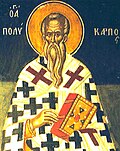 Polycarp of SmyrnaHieromartyr · Bishop of SmyrnaFeb 23
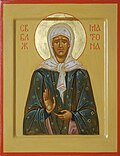 Matrona of MoscowFool-for-ChristFeb 23
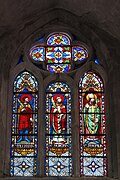 Serenus of SirmiumMartyr · Gardener, martyr of SirmiumFeb 23
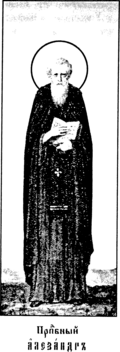 Alexander the UnsleepingVenerable · Founder of the Unsleeping OnesFeb 23
 GorgoniaRighteous · Sister of Gregory the TheologianFeb 23
 John TheristisVenerable · Monk in CalabriaFeb 23
 PolychroniusSaint · Bishop of BabylonFeb 23
- John, Antiochus, Antoninus and MosesVenerable · Syrian hermitsFeb 23
- ZebinasVenerable · Syrian hermitFeb 23
- PolychroniusVenerable · Hermit of SyriaFeb 23
- 73 MartyrsHoly MartyrsFeb 23
- AntoninusVenerableFeb 23