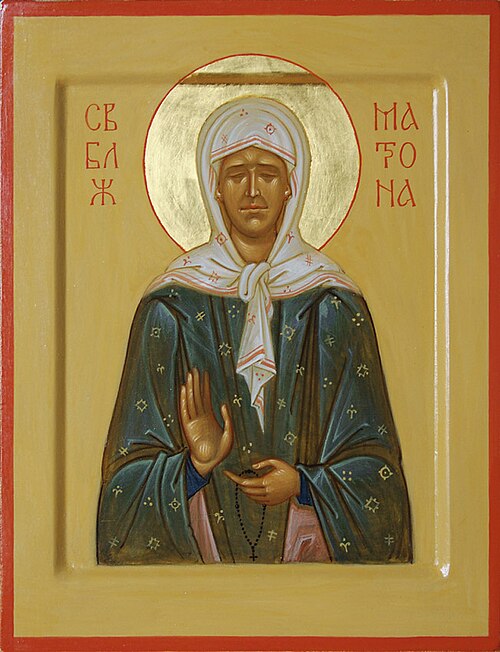
Fool-for-Christ
Matrona of Moscow
Blessed woman blind from birth, known for her gift of healing and spiritual counsel; she reposed in Moscow in 1952.
- Feast
- February 23old style March 8
- Reposed
- 195220th century
- Place
- Moscow
- Order
- Fools-for-Christ
Life
Saint Matrona of Moscow the Blessed (born Matrona Dimitrievna Nikonova) was a simple woman of the people, blind from birth, known for her gift of healing and spiritual guidance, who lived in Russia in the time of Communist persecution. She was born in 1881 and fell asleep on 2 May 1952. She is one of the best known and most loved saints of the Russian Church. The Romanian Orthodox Church entered her in its calendar in 2018.
Childhood
She was born in the village of Sebino in the Tula province, into a poor family of pious peasants, the fourth child. The year of her birth is given differently in the sources: 1881, 1883 or 1885. Her parents, Dimitry Ivanovich and Natalia Nikitina, thought of placing her in an orphanage, but her mother had a dream in which her still unborn daughter appeared as a white bird with closed eyes, and she changed her mind. The girl was born blind, without eyes, with the eyelids closed over empty sockets, and with a raised cross-shaped mark on her chest. At baptism she received the name Matrona, after the Venerable Matrona of Constantinople. It is told that when the priest plunged her into the font, those present saw a pillar of light, fragrant smoke rise above her. As a child she crawled to the icon corner and spoke with the saints. According to her Life, at around seven or eight years the gifts of foresight and healing were revealed in her, and people from ever more distant regions began to come to her.
Pilgrimages and illness
In adolescence she went on pilgrimages with a landowner's daughter, Lidia Yankova, to the Kiev Caves Lavra, the Trinity-St Sergius Lavra, to Petersburg and to other holy places. It is told that at fourteen, in the cathedral at Kronstadt, she met Saint John of Kronstadt, who is said to have called her forward before all. At sixteen or seventeen her legs failed and she could not walk for the rest of her life, but she never complained.
In Moscow
After the revolution of 1917 her brothers became Communist activists and did not welcome her, because she taught those who came to keep the faith. In 1925 she moved to Moscow and lived with relatives and acquaintances, in apartments, cellars or huts, usually without papers, to escape persecution. In a time when many believers were sent to camps or exile, no one betrayed her. Every day she received dozens of people with troubles of soul and body; she turned no one away, but she recognized those who came with evil intentions. It is said that she foretold her death three days before and that she received all visitors until the end.
Repose and veneration
She fell asleep on 2 May 1952 at Skhodnya near Moscow and was buried, as she wished, at the Danilov cemetery, beside the church, so that she could hear the services. Her grave became a place of pilgrimage, with queues of hours. On 8 March 1998, Sunday of Orthodoxy, with the blessing of Patriarch Alexy II, her relics were found and moved to the Intercession Convent in Moscow. She was canonized as a local saint of Moscow in 1999, and in 2004 the Bishops' Council of the Russian Church numbered her among the saints for the whole Church. Her life is known chiefly from the book The Tale of the Life of the Blessed Elder Matrona, written by Zinaida Zhdanova from gathered testimonies, which was later criticized; a synodal commission prepared a canonical text of the Life, from which uncertain testimonies were removed. She is commemorated on 2 May.
Commemorated the same day February 23
 Polycarp of SmyrnaHieromartyr · Bishop of SmyrnaFeb 23
 Serenus of SirmiumMartyr · Gardener, martyr of SirmiumFeb 23
 Alexander the UnsleepingVenerable · Founder of the Unsleeping OnesFeb 23
 GorgoniaRighteous · Sister of Gregory the TheologianFeb 23
 John TheristisVenerable · Monk in CalabriaFeb 23
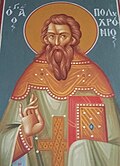 PolychroniusSaint · Bishop of BabylonFeb 23
- John, Antiochus, Antoninus and MosesVenerable · Syrian hermitsFeb 23
- Polycarp of BryanskVenerable · Founder of the Transfiguration MonasteryFeb 23
- ZebinasVenerable · Syrian hermitFeb 23
- PolychroniusVenerable · Hermit of SyriaFeb 23
- 73 MartyrsHoly MartyrsFeb 23
- AntoninusVenerableFeb 23