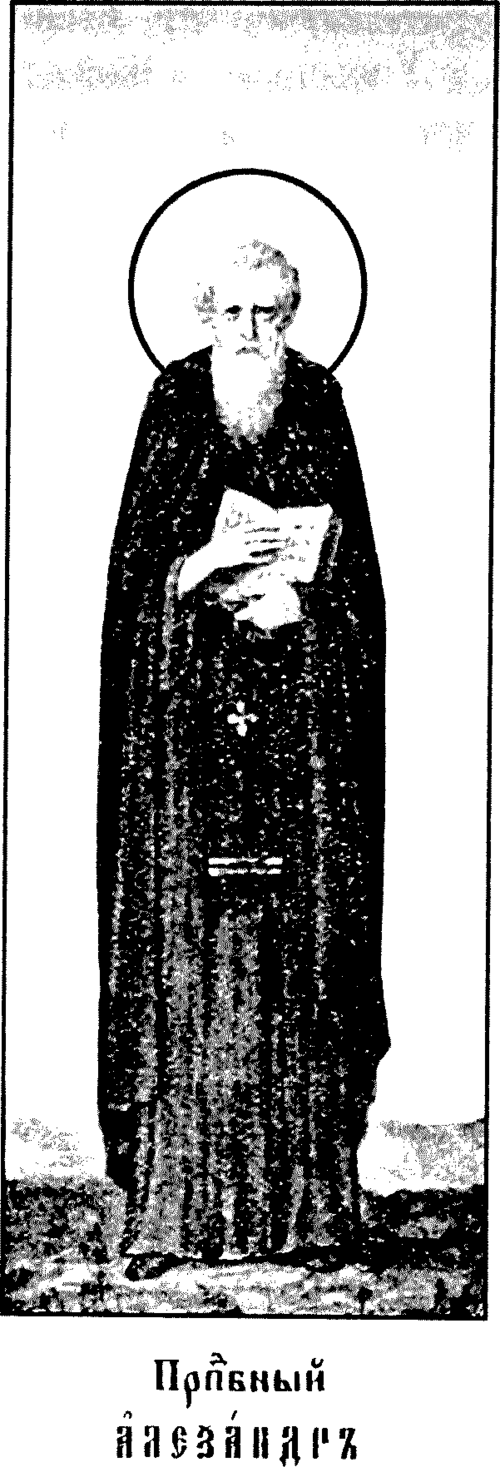
Venerable
Alexander the Unsleeping
Founder of the Unsleeping Ones
Monk from the Aegean islands, founder and first abbot of the Unsleeping Ones, died around 430.
- Feast
- February 23old style March 8
- Reposed
- 4305th century
- Place
- Aegean Islands
- Order
- Venerables
Life
Venerable Alexander the Unsleeping (Alexander Akoimetos or Alexander of Constantinople) was born around 350 on one of the islands of the Aegean Sea and died around 430, at Gomon, on the Asian shore of the Bosporus. He was the founder and first abbot of the community of the Akoimetoi, that is, "those who do not sleep". He is remembered on 23 February, in leap years on 24, and on 3 July.
Life
He was born on one of the islands of the Aegean, grew up in Constantinople, where he studied and served in the army, then received monastic tonsure in a monastery in Syria, in the surroundings of Antioch. After four years in the monastery he went into the desert and stayed there seven years. He proclaimed Christianity among the nomadic tribes and baptized Rabbula, one of the pagan governors of a city, who later became bishop of Edessa.
Disciples began to gather to the hermit Alexander and in the desert by the Euphrates he founded a monastery, in which soon about four hundred monks lived. Here he set the rule of unceasing singing of the psalms day and night, the "unsleeping psalter", from which the monastery received the name "monastery of the unsleeping". For this rule all the monks were divided into twenty-four prayer watches, which changed hour by hour at the reading of the Psalter.
At Constantinople
Around 420 he moved to Constantinople, where he founded a monastery with a rule like that on the Euphrates. In the capital, Alexander and his disciples were persecuted by the Nestorians and he was forced to move his community to the Asian shore of the Bosporus, at Gomon. In this monastery he fell asleep. A Bulgarian source says that the monks, with him at their head, first settled near the church of Saint Mena, in the Mangana quarter, then the community moved to the place called Irenaion, where they founded a monastery under the abbacy of Marcellus the Akoimetos, an opponent of the Monophysites. The monastery became known as that of the "wakeful" and was trilingual: services were held in Greek, Latin and Syriac. In 463 part of the community moved to the newly founded Stoudios monastery, which at first bore the same name. The Akoimetoi held a central place in the second period of monasticism in Constantinople, from the Council of Ephesus, in 431, to the beginning of the reign of Justinian the Great.
Judgements on him and the sources
A Serbian source sees in Alexander a radical ascetic, in whose track some traits of Messalianism can be recognised, that is, the rejection of work and property and unceasing prayer, without sleep. It says that he came to the capital with about a hundred monks, among them Hypatius of Bithynia, that the monks lived on alms but did not allow gifts or provisions to be stored, and that these "free" monks did not submit to any church or episcopal oversight, but went about the streets, preaching and sometimes badgering people. The Church condemned this life as the Messalian heresy, laying the foundation of traditional monasticism, with monasteries and abbots. The same source says that today it is thought that Alexander was condemned and exiled not because his sermons departed from Holy Scripture but because he was a political threat to the Church, and that in any case his steadfast vow of poverty strongly influenced Eastern monasticism through his disciples.
His first life was written by an unknown author soon after his death, around the years 450 to 460. His commemoration as a saint is first recorded in the Prologue of Constantine of Mokisia, of the twelfth century. In the Great Menaion-Readings of Metropolitan Macarius his life is under 19 February and his commemoration under 23 February, and in the Menaion-Readings of Dimitry of Rostov his life is under 3 July.
Commemorated the same day February 23
 Polycarp of SmyrnaHieromartyr · Bishop of SmyrnaFeb 23
 Matrona of MoscowFool-for-ChristFeb 23
 Serenus of SirmiumMartyr · Gardener, martyr of SirmiumFeb 23
 GorgoniaRighteous · Sister of Gregory the TheologianFeb 23
 John TheristisVenerable · Monk in CalabriaFeb 23
 PolychroniusSaint · Bishop of BabylonFeb 23
- John, Antiochus, Antoninus and MosesVenerable · Syrian hermitsFeb 23
- Polycarp of BryanskVenerable · Founder of the Transfiguration MonasteryFeb 23
- ZebinasVenerable · Syrian hermitFeb 23
- PolychroniusVenerable · Hermit of SyriaFeb 23
- 73 MartyrsHoly MartyrsFeb 23
- AntoninusVenerableFeb 23