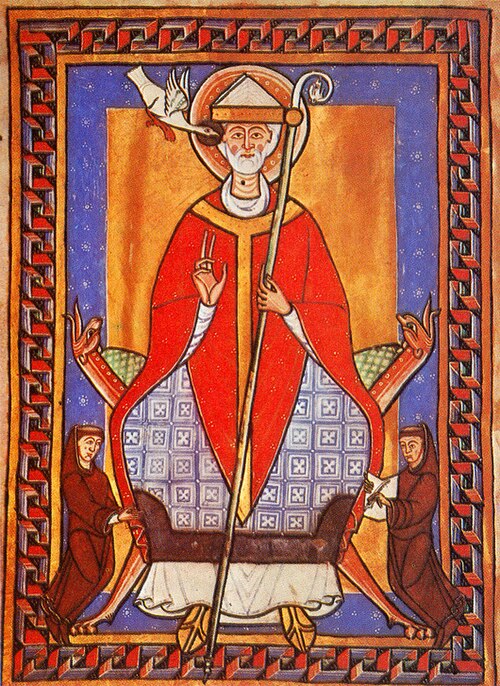
Saint
Gregory the Dialogist
Pope of Rome
Bishop of Rome from 590 to 604, author of the Dialogues and the Liturgy of the Presanctified Gifts.
Life
Saint Gregory the Dialogist was bishop of Rome from 590 to 604, a pastor who loved the poor, a father of monks and a spiritual writer. The Orthodox Church honours him especially because tradition ascribes to him the order of the Liturgy of the Presanctified Gifts, celebrated in Great Lent. In the West he is called Gregory the Great and is counted among the four great Fathers of the Latin Church, with Ambrose, Augustine and Jerome. He was honoured as a saint at Rome immediately after his death, and the Orthodox Church commemorates him on 12 March.
From official to monk
He was born around 540 at Rome, into a noble and pious family. His father, Gordian, was a senator, and his mother, Silvia, is also honoured as a saint, as are his father's sisters Tarsilla and Emiliana. He received a fine education, especially in law, and around 570 became prefect of Rome, the city's highest office. Italy was then passing through wars, plague and the invasion of the Lombards.
After his father's death Gregory renounced the world. He used his wealth for alms, founded six monasteries in Sicily, and turned his own house at Rome, on the Caelian Hill, into a monastery dedicated to the holy Apostle Andrew, where he received the monastic tonsure. He lived there a hard life of prayer and reading of Scripture and the Fathers. Pope Pelagius II ordained him deacon and in 579 sent him to Constantinople as apocrisiarius, his representative at the imperial court. He stayed there until 585 or 586, living with the monks who had accompanied him, and made friendships with notable people of the day, among them Leander of Seville. It was at this time that he began the commentary on the Book of Job known as the Moralia, which he completed and revised after he became bishop.
Pastoral ministry
In 590, when Pelagius II died of the plague, the clergy and people asked for Gregory as bishop, although out of humility he did not wish it. When Bishop John of Ravenna reproached him for his reluctance, he answered with a whole treatise on the duties of the bishop. The city was struck by plague and a great flooding of the Tiber, and the Lombards held a large part of Italy.
As bishop Gregory organized relief for the poor from the revenues of the Church's estates, sent grain to Rome in time of famine, and ordered that the sick and the homeless should receive food each day. It is said that he would not sit down to eat until the needy had been fed. Tradition tells that when he invited twelve poor men to his table he saw thirteen guests, and one of them was an angel. In his letters he took the title "servant of the servants of God". Eulogius of Alexandria proposed to him the title of ecumenical pope, but he refused it and preferred to call himself a servant of God.
In 596 he sent to Britain forty monks from the monastery of Saint Andrew, led by Augustine, the future archbishop of Canterbury, to preach the Gospel to the Anglo-Saxons, who later honoured him as their apostle. He also cared for the order of services, and the church chant of the West was later placed under his name, hence "Gregorian chant", though this link is attested only long after his death.
Writings
He bears the name Dialogist from his work Dialogues, in four books, written as a conversation with the deacon Peter, in which he tells the lives and miracles of the saints of Italy, among them Saint Benedict of Nursia. His other writings include the Pastoral Rule, which sets out the image of the true shepherd, the commentaries on Job and Ezekiel, and homilies on the Gospels. More than eight hundred of his letters survive.
The Presanctified Liturgy and repose
Church tradition ascribes to him the Liturgy of the Presanctified Gifts, celebrated on days in Great Lent when the usual Liturgy is not served. It has no anaphora, and the faithful receive Gifts sanctified on the preceding Sunday. How far he composed it himself is discussed, but his name remains tied to it. In the East the Sixth Ecumenical Council confirmed the order.
Saint Gregory led the Church of Rome for thirteen years. He reposed in the Lord on 12 March 604, after an illness of the joints, and his relics rest in the basilica of Saint Peter in Rome. A small portion of his relics is kept at the Boura monastery in Greece.
Commemorated the same day March 12
 Innocent I of RomeSaint · Bishop of RomeMar 12
 Theophanes the ConfessorVenerable · Chronicler and AbbotMar 12
 Symeon the New TheologianVenerable · Abbot of Saint Mamas MonasteryMar 12
 PhinehasProphet · Priest, grandson of AaronMar 12
 Demetrius II the Self-SacrificerRight-Believing · King of Eastern GeorgiaMar 12
- Maximilian of TebessaMartyr · Martyr of NumidiaMar 12
 Nicodemus of MammolaVenerable · Italo-Greek monk of CalabriaMar 12
 Alexander DerzhavinConfessor · PriestMar 12
- John PlekhanovHieromartyr · PriestMar 12
- Symeon the PiousVenerable · Monk of StoudiosMar 12
- Almut of WetterSaintMar 12
- Alphege of WinchesterSaint · Bishop of WinchesterMar 12