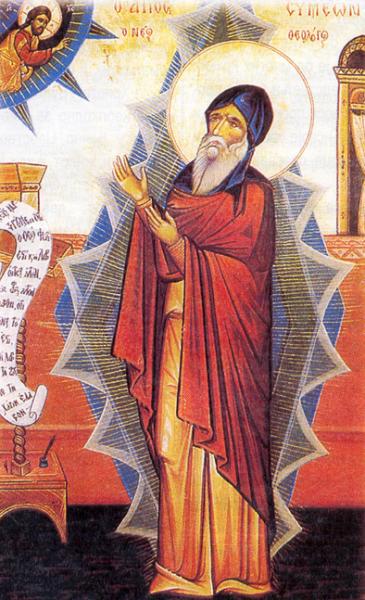
Venerable
Symeon the New Theologian
Abbot of Saint Mamas Monastery
Byzantine monk, poet, and mystic, one of three saints given the title Theologian by the Orthodox Church.
- Feast
- March 12old style March 25
- Reposed
- 102211th century
- Place
- Marmara Region
- Order
- Venerables
Life
Saint Symeon the New Theologian was a Byzantine monk, poet and mystic, abbot of the monastery of Saint Mamas in Constantinople, and one of the three saints whom the Orthodox Church has called “Theologian”, with the Apostle John and Saint Gregory of Nazianzus. The title does not point to academic learning, but to the fact that he spoke from personal experience of the vision of God. He is commemorated on 12 March.
Early life
He was born in 949 at Galatia in Paphlagonia (Asia Minor), to the noble family of Basil and Theophano, supporters of the Macedonian dynasty. His life is known from his own writings and from the Life written by his disciple Nicetas Stethatos. He first received the basic education of a Greek school; at eleven an uncle saw his gifts and helped him finish his studies at the court of the emperor Basil II and his brother Constantine VIII.
At fourteen he met Symeon the Pious, called the Studite, a renowned monk of the Stoudios monastery in Constantinople, who persuaded him to give up higher studies and take him as his spiritual father. The young man wanted to enter the monastery at once, but the elder asked him to wait, so until twenty-seven he served in the household of a patrician (according to some sources, the emperor). By day he lived in the world, and he spent his evenings in vigil and prayer, following the writings of Mark the Ascetic and Diadochos of Photiki. At that time he had his first experience of divine light, which he describes in one of his discourses; according to his own writings, around 970 he beheld the light of Tabor, and he ascribed it to the prayers of his spiritual father.
Abbot of Saint Mamas
At twenty-seven, in 973, he entered Stoudios, giving himself wholly to discipleship under Symeon the Studite, a simple monk who was not ordained. He was so zealous in his labours and in following his teacher that the abbot asked him to leave after a few months. Following the elder’s advice, he went to the monastery of Saint Mamas in Constantinople, which was run down, in body and in spirit. He became abbot around the age of thirty (in one source, in 980) and held the post for twenty-five years, drawing many monks and clergy through his reputation for holiness.
His teachings brought him into conflict with church authorities, especially the patriarch, over his method of spiritual life and the honour he showed his spiritual father, Symeon the Studite. Because of the severity with which he ruled the monastery and these disagreements, he was forced to leave his post and was sent into exile at Chrysopolis, near Constantinople, where he lived as a hermit. He reposed on 12 March 1022 (other sources say 1032).
Teaching and writings
Symeon is the first Eastern mystic to share his own spiritual experiences freely. His chief teaching is that man can and must experience communion with God directly, already in this life, as a light seen by the eye of the mind. He said, “Before the resurrection of bodies comes the resurrection of souls.” He insisted on the need for a spiritual father and taught that everyone, not only monks, can reach the vision of God, even a married man burdened with the care of a household and children. For him, communion in the Body and Blood of Christ is the resurrection to eternal life. He also held that an unordained monk who has had direct experience of God has the right to absolve sins, which drew criticism.
He wrote the Hymns of Divine Love, Ethical Discourses, Catechetical Discourses, practical and theological chapters, letters and the Letter on Confession, long attributed to Saint John of Damascus. Some of his writings are included in the Philokalia. His texts were kept after his death by a small group of disciples and much copied in the fourteenth century on Athos; he prepared the way for hesychasm. Recognition of him, however, was always greater outside the official Church, because of his ardent personality, his criticism of the hierarchy and some unusual teachings.
Commemorated the same day March 12
 Gregory the DialogistSaint · Pope of RomeMar 12
 Innocent I of RomeSaint · Bishop of RomeMar 12
 Theophanes the ConfessorVenerable · Chronicler and AbbotMar 12
 PhinehasProphet · Priest, grandson of AaronMar 12
 Demetrius II the Self-SacrificerRight-Believing · King of Eastern GeorgiaMar 12
- Maximilian of TebessaMartyr · Martyr of NumidiaMar 12
 Nicodemus of MammolaVenerable · Italo-Greek monk of CalabriaMar 12
 Alexander DerzhavinConfessor · PriestMar 12
- John PlekhanovHieromartyr · PriestMar 12
- Symeon the PiousVenerable · Monk of StoudiosMar 12
- Almut of WetterSaintMar 12
- Alphege of WinchesterSaint · Bishop of WinchesterMar 12