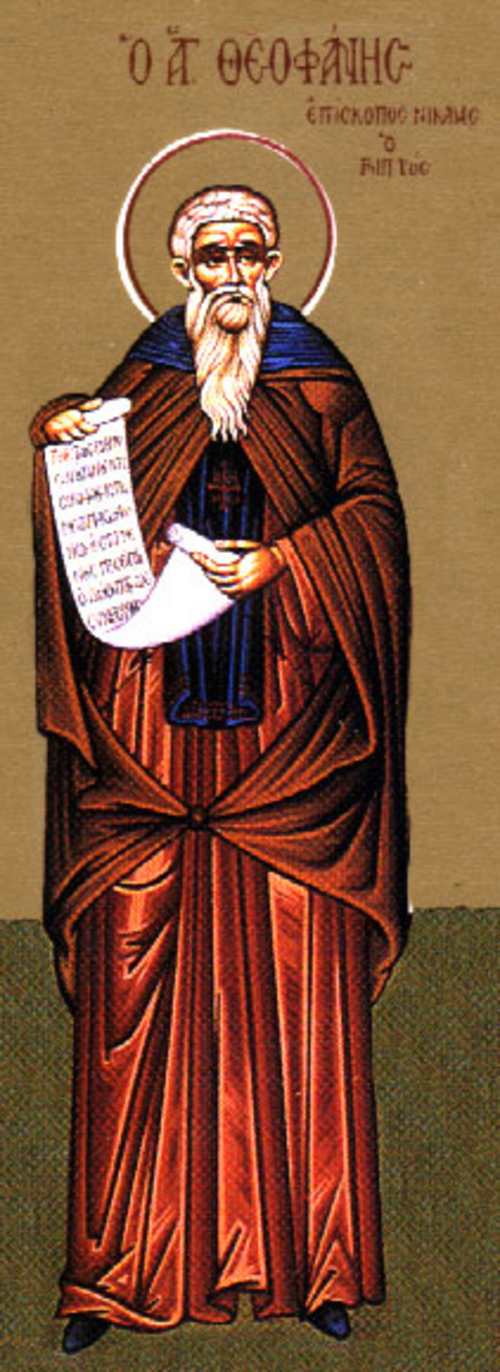
Venerable
Theophanes the Confessor
Chronicler and Abbot
Byzantine noble who became a monk, chronicler and defender of the holy icons, who died in exile in 817.
- Feast
- March 12old style March 25
- Reposed
- 8189th century
- Place
- Samothrace
- Order
- Venerables
Life
Venerable Theophanes the Confessor, also called Theophanes of Sigriane or of the Great Field, was a Byzantine nobleman who became a monk and abbot, wrote a chronicle that is one of the main sources for the history of Byzantium, and suffered imprisonment and exile for the veneration of the holy icons. He reposed in exile in 817 or 818. The Church commemorates him on 12 March.
He was born at Constantinople around 759, into a wealthy and pious family. His father Isaac, who was related to the imperial house and governed the islands of the Aegean, died when the boy was about three, and the emperor saw to his upbringing at court. Under Leo IV the Khazar he held several offices. While still young, he was married, but he persuaded his wife to live with him as a sister. When his parents and his father-in-law had died, around 779, they parted by mutual consent: she entered a convent near Constantinople, and he went to a monastery in the Sigriane district, near Cyzicus, on the Sea of Marmara. According to the synaxarion, the elder Gregory Stratitios foretold that Theophanes would receive the crown of martyrdom.
With the blessing of his elder, Theophanes built a monastery on his own land on the island of Kalonymos and shut himself in his cell, copying books, in which he became highly skilled. After about six years he returned to Sigriane and founded the monastery of the Great Field (Megas Agros), of which he became abbot. He shared in all the labours of the brothers and set an example of work and asceticism. The synaxarion says that God gave him the gift of healing the sick and casting out demons. In 787 he was summoned to the Seventh Ecumenical Council at Nicaea, where he came in poor and worn clothes and defended the veneration of the icons with wisdom, and he signed its decrees.
Around the age of fifty he fell seriously ill and remained ill for the rest of his life, bearing it with patience. In those years, at the urging of his friend George the Synkellos, who left him his notes when he died, he wrote the Chronographia. It continues the chronicle of George from the accession of Diocletian in 284 or 285 to the fall of Michael I in 813, arranged by the years of the world, and it keeps the record of sources that have since been lost. A modern scholar, Cyril Mango, has argued that most of its material was George's and that Theophanes mainly gave it its final form.
When Leo V the Armenian renewed the persecution against the icons in 813, he had Theophanes brought to Constantinople, where he tried in vain to make him renounce the icons. Theophanes was thrown into prison and kept for about two years in hardship. His monastery was burned. Then he was exiled to the island of Samothrace, where he lived only a few days (twenty-three according to the synaxarion, seventeen in other accounts) and fell asleep in the Lord, probably on 12 March 817 or 818. After the death of Leo, his body was brought to the rebuilt monastery of the Great Field.
He is called Confessor because he confessed the faith before the emperor and suffered for it, but was not put to death. He is venerated by the Orthodox and by the Catholic Church on 12 March. He should not be confused with Theophanes of Nicaea, commemorated on 11 October, or with Saint Theophan the Recluse.
Commemorated the same day March 12
 Gregory the DialogistSaint · Pope of RomeMar 12
 Innocent I of RomeSaint · Bishop of RomeMar 12
 Symeon the New TheologianVenerable · Abbot of Saint Mamas MonasteryMar 12
 PhinehasProphet · Priest, grandson of AaronMar 12
 Demetrius II the Self-SacrificerRight-Believing · King of Eastern GeorgiaMar 12
- Maximilian of TebessaMartyr · Martyr of NumidiaMar 12
 Nicodemus of MammolaVenerable · Italo-Greek monk of CalabriaMar 12
 Alexander DerzhavinConfessor · PriestMar 12
- John PlekhanovHieromartyr · PriestMar 12
- Symeon the PiousVenerable · Monk of StoudiosMar 12
- Almut of WetterSaintMar 12
- Alphege of WinchesterSaint · Bishop of WinchesterMar 12