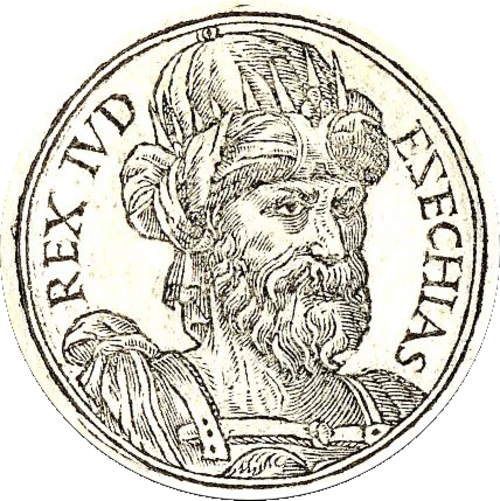
Right-Believing
Hezekiah
King of Judah
King of Judah, son of Ahaz, who restored the worship of God in Jerusalem.
- Feast
- August 28old style September 10
- Reposed
- 686 BC7th century BC
- Place
- Jerusalem
Life
The Holy Righteous Hezekiah was king of Judah, the son of King Ahaz, of the line of David. Taking a path entirely different from his father's, he cleansed the temple in Jerusalem, destroyed the idols and turned the people back to the worship of the true God. Scripture says that among the kings before and after him none was like him in his trust in the Lord. The Church commemorates him on 28 August (the Menaion date; by the civil calendar of Churches on the old calendar it falls on 10 September), on Cheesefare Saturday and on the Sundays of the Holy Forefathers.
The beginning of his reign
Hezekiah was twenty-five when he became king and reigned twenty-nine years in Jerusalem (2 Kings 18:2). His mother, Abi, was the daughter of Zechariah. The chronology of his reign is disputed: by the most widely used calculations he reigned about 715 to 686 before Christ, while other reckonings place him several years earlier. Doxologia gives 696 for his death.
He saw from nearby the fall of Samaria and of the northern kingdom to the Assyrians. In his days Isaiah and Micah prophesied and served him as counsellors (the Church remembers them on 9 May and 14 August).
The renewal of worship
The king's first care was the temple. He opened it again, cleansed it of defilement, restored order among priests and Levites and renewed the services. He swept away the idolatrous high places and broke the bronze serpent made by Moses, to which the people had come to burn incense (2 Kings 18:4).
Then he called all of Judah, and even Israel, to Jerusalem for the Passover. Some in the north laughed at his messengers, but others humbled themselves and came. The Book of Chronicles says that there had been no such joy in the city since the days of Solomon. As a result, idolatry ceased not only in Judah but in many places in Israel.
The siege of Sennacherib
In the fourteenth year of his reign the Assyrian king Sennacherib took many cities of Judah, among them Lachish. Hezekiah paid him tribute in silver and gold, even stripping the gold from the doors of the temple, but Sennacherib still sent an army toward Jerusalem and demanded surrender.
The king had prepared the city: he strengthened the walls, raised towers and brought the water of a spring outside the walls into the city through a channel cut in the rock, today called the Siloam Tunnel. When he received Sennacherib's threatening letters, he spread them out before the Lord in the temple and prayed. Isaiah sent him word that the Lord would defend the city, and in one night the angel of the Lord struck down one hundred and eighty-five thousand in the Assyrian camp. Sennacherib returned to Nineveh. His own annals say only that he shut Hezekiah up in Jerusalem like a bird in a cage, and they do not mention taking the city.
Illness and prayer
Soon afterward Hezekiah fell mortally ill. Isaiah told him to put his house in order, for he would die. The king turned his face to the wall and prayed with tears. The Lord sent word through the same prophet that He had heard his prayer and would add fifteen years to his life. As a sign, the shadow went back ten steps on the dial of Ahaz.
The power of this prayer is one reason the Church honours him. Later, envoys of the king of Babylon came to ask about his recovery, and Hezekiah showed them his treasuries. Isaiah warned him that such riches would one day be carried off to Babylon.
His death
Hezekiah died at fifty-four and was buried with honour in the upper part of the tombs of the sons of David (2 Chronicles 32:33). He was followed by his son Manasseh. His name stands in the line of the ancestors of the Saviour in the Gospel of Matthew.
His reign is recalled in the Book of Proverbs, where the men of Hezekiah copied out further proverbs of Solomon (Proverbs 25:1). A seal bearing his name has also been found in Jerusalem.
Commemorated the same day August 28
 Moses the BlackVenerable · Ascetic of the Scetis DesertAug 28
 Hermes of RomeMartyr · Martyr of RomeAug 28
 Julian of BrioudeMartyr · Martyr of BrioudeAug 28
 Vivianus of SaintesSaint · Bishop of SaintesAug 28
 Paul the ObedientVenerable · Ascetic of the Far CavesAug 28
 Savva of KrypetsVenerable · Founder of Krypets MonasteryAug 28
 Vicinius of SarsinaSaint · First bishop of SarsinaAug 28
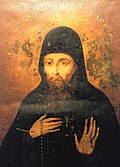 Zechariah the FasterVenerable · Faster of the Kiev CavesAug 28
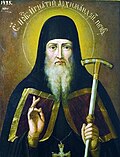 Ignatius of the Kiev CavesVenerable · Archimandrite of the Kiev CavesAug 28
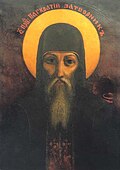 Pancratius the RecluseVenerable · Hieromonk of the Kiev CavesAug 28
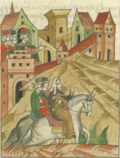 Theophilus of NovgorodSaint · Archbishop of Novgorod and PskovAug 28
- Akindin of the CavesVenerable · Archimandrite of the Kyiv Caves LavraAug 28