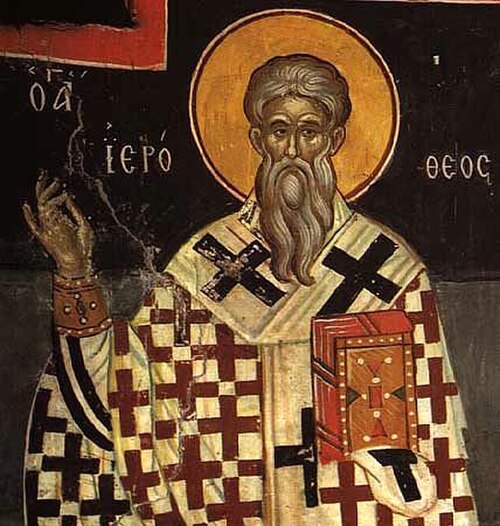
Hieromartyr
Hierotheos the Thesmothete
Bishop of Athens
Member of the Areopagus and reputed first bishop of Athens, a disciple of the Apostle Paul by tradition.
Life
Saint Hierotheos is, according to tradition, one of the members of the Areopagus in Athens, a disciple of the Apostle Paul and the first bishop of Athens. He is called the Thesmothete, one of the six Athenian magistrates who kept and interpreted the laws. The Church remembers him on 4 October, the day after Saint Dionysius the Areopagite.
Little is known of his life. Tradition says he was one of the learned men of Athens and that the Apostle Paul taught him, baptized him and ordained him around the year 52. He often visited Dionysius the Areopagite and guided him in the faith. Historians have not agreed whether he was a priest or a bishop, and some traditions count Dionysius as the first bishop of Athens, as a letter of Dionysius of Corinth, cited by Eusebius, also says. In the Byzantine synaxaria, however, Hierotheos appears as the first bishop of Athens. Saint Dimitry of Rostov calls him a hieromartyr, but the Byzantine and Slavic synaxaria do not mention a martyrdom. A Serbian source says he suffered martyrdom at the end of the first century.
The writings attributed to Dionysius the Areopagite speak of Hierotheos as an accomplished hymnographer, so absorbed and carried out of himself in communion with the holy things he praised in song that to all who heard and saw him he seemed inspired by God. It is also noted that the name Hierotheos is unique in Greek literature and is found in only one inscription from Athens. Some hold that the author of those writings used earlier names, so that the Hierotheos described there may be a creation or a tribute.
According to tradition Hierotheos was present, with Dionysius, at the burial of the Mother of God in Jerusalem. He stood among the apostles and comforted them with songs and hymns, which he sang accompanied by musical instruments. For this reason, from the sixth century, his image together with that of Dionysius is a sign of the icon of the Dormition, where the two saints stand behind the bier of the Virgin, beside Christ. He is shown as a grey-haired elder with a high forehead and a broad beard, in episcopal vestments, holding the Gospel. His relics are venerated in the West too, and in Western calendars his memory appears from the fourteenth century.
Commemorated the same day October 4
 Vladimir of NovgorodRight-Believing · Prince of NovgorodOct 4
 Ammon of NitriaVenerable · Founder of the Nitria communityOct 4
 Dumitru StăniloaeConfessorOct 4
 Paul the SimpleVenerable · Disciple of Saint Anthony the GreatOct 4
- Luke ZhidiataSaint · Bishop of NovgorodOct 4
 Stefan ŠtiljanovićRight-Believing · Serbian noblemanOct 4
 Gurias of KazanSaint · First Archbishop of KazanOct 4
 Arcadius of NovgorodSaint · Bishop of NovgorodOct 4
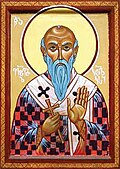 Eudemus I of GeorgiaHieromartyr · Catholicos-Patriarch of GeorgiaOct 4
 Gaius of CorinthApostle · of CorinthOct 4
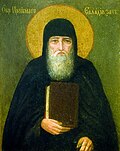 Helladius of KievVenerable · Recluse of the Kiev CavesOct 4
 John LampadistisVenerableOct 4