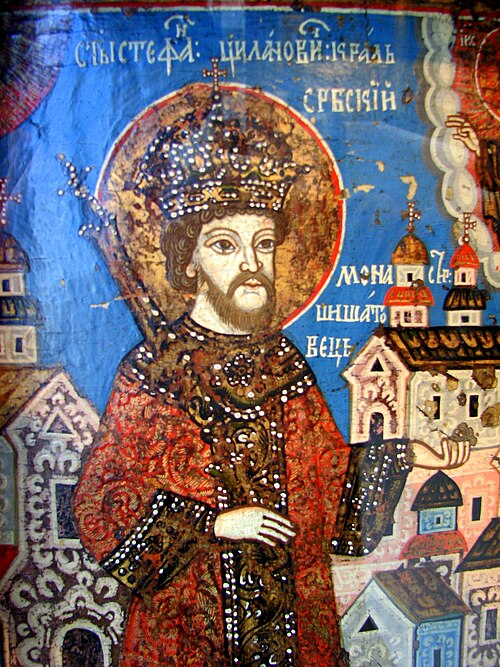
Right-Believing
Stefan Štiljanović
Serbian nobleman
Last prominent Serbian nobleman of the Ottoman period, by folk tradition the last Despot of Serbia; died in 1543.
- Feast
- October 4old style October 17
- Reposed
- 154316th century
- Place
- Siklós
Life
Saint Despot Stefan Štiljanović, the Right-believing, was the last prominent Serbian nobleman of the period of Ottoman Serbia and, according to folk tradition, the last Despot of Serbia. He ruled a large territory under the Hungarian crown, famed for his operations against the Ottomans on the frontier. He died around 1543. The Serbian Orthodox Church venerates him as a saint and remembers him on 17 October (4 October on the old calendar).
Origins and coming to Syrmia
He was born in Paštrovići (today in Montenegro), where he was elected knez at the Rezevići monastery, the last and most celebrated of the knezes of that region. Paštrovići, mentioned in 1377 as one of the Serbian communes, came in 1423 under the rule of the Republic of Venice. He traced his family to the Primorje; his wife was Jelena Bogdanović. He owned seven mills. After a feud with Venice, in 1498 he left his possessions to his people and went to Syrmia. The same year he had the town of Morović built, where he had his residence. In 1507 he received from King Louis II of Hungary the town of Siklós in Baranya.
The struggle on the frontier
In the war for the Hungarian throne between King Ferdinand and the voivode John Zápolya he took Ferdinand's side, and after his coronation on 3 November 1527 he became administrator of Novigrad and Orahovica. He received estates in Virovitica county, among them the villages of Donji Miholjac and Glogovnica, and the town of Valpovo, where he had his residence. He administered significant towns which had earlier been under the rule of Jovan Nenad. He had his own flotilla. He was the commander of the Slavonian frontiersmen who fought against the Ottoman Empire. He took part in the civil war from the Battle of Mohács in 1526 until 1541, when the Turks took Buda. The last record of him is from 1540, when he was prefect of the fortified town of Valpovo. In 1543 he was defeated and captured by the Ottomans, but Murat-beg spared his life because of his famous heroism and let him go. He left Slavonia, and his last years were spent at Siklós, where he died around 1543. The Ottoman vizier Skender-pasha Mihailović was his nephew on his mother's side.
Folk tradition shows him as the most exemplary Christian ruler and ties many noble deeds to him, and valiant struggle against the Turks. The most striking tradition about him was recorded by Stjepan Mitrov Ljubiša in “Skočidjevojka,” a tale of Paštrovići from the end of the fifteenth century. His widow Jelena (also venerated as a saint) is said to have founded the Petkovica monastery on Fruška Gora.
Relics and veneration
According to tradition and the “Povesno slovo,” he was first buried on the nearby hill of Göntér. As early as 1545 his relics were at the Šišatovac monastery in Syrmia; the monastery's Panegyrikon of 1545 says that there rest the incorrupt relics of “the holy and righteous and wondrous Stefan Štiljanović, despot of the Serbs.” In the time of Turkish rule the relics had great importance and were believed to have healing power. In 1634 Patriarch Pajsije Janjevac, staying at Šišatovac, wrote the life of Stefan Štiljanović, in a revival of Serbian hagiographical literature. During the Second World War the Croatian Ustaše pillaged Štiljanović's tomb: the remains were deliberately damaged, and valuables, among them his crown, were taken to Zagreb. Serbian church officials managed to recover the remains, which were then buried on the Göntér hill. Since April 1942 his relics have rested in the treasury of the cathedral of the Archangel Michael in Belgrade. The Serbian Orthodox Church numbered him among the saints, as Saint Despot Stefan Štiljanović. At Augsburg in Germany a parish bears his name and his wife's: “Orthodox Parish of Saint Stefan and Saint Helena Stiljanovic.”
Commemorated the same day October 4
 Vladimir of NovgorodRight-Believing · Prince of NovgorodOct 4
 Ammon of NitriaVenerable · Founder of the Nitria communityOct 4
 Hierotheos the ThesmotheteHieromartyr · Bishop of AthensOct 4
 Dumitru StăniloaeConfessorOct 4
 Paul the SimpleVenerable · Disciple of Saint Anthony the GreatOct 4
- Luke ZhidiataSaint · Bishop of NovgorodOct 4
 Gurias of KazanSaint · First Archbishop of KazanOct 4
 Arcadius of NovgorodSaint · Bishop of NovgorodOct 4
 Eudemus I of GeorgiaHieromartyr · Catholicos-Patriarch of GeorgiaOct 4
 Gaius of CorinthApostle · of CorinthOct 4
 Helladius of KievVenerable · Recluse of the Kiev CavesOct 4
 John LampadistisVenerableOct 4