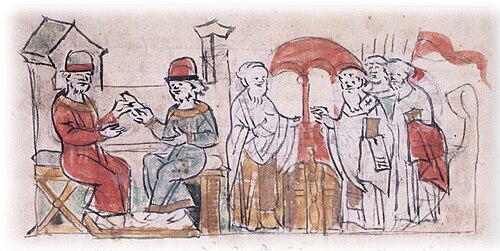
Saint
Luke Zhidiata
Bishop of Novgorod
Second bishop of Novgorod, from about 1035 to 1059, successor of Ephraim.
Life
Saint Luke Zhidiata was the second bishop of Novgorod, from about 1035 to 1059, successor of Ephraim, and the first bishop of Russian birth in the history of the Russian Church. The Russian Church honours him as a hierarch and remembers him on 4 October, 10 February and 4 November.
Very little is known of his life. Neither his origin nor the year and place of his birth are known. Until him the bishops of Novgorod had been Greeks, but Prince Yaroslav chose Luke as successor of the first bishop, the Greek Joachim, after Ephraim had run the diocese without being consecrated. The name Zhidiata is probably a diminutive of Zhidoslav, and one source's view that he was of Jewish descent is regarded as unfounded. According to the chronicle he took the see in 1034 or 1035 and, on 14 September 1052 (other sources say 1051), consecrated the stone cathedral of Saint Sophia, which replaced the wooden one burned during his episcopate and which may be the oldest building still in use in Russia.
Luke opposed the grand princes' appointment of Hilarion and of Ephraim as metropolitans of Kiev, not out of enmity toward Kiev but because the naming of the metropolitan belonged to the Patriarch of Constantinople. Later he was slandered by his slave, Dudik, and summoned to Kiev, where he was held for three years, from 1055 to 1058. When the slander was uncovered, the slave was sternly punished: his nose and both hands were cut off. Luke died on the return journey from Kiev to Novgorod, along the river Kopys (today in Belarus), on 15 October 1059 or 1060, and was buried in the cathedral of Saint Sophia.
In a work of his own, the Instruction to the Brethren, his only surviving writing in Old Russian literature, we see the first original spiritual work of Russia. In very simple words he gives the faithful, still little penetrated by Christian teaching, first counsels of faith and morals: he reminds them of the Creed, of their duty toward God, the Church and neighbour, and condemns the sins of the time, among them drunkenness, foul language and usury. His relics were found on 22 March 1558.
Commemorated the same day October 4
 Vladimir of NovgorodRight-Believing · Prince of NovgorodOct 4
 Ammon of NitriaVenerable · Founder of the Nitria communityOct 4
 Hierotheos the ThesmotheteHieromartyr · Bishop of AthensOct 4
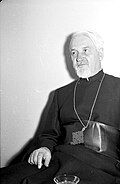 Dumitru StăniloaeConfessorOct 4
 Paul the SimpleVenerable · Disciple of Saint Anthony the GreatOct 4
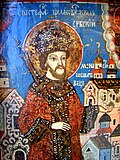 Stefan ŠtiljanovićRight-Believing · Serbian noblemanOct 4
 Gurias of KazanSaint · First Archbishop of KazanOct 4
 Arcadius of NovgorodSaint · Bishop of NovgorodOct 4
 Eudemus I of GeorgiaHieromartyr · Catholicos-Patriarch of GeorgiaOct 4
 Gaius of CorinthApostle · of CorinthOct 4
 Helladius of KievVenerable · Recluse of the Kiev CavesOct 4
 John LampadistisVenerableOct 4