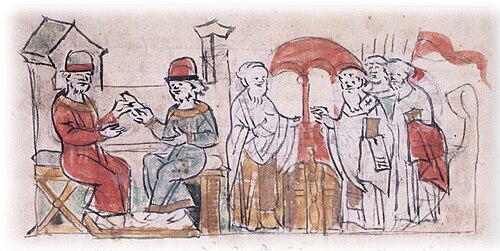
Right-Believing
Vladimir of Novgorod
Prince of Novgorod
Eldest son of Yaroslav the Wise, Prince of Novgorod from 1036 until his death in 1052.
- Feast
- October 4old style October 17
- Reposed
- 105211th century
- Place
- Veliky Novgorod
Life
Vladimir Yaroslavich was Prince of Novgorod from 1036 until his death on 4 October 1052, the eldest son of Grand Prince Yaroslav the Wise. The Russian Church honours him as a right-believing prince and the builder of the cathedral of Saint Sophia in Novgorod, in which his relics rest.
Family and reign
He was born in 1020 to Yaroslav and Ingegerd, daughter of King Olof Skötkonung of Sweden, called Irina in Orthodoxy. Older Lives sometimes made him the son of Anna, Yaroslav's first wife, but scholars think this opinion arose because her shrine stood beside his in Saint Sophia. According to tradition, his baptismal name was Basil. The chronicles disagree on the year when Yaroslav set him as prince in Novgorod, some saying 1030, most 1034, others 1036.
In governing he was helped by the voivode Vyshata and Bishop Luka Zhidiata, later canonized and counted among the first Russian writers. In 1042 Vladimir led a victorious campaign against the Finnish tribe of the Yam, but a plague killed the army's horses and the victory was lost. In the next year, 1043, by his father's command he led a great fleet against Constantinople, together with the future Norwegian king Harald Hardrada. The expedition ended in failure, though some scholars think he took Chersonesos in 1044.
Saint Sophia
Vladimir built the cathedral of Saint Sophia at Novgorod, consecrated by Bishop Luka on 14 September 1052, and a stone fortress. He departed to the Lord on 4 October 1052, at the age of thirty-two, twenty days after the cathedral was consecrated. His father buried him in Saint Sophia, two years before his own death, and his sarcophagus stands in a niche on the south side of the main body of the church. The circumstances of his death are not known.
He left one son, Rostislav, a landless prince who came to hold Tmutarakan. His descendants ruled Galicia until the end of the twelfth century. The name of Vladimir's wife is uncertain. Some scholars name her Ode, daughter of Count Leopold of Staden, others reject this, and a Greek source names her Anna. The Norse sagas remember him as Valdemar Holti, meaning the Nimble, and the Byzantine chronicler George Kedrenos noticed his pride in dealing with the Byzantines.
Veneration
In 1439 Archbishop Euthymius II of Novgorod glorified him as a saint, set his commemoration on 4 October, and remembered him together with Saint Anna of Novgorod, buried beside him. His name entered the Synaxis of the Saints of Novgorod, whose celebration was finally established in 1981. On 7 September 1862 the relics were moved to a new shrine, and in Saint Sophia the saint's sarcophagus can still be seen, with a fresco and an icon above it.
Commemorated the same day October 4
 Ammon of NitriaVenerable · Founder of the Nitria communityOct 4
 Hierotheos the ThesmotheteHieromartyr · Bishop of AthensOct 4
 Dumitru StăniloaeConfessorOct 4
 Paul the SimpleVenerable · Disciple of Saint Anthony the GreatOct 4
 Luke ZhidiataSaint · Bishop of NovgorodOct 4
 Stefan ŠtiljanovićRight-Believing · Serbian noblemanOct 4
 Gurias of KazanSaint · First Archbishop of KazanOct 4
 Arcadius of NovgorodSaint · Bishop of NovgorodOct 4
 Eudemus I of GeorgiaHieromartyr · Catholicos-Patriarch of GeorgiaOct 4
 Gaius of CorinthApostle · of CorinthOct 4
 Helladius of KievVenerable · Recluse of the Kiev CavesOct 4
 John LampadistisVenerableOct 4