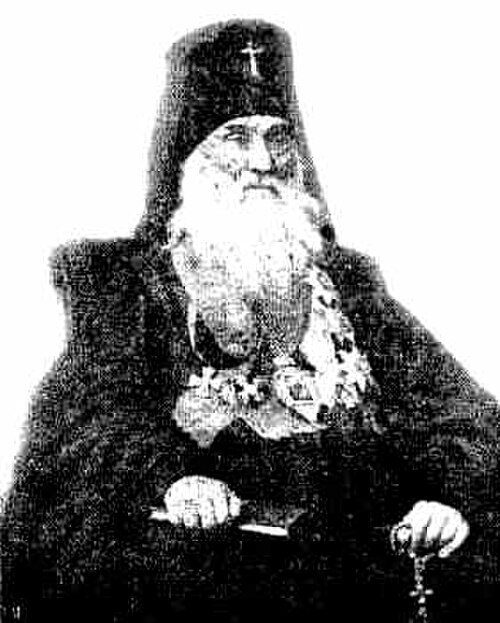
Saint
Hilarion (Yushenov)
A hierarch honored by the Orthodox Church, commemorated in the Ukrainian calendar.
Life
Holy Hierarch Hilarion (Yushenov) was Bishop of Poltava and Pereyaslav from 1887 to 1904 and passed away in 1904. The Ukrainian Orthodox Church glorified him as a locally venerated saint of the Poltava eparchy in 2015.
The priest
He was born on 22 February 1824 in the village of Novoe, in the Vyazma district of the Smolensk province, as Ivan Efimovich Yushenov, in the family of a poor priest. At nine he was sent to the school in Vyazma, and at fourteen he entered the Smolensk seminary, which he finished in 1844. That year he married and was ordained a priest by Bishop Timothy of Smolensk, receiving the parish of the village of Kolkovichi. In 1846 he was moved to Smolensk, to the Ascension convent, where he gave catechetical talks and composed some eighty sermons that the church censors approved and that served as models in the eparchy.
In 1856, at thirty-two, he was widowed, and the next year, during a cholera epidemic, he lost his seven-year-old daughter. Wishing to become a monk, he went to the Kyiv Theological Academy, but Archbishop Timothy sent him home to raise his young children. In 1859 he was appointed rector of the Smolensk cathedral and dean of the city's churches. After the death of his eldest son, a university student, in 1868, he prepared for monastic life.
The monk and bishop
On 4 March 1873 he was tonsured a monk with the name Hilarion, and in the same year he was made igumen, then archimandrite and superior of the Holy Trinity monastery in Smolensk, which he repaired. After the death of his last son, in 1876, he went on pilgrimage to Kyiv and met Metropolitan Philotheus, who proposed him, and in 1878 he was appointed superior of the Kyiv Caves Lavra. He built a guesthouse, founded an icon-painting school, rebuilt the burnt printing house and repaired the bell tower and the Great Church.
In 1884 he was consecrated Bishop of Priluki, vicar of Poltava, and superior of the Holy Cross Exaltation monastery in Poltava, which he renewed. In 1886 he governed the Poltava eparchy, and on 14 November 1887 he became Bishop of Poltava and Pereyaslav. He introduced readings and talks outside the services in all parishes and founded parish schools, up to a network of over a thousand; in 1888 he opened the diocesan committee of the missionary society, in 1890 the Saint Macarius brotherhood, in 1899 a branch of the Orthodox Palestine Society, and he built orphanages and charitable institutions. He renewed the cathedral and the Holy Cross church of the bishop's house and had the Sampson church on the Poltava battlefield restored, and a new monument was built at the battle site.
He passed away on 18 January 1904, in Poltava, and was buried within the precinct of the Holy Cross Exaltation monastery.
Glorification
On 16 September 2014 the Holy Synod of the Ukrainian Orthodox Church blessed his local glorification and veneration in the Poltava eparchy, approved his icon, troparion and kontakion, and decided that his remains should be regarded as holy relics. The glorification took place on 12 May 2015 at the Holy Cross Exaltation monastery in Poltava, led by Metropolitan Philip of Poltava and Myrhorod; the day of the glorification was set as his day of commemoration. The calendar gives it as 29 April, old style (12 May by the new).
Commemorated the same day April 29
 Basil of OstrogSaint · Bishop of ZahumljeApr 29
 Torpes of PisaMartyr · Martyr of PisaApr 29
 Memnon the WonderworkerVenerable · Abbot in Egypt and wonderworkerApr 29
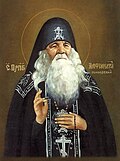 Amphilochius of PochayivVenerable · Monk of the Pochayiv LavraApr 29
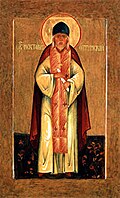 Nectarius of OptinaVenerable · Elder of OptinaApr 29
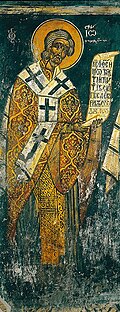 John Kaloktenes the NewSaint · Metropolitan of ThebesApr 29
- Three Hundred Laz MartyrsHoly New MartyrsApr 29
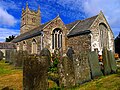 EndelientaVenerable · Hermit of CornwallApr 29
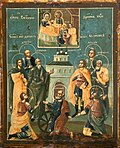 Nine Martyrs of CyzicusHoly Martyrs · Martyrs of CyzicusApr 29
- Sopater of BereaApostle · of BereaApr 29
- AemilianusMartyr · Martyr of CirtaApr 29
- Agapius and CompanionsHoly MartyrsApr 29