Saint
Honoratus of Amiens
Bishop of Amiens
Seventh bishop of Amiens in Gaul, who died around 600.
Life
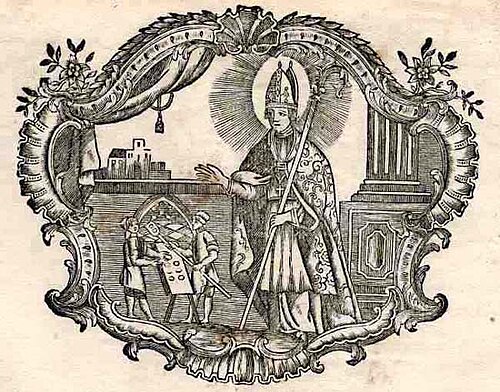
Saint Honoratus was the seventh bishop of Amiens in Gaul and fell asleep around 600, on 16 January. He is commemorated on 16 May. He was venerated first as patron of Amiens and Picardy, then as patron of bakers and pastry cooks, and the St. Honoré cake takes its name from him. He is not to be confused with Honoratus of Lérins, archbishop of Arles.
He was born at Port-le-Grand in Ponthieu near Amiens, into a noble family, in the early sixth century. Seeing his pious disposition, his family entrusted his education to his predecessor in the see of Amiens, Saint Beatus. According to his Life, written toward the end of the eleventh century by a canon of Amiens from old manuscripts and local legends, when they wanted to make him bishop, Honoratus resisted, thinking himself unworthy. Then a ray of light of divine origin descended on his head, and holy oil of unknown origin appeared on his forehead. When it was known in his native village that he had been proclaimed bishop, his nurse, who was baking bread, did not believe it and said she would believe only if the peel she used would take root and become a tree. The peel set in the ground turned into a mulberry tree, with flowers and fruit, which was still shown in the sixteenth century. In his pastorate he discovered the relics of Victoricus, Fuscian and Gentian, martyrs of Amiens, which had been hidden three hundred years. It is said that once, at Pascha, the hand of Christ appeared from a cloud before him and the faithful. In deep old age he died in his native village, where he was on a pastoral visit, and was buried there.
His veneration spread in France after reports of numerous miracles when his body was exhumed in 1060. His relics were invoked against drought and floods, to bring a good wheat harvest. Bishop Guy ordered a procession, in which an urn with the relics was carried around the city walls. In 1202 a baker, Renold Thériens, gave the city of Paris land for a chapel in his honour, which became one of the richest in Paris and gave its name to the Rue du Faubourg Saint-Honoré. In 1240, during the building of Amiens Cathedral, his relics were carried through the countryside to raise funds. A statue of him stands in the south portal of the cathedral. In 1400 the bakers of Paris set up their guild in the church of Saint Honoratus, and in 1659 Louis XIV ordered every baker to keep his feast.
Commemorated the same day May 16
 Brendan of ClonfertVenerable · Irish AbbotMay 16
 VitusMartyr · of SicilyMay 16
 Nicholas MystikosSaint · Patriarch of ConstantinopleMay 16
 Alexander of JerusalemHieromartyr · Bishop of JerusalemMay 16
 Theodore the SanctifiedVenerable · Successor of St. PachomiusMay 16
 Peregrine of AuxerreHieromartyr · First Bishop of AuxerreMay 16
 Vukašin MandrapaNew Martyr · Elder of KlepciMay 16
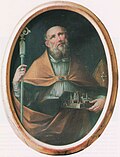 PossidoniusSaintMay 16
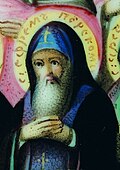 Ephraim of PerekomVenerable · Founder of Perekom MonasteryMay 16
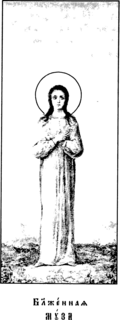 Musa of RomeVenerable · Virgin of RomeMay 16
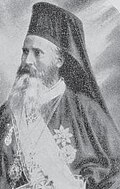 Vincent KrdžićSaint · Metropolitan of SkopjeMay 16
 Theodore of VršacHieromartyr · Bishop of VršacMay 16