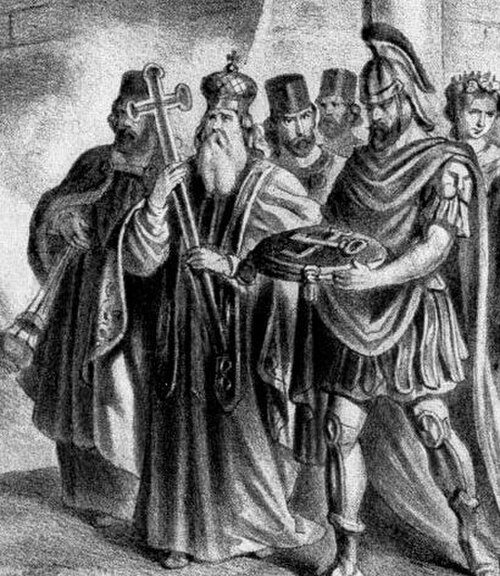
Saint
Nicholas Mystikos
Patriarch of Constantinople
Ecumenical Patriarch from 901 to 907 and again from 912 until his death in 925.
Life
Saint Nicholas Mystikos, hierarch, was patriarch of Constantinople from 901 to 907 and then from 912 until his death in 925. He is commemorated on 16 May.
Beginnings
He was born in 852, in a family linked with Italy, and was close to Saint Photios the patriarch, to whom some sources show him related. After the removal of Photios in 886 he fell into disfavour and retired to the monastery of Saint Tryphon, near Chalcedon. The emperor Leo VI the Wise brought him back and made him mystikos, that is, personal secretary. On 1 March 901 he was chosen patriarch.
The quarrel with the emperor
Leo VI married a fourth time, his beloved Zoe Karbonopsina, although the Church forbade a fourth marriage. Nicholas baptized, reluctantly, their son, the future Constantine VII, on 6 January 906, demanding that the emperor separate from Zoe, but he did not. The patriarch then forbade the emperor to enter the church and deposed the priest who had performed the wedding. At Christmas 906 he closed the doors of Hagia Sophia to the emperor. Leo appealed to Pope Sergius III and the patriarchs of the East, and in 907 Nicholas was forced to withdraw and was exiled to his own monastery, while Euthymius was set in the see. Nicholas judged the deposition unjust and drew the pope into the quarrel.
The second patriarchate
In 912, at the accession of Alexander, brother of Leo, Nicholas was restored to the see. A long struggle followed with those who had held with Euthymius, which ended only when the emperor Romanos Lekapenos issued the Tomos of Union, in 920. Alexander died in 913, and Constantine VII, still a child, became emperor. Nicholas was the first of the seven regents and had to face the advance of Simeon of Bulgaria on Constantinople. He negotiated and reached peace, crowned Simeon, in a hasty service outside the city, and arranged the marriage of Simeon’s daughter to Constantine. But this unpopular concession weakened his position, and in March 914 Zoe overthrew him and took his place at the head of the regency. Zoe broke the agreement with Simeon and war began again, and after the defeat of her army, in 917, she lost ground. In 919 she was pushed aside by the admiral Romanos Lekapenos, who crowned himself emperor in 920. Nicholas became one of the steadiest supporters of the new emperor and bore the brunt of negotiations with the Bulgarians until his death.
His writings
From him remain many letters to notables and foreign rulers, among them Simeon of Bulgaria, and a homily on the sack of Thessalonica by the Arabs in 904. He died in 925, on 15 May, in Constantinople, and the Church numbered him among the saints.
Commemorated the same day May 16
 Brendan of ClonfertVenerable · Irish AbbotMay 16
 VitusMartyr · of SicilyMay 16
 Alexander of JerusalemHieromartyr · Bishop of JerusalemMay 16
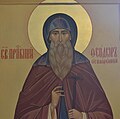 Theodore the SanctifiedVenerable · Successor of St. PachomiusMay 16
 Honoratus of AmiensSaint · Bishop of AmiensMay 16
 Peregrine of AuxerreHieromartyr · First Bishop of AuxerreMay 16
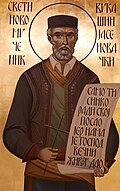 Vukašin MandrapaNew Martyr · Elder of KlepciMay 16
 PossidoniusSaintMay 16
 Ephraim of PerekomVenerable · Founder of Perekom MonasteryMay 16
 Musa of RomeVenerable · Virgin of RomeMay 16
 Vincent KrdžićSaint · Metropolitan of SkopjeMay 16
 Theodore of VršacHieromartyr · Bishop of VršacMay 16