Martyr
Vitus
of Sicily
Young Christian of Sicily, killed for his faith in the time of Diocletian, around the third or fourth century.
Life
Saint Vitus the Martyr was a young Christian of Sicily, killed for the faith in the time of the persecution of Diocletian, around 303. His veneration spread very widely in Europe, above all among Germans, Czechs and Serbs. He is honoured as a saint of the undivided Church, together with the holy martyrs Modestus and Crescentia, on 15 June.
What is known of him
No certain historical testimony has been preserved about his life or the circumstances of his death. The earliest mention is in the Hieronymian Martyrology, of the fifth century, which names in Sicily Vitus, Modestus and Crescentia. In the earliest sources these were separate traditions, joined later, and some scholars think Modestus and Crescentia may be fictitious. In the sixth and seventh centuries an account of their martyrdom was written, embellished with many miracles, in which history and legend are hard to separate. Pope Gregory the Great speaks of a monastery dedicated to Vitus in Sicily, and Pope Gelasius I, between 492 and 496, of a shrine of his at Rome.
The account of the martyrdom
According to the account, Vitus was the son of a pagan noble of Sicily, a boy of seven or twelve years depending on the source. His nurse Crescentia and his tutor Modestus, both Christians, raised him in the faith of Christ. His father, learning of it, tried to turn him back with torments but did not succeed. To save him, Modestus and Crescentia took him away secretly by boat to Lucania in southern Italy, where, according to tradition, he healed the sick and brought pagans to the faith.
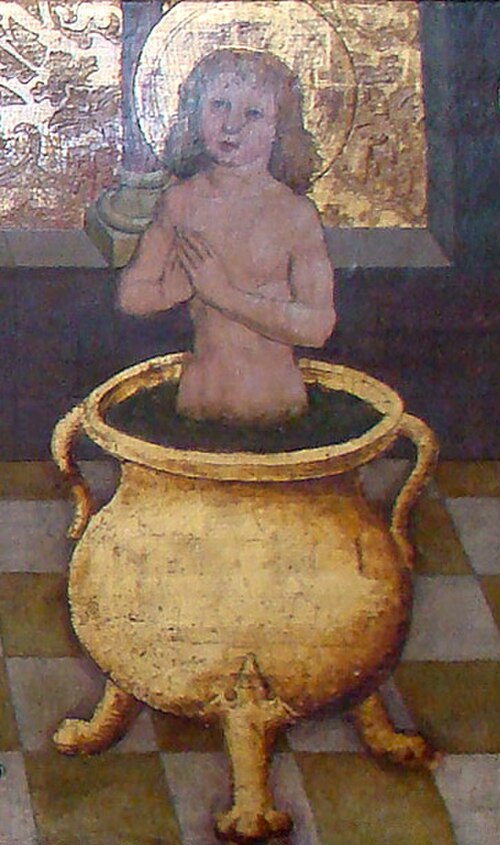
The news reached Rome. The emperor Diocletian asked him to heal his son, who was possessed by an unclean spirit. Vitus healed him, but refused to sacrifice to the gods. The emperor ordered him thrown into a cauldron of boiling oil and then before a lion, but neither the fire nor the beast harmed him. The three were bound to pillars and scraped with iron claws. An earthquake overturned the temples, and an angel took them out and brought them to Lucania, where they gave up their souls in peace. A woman named Florentia found their bodies and buried them.
Veneration
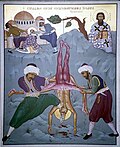
In the Middle Ages Vitus was counted among the Fourteen Holy Helpers. In Germany people danced before his statue on his day, so the nervous disorder called chorea came to be called "Saint Vitus's dance," and he became patron of dancers. His relics were taken to the abbey of Corvey in Germany in 836, and in 925 a hand of the saint reached Prague, where the cathedral of Saint Vitus bears his name. Among the Serbs his day, 15 June by the Julian calendar (28 June by the civil), is Vidovdan, the day of the battle of Kosovo in 1389. In icons he is shown as a youth, in a cauldron, sometimes with a lion.
Commemorated the same day May 16
 Brendan of ClonfertVenerable · Irish AbbotMay 16
 Nicholas MystikosSaint · Patriarch of ConstantinopleMay 16
 Alexander of JerusalemHieromartyr · Bishop of JerusalemMay 16
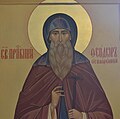 Theodore the SanctifiedVenerable · Successor of St. PachomiusMay 16
 Honoratus of AmiensSaint · Bishop of AmiensMay 16
 Peregrine of AuxerreHieromartyr · First Bishop of AuxerreMay 16
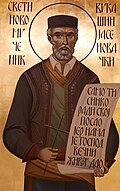 Vukašin MandrapaNew Martyr · Elder of KlepciMay 16
 PossidoniusSaintMay 16
 Ephraim of PerekomVenerable · Founder of Perekom MonasteryMay 16
 Musa of RomeVenerable · Virgin of RomeMay 16
 Vincent KrdžićSaint · Metropolitan of SkopjeMay 16
 Theodore of VršacHieromartyr · Bishop of VršacMay 16