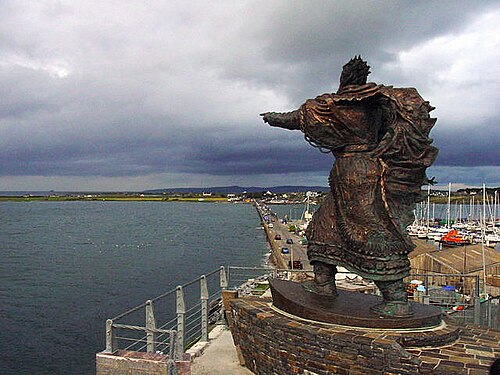
Venerable
Brendan of Clonfert
Irish Abbot
Irish abbot and founder of monasteries, known for the legendary account of his voyage at sea.
- Feast
- May 16old style May 29
- Reposed
- 5776th century
- Place
- Annaghdown
- Order
- Venerables
Life
Venerable Brendan of Clonfert, called the Navigator or the Voyager, was an Irish abbot and founder of monasteries, one of the twelve apostles of Ireland. He is known above all for the legendary account of his voyage at sea in search of the Isle of the Blessed. Few things about him are certain, and most of them come from the Irish annals and genealogies and from Lives written later. He is remembered on 16 May by the Orthodox, the Catholic and the Anglican Churches.
Childhood and schooling
Brendan was born in the year 484 at Tralee, in County Kerry, in the province of Munster, to parents named Finnlug and Cara, of the Altraige clan. Tradition says he was born in the Fenit area. He was baptized at Tubrid, near Ardfert, by Bishop Erc, with signs and portents at his birth. For five years he was raised and taught by Saint Ita of Killeedy (15 January), "the Brigid of Munster", who taught him three things God loves: the true faith of a pure heart, the simple religious life and bounty born of Christian charity. At six he was sent to the school of Saint Jarlath's monastery at Tuam, and later he is counted among the disciples of Finnian of Clonard, from which comes the number of the twelve apostles of Ireland.
At twenty-six he was ordained priest by Erc. He then founded several monasteries. His first voyage took him to the Aran Islands, where he built a monastery. He went to Hinba, an island in Argyll, in Scotland, where he is said to have met Saint Columba, then to Wales and finally to Brittany. In Wales he lived for a time under the discipline of Saint Gildas. Between 512 and 530 he built cells at Ardfert and at Shanakeel, at the foot of Mount Brandon.
The voyage
From Shanakeel he is said to have set out on his famous seven-year voyage toward the earthly Paradise. The story is in the Navigatio Sancti Brendani Abbatis, written in Latin, with the oldest surviving version dating from around 900, in more than a hundred manuscripts. It is a kind of Irish tale called an immram, a sea adventure. On the Kerry coast Brendan built a boat of wattle covered with hides tanned in oak bark and softened with butter, raised a mast and sail and, after forty days of fasting and prayer on the shore, set out in the name of the Most Holy Trinity.
According to the tale, fourteen monks went with him, to whom three disobedient men were later added, or sixty in other versions. The Navigatio tells of marvellous islands: one with sheep, one with birds that sing praises, one inhabited by silent monks, and the island where they lit a fire and which proved to be a huge fish, Jasconius, on whose back they celebrated Easter. After seven years, reaching the Promised Land of the Saints, they were welcomed and allowed to enter for a short time, then returned to Ireland rejoicing. The three disobedient men did not return, as Brendan had prophesied.
Scholars ask how much is truth and how much story. Brendan was a real man, but many see in the voyage an allegory of salvation and of monastic obedience. There is no evidence that he reached Greenland or America. Yet in 1976 the explorer Tim Severin crossed the Atlantic in a leather boat built after the text of the Navigatio, to show that such a voyage would have been possible. On the maps of the time of Columbus there was an Isle of Saint Brendan.
Clonfert and the last years
Brendan founded the monastery of Clonfert, on the river Shannon, around the middle of the sixth century (the sources give 557, 559 or 561), which became a great centre of learning. It is said that he was abbot of a community of three thousand monks and of a rule dictated by an angel, which belongs to legend rather than to history. He went to Iona and to Wales, then founded a monastery at Annaghdown, where he spent his last years. Near it stood the convent led by his sister, Brig.
He fell asleep around 577 (the sources give 577 or 578, at the age of ninety-three or ninety-four), probably at his sister's, at Annaghdown. Their last conversation is told: when he asked her to ease his death with her prayers, she asked why he was afraid, and he said he feared the loneliness of the unknown road, the face of the King and the sentence of the Judge. So that no one would quarrel over his body, he asked that his death be kept secret. His relics were carried to Clonfert in a cart, disguised as baggage sent ahead.
Brendan is honoured in Ireland and in the whole Church. A Greek Orthodox source notes that neither his existence nor the dates of his life are fully verified, but tradition keeps him in the calendars, and in Russia he is called Brendan the Wanderer, in the synaxis of the British and Irish saints.
Commemorated the same day May 16
 VitusMartyr · of SicilyMay 16
 Nicholas MystikosSaint · Patriarch of ConstantinopleMay 16
 Alexander of JerusalemHieromartyr · Bishop of JerusalemMay 16
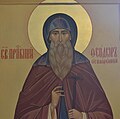 Theodore the SanctifiedVenerable · Successor of St. PachomiusMay 16
 Honoratus of AmiensSaint · Bishop of AmiensMay 16
 Peregrine of AuxerreHieromartyr · First Bishop of AuxerreMay 16
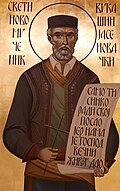 Vukašin MandrapaNew Martyr · Elder of KlepciMay 16
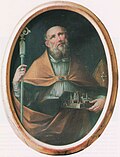 PossidoniusSaintMay 16
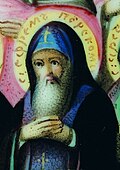 Ephraim of PerekomVenerable · Founder of Perekom MonasteryMay 16
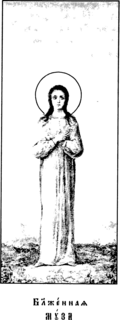 Musa of RomeVenerable · Virgin of RomeMay 16
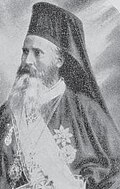 Vincent KrdžićSaint · Metropolitan of SkopjeMay 16
 Theodore of VršacHieromartyr · Bishop of VršacMay 16