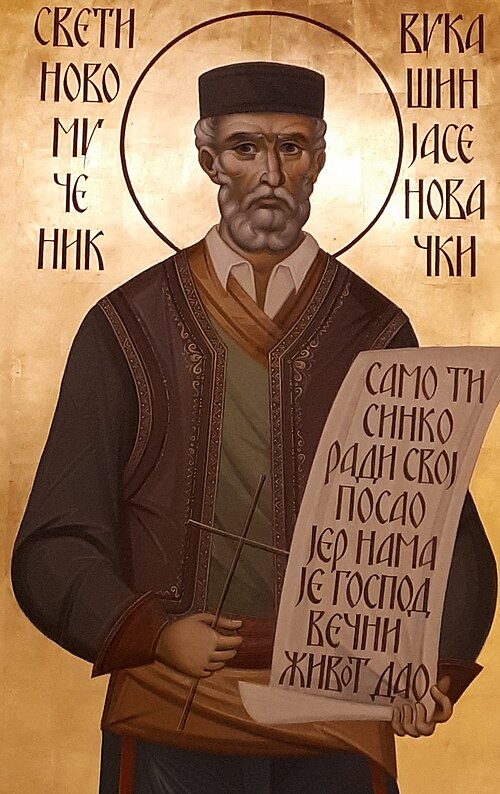
New Martyr
Vukašin Mandrapa
Elder of Klepci
Venerated in the Serbian Church, killed in the Jasenovac concentration camp in 1942 or 1943.
Life
The holy new martyr Vukašin Mandrapa, also called Vukašin of Klepci or Elder Vukašin, is venerated in the Serbian Orthodox Church as a saint, killed in the Jasenovac concentration camp in 1942 or 1943, according to other sources in August 1942. He is commemorated on 29 May and, with the other New Martyrs of Jasenovac, on 31 August (13 September in the new style). His historical existence is disputed, because no evidence survives, and the sole source of the story is the testimony of a former prisoner.
Who he was
Little is known of his life before the camp. According to the official version, he was named Vukašin Mandrapa and was born at Klepci, on the east bank of the Neretva in Herzegovina, near Čapljina, in a family of merchants of Sarajevo, linked with the Old Church of Sarajevo. He was a farmer and merchant. According to another version, his name was Vukašin Toholj and he was from the village of Lokve near Čapljina, of a peasant family. In 1941, after the collapse of Yugoslavia and the founding of the Independent State of Croatia, arrests and killings of Serbs by the Ustaše began. His family tried to hide in the native village but was arrested and sent first to Sarajevo, then, in 1942, to the camp at Jasenovac, where those regarded as "dangerous" to the state were held, above all Orthodox Serbs who refused to accept Catholicism. The presence of the elder Vukašin in the camp was spoken of by Žarko Vidović, a Sarajevan prisoner who survived the camp.
The martyrdom, according to a prisoner's testimony
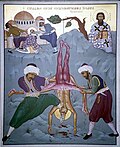
The only account of his martyrdom comes from Nedeljko (Nedo) Zec, a neuropsychiatrist and "free prisoner" at Jasenovac, who told in 1970 the testimony that an Ustaša executioner, Friganović (Žile, Josip or Mile), had given him in January 1943. The man was competing with other guards, among them Petar Brzica, over who could kill more prisoners, and said that he had already killed some 1,100. Among his victims was to be the elder Vukašin, whom he had noticed for his calm behaviour during forced labour and executions. He took him to the edge of the pit into which bodies were thrown and told him to shout "Long live Pavelić", and the old man did not answer. Furious, the Ustaša cut off his ears and nose, after each refusal, then threatened to take out his heart with a knife. Vukašin looked at him and said quietly and clearly, making the sign of the cross: "Child, do your work." Then the Ustaša killed him. According to Zec, the deed shattered Friganović psychologically, so that he could not kill any more that night and needed psychiatric treatment. Through the account Zec published in 1970, the story became known to the Serbian people and the Serbian Church.
The dispute and veneration
The Croatian historian Ivo Rendić-Miočević, like Filip Škiljan, thinks there is no ground for trusting Zec's testimony and questions Vukašin's existence. The philosopher Aleksandar Pražić thinks Zec's account is fiction. Nevertheless, at the regular session of the Holy Assembly of Bishops of the Serbian Church in 1998 Vukašin was entered, as a confessor, in the calendar of the Serbian Church, as a saint and new martyr. In 2000 the Russian Church put his name in its calendar. His image is found in frescoes in the church of Saint Sava in Belgrade and in the skete of Saint John (Jovan Do) of Ostrog monastery, and on the icon of the diocese of Zahumlje-Herzegovina painted for the 780th anniversary of the diocese. In 2007 his name was officially mentioned among the victims of the Jasenovac camp.
Commemorated the same day May 16
 Brendan of ClonfertVenerable · Irish AbbotMay 16
 VitusMartyr · of SicilyMay 16
 Nicholas MystikosSaint · Patriarch of ConstantinopleMay 16
 Alexander of JerusalemHieromartyr · Bishop of JerusalemMay 16
 Theodore the SanctifiedVenerable · Successor of St. PachomiusMay 16
 Honoratus of AmiensSaint · Bishop of AmiensMay 16
 Peregrine of AuxerreHieromartyr · First Bishop of AuxerreMay 16
 PossidoniusSaintMay 16
 Ephraim of PerekomVenerable · Founder of Perekom MonasteryMay 16
 Musa of RomeVenerable · Virgin of RomeMay 16
 Vincent KrdžićSaint · Metropolitan of SkopjeMay 16
 Theodore of VršacHieromartyr · Bishop of VršacMay 16