
Saint
Job of Moscow
First Patriarch of Moscow
First Patriarch of Moscow and all Rus, from 1589 to 1605, who died in 1607.
Life
Saint Job, hierarch, was the first Patriarch of Moscow and all Rus, from 1589 to 1605. He was born about 1525 at Staritsa and fell asleep on 19 June 1607 in the same town, after suffering exile in the troubled years that followed the death of Tsar Feodor. The Russian Church canonised him in 1989.
Youth and monastic life
As a child Ioann, as he was called in the world, came from a family of townspeople at Staritsa, near Tver. According to some sources, already as a teenager he knew most of the Scriptures by heart and wished to become a monk, but his father wanted him to marry. Once he asked permission to visit his confessor at the Dormition monastery of his town and stayed there, becoming a monk and taking the name Job, after the long-suffering Job. The sources differ on the year of his tonsure, 1551 according to some, 1556 according to others. A disciple of Archimandrite Herman, he was well taught in the order and the fear of God.
After fifteen years in the monastery he became abbot, with the help of Ivan the Terrible, who made his residence at Staritsa in the time of the Oprichnina; the sources give 1566 or 1569. In 1571 he was moved to Moscow as abbot of the Simonov monastery, and in 1575 he became archimandrite of Novospassky. In 1581 he was consecrated bishop of Kolomna, in 1586 he was appointed archbishop of Rostov, and then metropolitan of Moscow and all Rus, in 1586 or 1587, with the help of Boris Godunov. His contemporaries praised his beautiful voice and his way of reading; he knew the Psalter, the Apostle and the Gospel by heart.
Patriarch of Moscow
Godunov argued that church authority in Russia must be strengthened and persuaded Patriarch Jeremias II of Constantinople, who was then in Moscow, to establish a patriarchate. In 1589 Job was installed, with the blessing of Jeremias, as the first Patriarch of Moscow. His residence was fixed in the Kremlin. A council at Constantinople confirmed the new order in 1590, and three years later the four other patriarchs confirmed it at another council.
Under his direction the clergy corrected the books of the services and prepared them for printing. Job worked for the canonisation of several Russian saints, such as Basil the Fool for Christ in 1588, Joseph of Volokolamsk, for whom he himself wrote the service, Anthony the Roman and Cornelius of Komel, and he established feasts in honour of the three hierarchs of Moscow, Peter, Alexis and Jonah. He supported the building of new cathedrals and monasteries and the Christian mission in Siberia, in Kazan and Astrakhan, and at the request of King Alexander of Georgia he sent men of learning to Georgia. In 1591 he founded the Donskoy monastery in Moscow. He did not accept Godunov's proposal to open a university in Moscow with foreign professors, fearing that their presence would harm the purity of the Russian Church.
Also in 1591 he headed the inquiry into the death of Tsarevich Dmitry at Uglich. After consulting the church council and the boyar duma, the patriarch announced that the tsarevich had stabbed himself by accident and had not been murdered. The verdict was supported by Godunov and remains a disputed subject to this day.
The Time of Troubles
After the death of Tsar Feodor in 1598, and after Tsarina Irina refused the throne, Job became head of the state. On 21 February 1598 he led a procession to the Novodevichy convent, begging Boris Godunov to accept the throne. When False Dmitry appeared, he insisted on loyalty to Feodor Borisovich and put under anathema those who followed the impostor. One of the patriarch's secretaries for a time had been Grigory Otrepyev, whom some scholars identify with False Dmitry. After the death of Boris Godunov in 1605, Job was arrested during the service in the Dormition cathedral, his patriarchal vestments were taken from him and he was sent as a simple monk into exile in the monastery at Staritsa. The Greek Ignatius was elected in his place, but the change was not canonical, since Job had been neither deposed nor deprived of his rank.
Repose and veneration
Job lived two more years at Staritsa. Before his death he was rehabilitated in the time of Vasily Shuisky and visited Moscow, but, being blind, he refused to return to the patriarchal throne. He fell asleep in 1607 and was buried at the Dormition monastery in Staritsa. He left a Testament and a Tale of Tsar Feodor Ioannovich. A chapel was raised over his grave, and in 1652 his relics, found incorrupt, were moved to the Dormition cathedral in the Kremlin, beside the tomb of Patriarch Joasaph. The Russian Church numbered him among the holy hierarchs at the Council of Bishops on 9 October 1989. He is commemorated on 19 June.
Commemorated the same day April 5
 Plato of SakkoudionVenerable · Abbot of SakkoudionApr 5
 Philip I of MoscowSaint · Metropolitan of MoscowApr 5
 Theodora of ThessalonicaVenerable · Nun of ThessalonicaApr 5
 PherbuthaMartyrApr 5
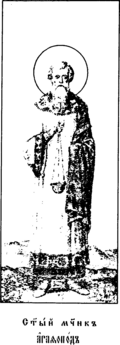 Theodulus and AgathopodesHoly Martyrs · Martyrs of ThessalonicaApr 5
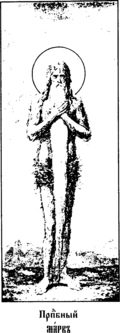 Mark of AthensVenerable · Hermit and fool for ChristApr 5
- Agathopus of ThessalonikiMartyrApr 5
 Argyre of ProusaNew MartyrApr 5
- Nicholas SimoHieromartyr · ArchpriestApr 5
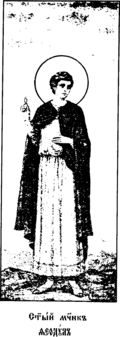 Theodulus of ThessalonikiMartyrApr 5
- AbdiesusSaintApr 5
- Alexis KrotenkovHieromartyrApr 5