Hieromartyr
Nicholas Simo
Archpriest
Archpriest of the Leningrad and Gdov diocese, born in 1875 at Arensburg, who died on 18 April 1931.
Life
Saint Nicholas Simo (1875 to 1931), hieromartyr, was an archpriest of the Leningrad and Gdov diocese, an Estonian by birth and a priest at Kronstadt, where he founded the church for the Estonian faithful. He was shot in Leningrad on 18 April 1931 and numbered among the new martyrs and confessors of Russia by decision of the Holy Synod on 22 February 2001.
Family and formation
He was born in 1875 at Arensburg, in Estonia (the province of Estland), into the family of an Estonian Orthodox priest, Adam Petrovich Simo, a peasant's son who had graduated from the church school and seminary at Riga, had served on the island of Ösel and was transferred in 1888 to the Estonian parish at Kronstadt. His mother, Olga Yakovlevna, born Boikova, was a priest's daughter. Nicholas finished the German gymnasium at Dorpat in 1887 and the church school at Riga in 1891, began the seminary at Riga and from 1894 continued at Saint Petersburg, where he finished in 1897. He was appointed priest in his father's place at the Cathedral of Saint Andrew in Kronstadt, and his father was moved to Gatchina.
Priest at Kronstadt
Father Nicholas joined priestly service with public and educational work. He led the Kronstadt branch of the Alexander Nevsky Temperance Society, working hard against drunkenness, headed the Estonian parish school and taught religion at the customs school. Not everyone looked kindly on his mission among the Estonians of the town, and he was allowed to serve in the cathedral only once a week. For the nearly eight hundred Estonian believers he then thought of building a church of their own. Together with Bishop Plato he brought about the opening of the Church of the Exaltation of the Holy Cross, consecrated on 1 December 1902 by Saint John of Kronstadt in the presence of Vice-Admiral Makarov and other officers and officials. Father Nicholas became its rector, and the services were held in Russian and Estonian.
In December 1917 he was elected priest of the Cathedral of Saint Andrew, in 1919 he was raised to archpriest, and in 1923 he became rector of the cathedral and dean of all the Kronstadt parishes. In March 1921 he was arrested on suspicion of taking part in the Kronstadt rebellion, but was released after two weeks because no offence was found.
Arrest and martyrdom
He was arrested a second time on 13 October 1930, accused of leading a counter-revolutionary organization of former officers and nobles who were said to be spreading monarchist ideas. The real reason, however, was his firm opposition to the renovationist movement. Sixty-four people were drawn into the same case. On 15 February 1931 the OGPU Collegium sentenced him to ten years in a camp and sent him to Solovki, but on 16 March he was arrested again in the camp, immediately after arrival, and brought back to Leningrad. On 13 April 1931 he was sentenced to death, and on 18 April he was shot and buried in an unknown grave.
Family and veneration
His brother Paul died at Odessa in 1929, and another brother, Protodeacon Peter, was shot in 1937. His sister Claudia perished in a camp. His wife, Lydia Pavlovna, born Panova, a priest's daughter from Ösel, died in 1910. His son Nicholas was shot at Tomsk on 17 December 1937, and his wife in January 1938. His daughters, Elena and Maria, survived.
Since 2001 the name of Father Nicholas, priest of Kronstadt, has been commemorated at every Liturgy in the Vladimir Cathedral at Kronstadt, and his day of remembrance is kept each year on 18 April. He is commemorated on 18 April (5 April Old Style).
Commemorated the same day April 5
 Job of MoscowSaint · First Patriarch of MoscowApr 5
 Plato of SakkoudionVenerable · Abbot of SakkoudionApr 5
 Philip I of MoscowSaint · Metropolitan of MoscowApr 5
 Theodora of ThessalonicaVenerable · Nun of ThessalonicaApr 5
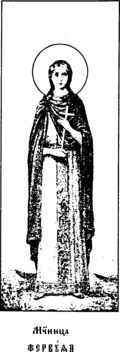 PherbuthaMartyrApr 5
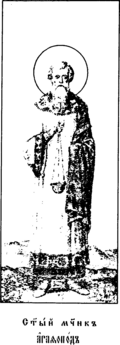 Theodulus and AgathopodesHoly Martyrs · Martyrs of ThessalonicaApr 5
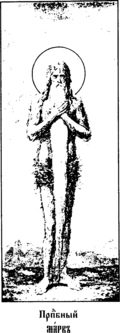 Mark of AthensVenerable · Hermit and fool for ChristApr 5
- Agathopus of ThessalonikiMartyrApr 5
 Argyre of ProusaNew MartyrApr 5
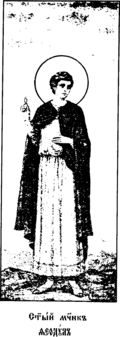 Theodulus of ThessalonikiMartyrApr 5
- AbdiesusSaintApr 5
- Alexis KrotenkovHieromartyrApr 5