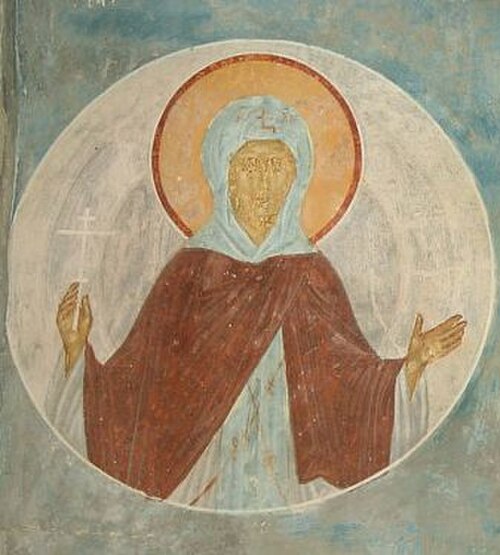
Venerable
Theodora of Thessalonica
Nun of Thessalonica
Byzantine nun from Aegina, whose Life is the longest ever written about a Byzantine holy woman; commemorated on 29 August.
- Feast
- April 5old style April 18
- Reposed
- 8929th century
- Place
- Thessaloniki
- Order
- Venerables
Life
Saint Theodora of Thessalonica was a Byzantine nun of the ninth century, born on the island of Aegina and known for her obedience, hard work and humility. Her Life, written not long after her death, is the longest ever composed about a holy woman in Byzantium, about twenty thousand words.
Aegina and the move to Thessalonica
She was born around 812 into a Christian family on Aegina. According to her biographer, Gregory the Presbyter, her father was a senior priest who later took monastic vows, her brother was a deacon and her sister a nun. From childhood she learned the Scriptures, and at seven she was betrothed to a young man of good family known for his learning and eloquence. They had children, and the Bulgarian sources add that her mother had died when she was born.
Her life was shaken by the Arab raids that devastated the Aegean coasts in the ninth and tenth centuries. Her brother was killed in one of these attacks, and Theodora left with her husband and her father for Thessalonica, at some point between 820 and 830 (the sources give different years). They had relatives there: Aikaterine, abbess of the convent of Saint Luke; her brother Anthony, who was briefly bishop of Thessalonica; Anna, abbess of the convent of Saint Stephen; and Theodora's sister, a nun at Saint Stephen.
Monastic life
After two of her children died, Theodora vowed to give the third, her daughter Theophiste, to the monastic life. The girl was placed in her aunt's convent. When her husband died, around 837, Theodora divided her goods between the poor and the convent of Saint Stephen the Protomartyr, and entered it as a nun. Her daughter was moved to the same community, and the two worked together for fifteen years, until Theophiste became abbess.
Her Life does not tell of unusual feats of asceticism. She was praised for obedience, diligence and humility. The biographer also relates, in some versions, miracles worked during her lifetime.
Repose and relics
The saint reposed on 29 August 892. Some time later it was decided to move her body from the common tomb of the nuns into a separate sarcophagus. The biographer describes the scene in the manner of the tomb of Christ: at midnight priests and faithful came to the grave, but the stone could not be moved until prayers had been said. From the sarcophagus in which her remains were placed there flowed a fragrant, wonder-working oil. Gregory tells of other miracles after her death, among them the healing of his own sister.
The Life and her veneration
Her Life also contains a short biography of Saint Anthony the Confessor, archbishop of Thessalonica, and an anti-iconoclast discourse he addressed to Emperor Leo V the Armenian. The author added many chronological indications and a list of posthumous miracles. Two versions survive, one in a twelfth-century Moscow manuscript and another in a thirteenth- or fourteenth-century Vatican manuscript. In the fourteenth century Nicholas Cabasilas wrote a eulogy in her honour.
Her veneration continued under Ottoman rule. Her relics rest in a silver reliquary in the monastery in Thessalonica that bears her name, formerly the monastery of Saint Stephen and now a men's monastery. A small portion of them is kept at the Ćelije monastery near Valjevo in Serbia. In 2010 archaeologists in Thessalonica found a tomb which they tentatively identified as hers, beside the remains of a large three-aisled basilica dedicated to her.
Her feast was originally on 29 August but gradually came to be kept on 3 August, since the earlier day coincides with the beheading of John the Baptist. She is also commemorated on 5 April.
Commemorated the same day April 5
 Job of MoscowSaint · First Patriarch of MoscowApr 5
 Plato of SakkoudionVenerable · Abbot of SakkoudionApr 5
 Philip I of MoscowSaint · Metropolitan of MoscowApr 5
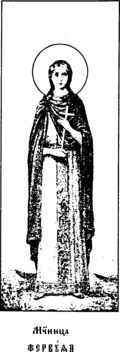 PherbuthaMartyrApr 5
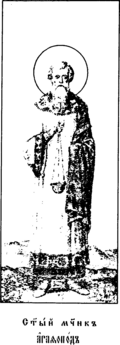 Theodulus and AgathopodesHoly Martyrs · Martyrs of ThessalonicaApr 5
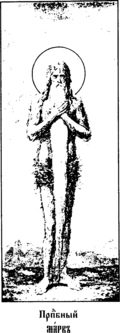 Mark of AthensVenerable · Hermit and fool for ChristApr 5
- Agathopus of ThessalonikiMartyrApr 5
 Argyre of ProusaNew MartyrApr 5
- Nicholas SimoHieromartyr · ArchpriestApr 5
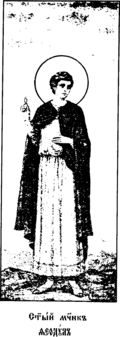 Theodulus of ThessalonikiMartyrApr 5
- AbdiesusSaintApr 5
- Alexis KrotenkovHieromartyrApr 5