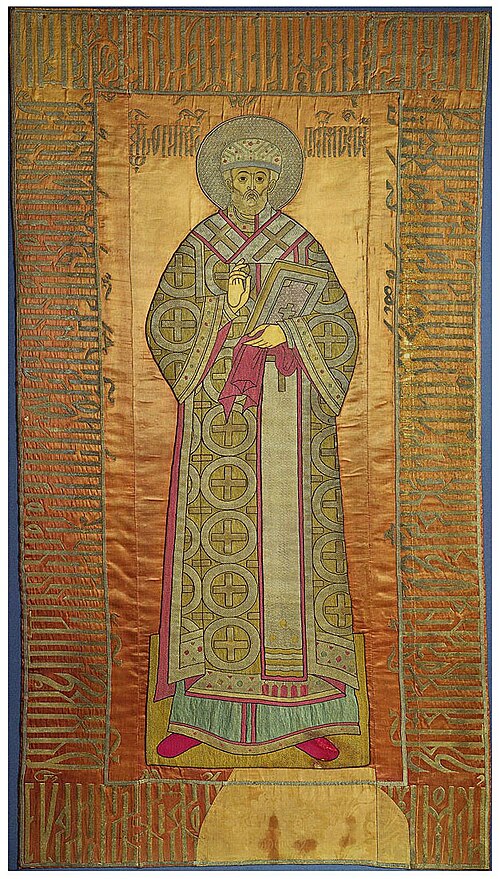
Saint
Philip I of Moscow
Metropolitan of Moscow
Metropolitan of Moscow and all Rus from 1464 to 1473, appointed without the approval of the Patriarch of Constantinople.
Life
Saint Philip I, Hierarch, was Metropolitan of Moscow and all Rus' from 1464 to 1473, the third metropolitan set in Moscow without the approval of the Ecumenical Patriarch of Constantinople. The Russian Church canonized him and remembers him on 5 April, the day of his repose, and on 27 May, in the Synaxis of the saints of Moscow.
Beginnings
According to Archimandrite Macarius (Veretennikov), he was born in the Byzantine Empire at the beginning of the fifteenth century. He was a patriarchal clerk-official and lived in Constantinople. At his tonsure he was named after the Apostle Philip. He came to Russia, it seems, after the death of Metropolitan Photius (after 1431) and stayed there a long time, became Russified, and the memory of his Greek origin was almost lost. In 1455 he is mentioned as bishop of Suzdal; in February 1459 he took part in the consecration of Archbishop Jonah of Novgorod, and in 1461 in the elevation to the see of Moscow of Archbishop Theodosius of Rostov. In 1464 he was unanimously chosen successor of Metropolitan Theodosius, who also recommended him, and on 11 November 1464 he was set on the metropolitan throne of Moscow.
Ministry
Metropolitan Philip took part not only in church affairs but also in the internal politics of the grand prince of Moscow. In 1470 he wrote a letter to Novgorod, in which he begged the inhabitants to be loyal to Moscow, having in mind this time only the political side. But the same year circumstances forced him to send to Novgorod another epistle, in which he urged the Novgorodians not to pass under the Lithuanian metropolitan and fiercely rebuked them for their interest in Lithuanian “Latinism.” Metropolitan Philip was against Ivan III's marriage alliance with the Uniate Sophia Palaiologina (in some Greek sources he nevertheless helped bring the marriage about). The official grand-princely chronicle says that the metropolitan married them, but the unofficial one (in the Sophia II and Lvov Chronicles) denies the metropolitan's participation in the ceremony: the archpriest of Kolomna, Hosea, married them. Philip was against admitting the papal legate in the bride's entourage into Moscow and threatened the grand prince that he would leave Moscow if he allowed his coming, ahead of the Latin cross; afterward he held with the legate, Bishop Antony, theological discussions that lasted seven weeks.
Under Metropolitan Philip the building of the new Dormition cathedral in the Moscow Kremlin began, the chief shrine of the Russian Church. The old cathedral, built by Metropolitan Peter in 1326, was dilapidated; Philip hired inexperienced workers, and soon after his death the building collapsed; it was rebuilt by Aristotele Fioravanti under Metropolitan Gerontius. During the building, in 1472, the relics of the holy hierarchs Peter, Cyprian, Photius and Jonah were found, and a commemoration of this event was established. Metropolitan Philip was a faster and ascetic: after his death iron chains were found on his body, with which he humbled his body. He wrote several epistles: to the Novgorodians, on the inalienability of church property; to Vyatka, with a call to help Moscow in the Kazan campaigns of 1468-1469; two epistles to Novgorod in 1471 against recognizing the West Russian metropolitan; and an epistle on pardoning the Novgorodians subject to the grand prince after the defeat on the Shelon. On his initiative the baptized Jew Theodore translated from Hebrew a book of “worldly psalms” (the Mahzor collection).
Repose and veneration
Saint Philip fell asleep on 5 April 1473, aged seventy, and was buried in the Dormition cathedral in the Kremlin. On 27 August 1479, when the relics of the hierarchs of Moscow were moved to the new Dormition cathedral, it was found that the body of Metropolitan Philip had hardly decayed. Only miraculous healings at his shrine were lacking to confirm his holiness, but no miracle was recorded, so the question of his canonization was closed. His tomb in the Dormition cathedral was in time lost. In 2009 his name was entered in the Synaxis of the saints of Moscow, as a hierarch, with commemoration on 5 April and 27 May.
Commemorated the same day April 5
 Job of MoscowSaint · First Patriarch of MoscowApr 5
 Plato of SakkoudionVenerable · Abbot of SakkoudionApr 5
 Theodora of ThessalonicaVenerable · Nun of ThessalonicaApr 5
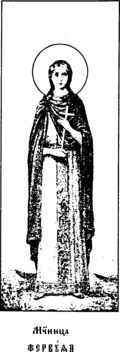 PherbuthaMartyrApr 5
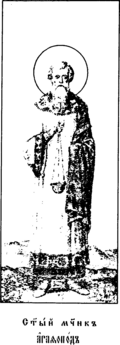 Theodulus and AgathopodesHoly Martyrs · Martyrs of ThessalonicaApr 5
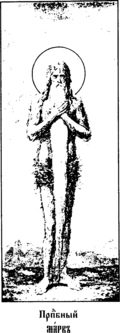 Mark of AthensVenerable · Hermit and fool for ChristApr 5
- Agathopus of ThessalonikiMartyrApr 5
 Argyre of ProusaNew MartyrApr 5
- Nicholas SimoHieromartyr · ArchpriestApr 5
 Theodulus of ThessalonikiMartyrApr 5
- AbdiesusSaintApr 5
- Alexis KrotenkovHieromartyrApr 5