Venerable
John of Palestine
A fellow ascetic of Venerable Symeon the Fool for Christ.
- Feast
- July 21old style August 3
- Era
- 6th century
- Order
- Venerables
Life
Holy Venerable John of Palestine, the fasting companion of Venerable Simeon the Fool for Christ, was a Syrian from Edessa and lived in the sixth century. From childhood a close friendship had bound them. Simeon, the elder, was unmarried and lived with his aged mother. John had just married and lived with his father (his mother had died) and his young wife. Both came from rich families. When Simeon was thirty and John twenty-four, they made a journey to Jerusalem for the feast of the Exaltation of the Holy Cross. On the way back they spoke of the ways of the salvation of the soul. They dismounted, sent the servants ahead with the horses, and went on foot.
Coming to the Jordan, they saw on the bank monasteries set at the edge of the desert. In both there was kindled an irresistible desire to leave the world and spend the rest of their life in monastic labours. They left the road by which the servants were going to Syria and, praying zealously to God, set out in the opposite direction, toward the monasteries. They asked the Lord to show them which monastery to choose and decided to go to the one whose gates would be open. At that time the Lord announced in a dream to the abbot of the monastery, Nicon, to open the gates and receive the sheep of Christ. The two friends, full of joy, came to the open gates, were kindly received by the abbot and stayed in the monastery. Soon they were tonsured monks.
After they had stayed some time in the monastery, Simeon was kindled with the desire to strengthen his labour, to go deep into the desert and struggle in complete solitude. John would not stay behind his friend and resolved to share with him the labour of the desert life. The Lord revealed to the abbot Nicon the plan of the friends, and on the night when the monks Simeon and John wished to leave the monastery, he himself opened the gates to them, prayed with them, blessed them and let them go into the desert. Beginning the desert life, the spiritual brothers first had to endure a strong warfare from the devil, who inspired in them sorrow for the relatives they had left, frightened them, brought upon them weakness, despondency and sloth. Simeon and John, firmly remembering the vows made at their tonsure and hoping in the prayers of their elder, the abbot Nicon, went on unswervingly in the chosen path, spending their time in unceasing prayer and strict fasting, supporting one another in the struggle against temptations. After a time, with God's help, the temptations ceased.
The monks received from God the news that Simeon's mother and John's wife had died and that the Lord had deemed them worthy of the bliss of paradise. After this Simeon and John lived in the desert twenty-nine years, attained complete dispassion and a high spiritual degree. Venerable Simeon, by God's prompting, thought that now he must serve people and, for this, leave the solitude of the desert and go into the world. Saint John, reckoning that he had not yet reached the degree of dispassion of his companion, resolved not to leave the desert. The brothers parted in tears. Simeon went to Jerusalem, bowed at the Tomb of the Lord and at all the holy places. In his great humility the ascetic prayed zealously to the Lord to make him worthy to serve his neighbour in such a way that people should not glorify him.
Saint Simeon chose for himself the hard labour of foolishness for Christ. Coming to the city of Emesa, he stayed there and behaved like a madman, doing strange things, for which he was mocked, abused and beaten, and yet he did many good deeds. He cast out demons, healed diseases, delivered from sudden death, brought unbelievers to faith and sinners to repentance. All these good deeds he did under the guise of foolishness and received no praise or thanks from people. But he greatly honoured his spiritual brother, Venerable John: when one of the inhabitants of Emesa visited John in the desert, asking counsel and prayers, he always sent them to "the fool Simeon", who could give better spiritual advice.
Three days before his death, Saint Simeon stopped appearing in the streets and shut himself in his hut, in which there was nothing but a bundle of brushwood. After three days of unceasing prayer, Saint Simeon passed to the Lord. Some of the town's beggars, his friends, no longer meeting him, came to the hut and found him dead. They took the body and carried it, without the usual chanting, to the place where the homeless and strangers were buried. As the body of Saint Simeon was carried, some of the inhabitants heard wonderful church singing, without understanding where it came from. After Saint Simeon, in the desert Venerable John passed peacefully to the Lord. Shortly before his death, Saint Simeon was granted to see above the head of his spiritual brother a crown with the inscription "For desert patience".
The Church commemorates him on 3 August, in the new style.
Commemorated the same day July 21
 EzekielProphet · The ProphetJul 21
 Victor of MarseillesMartyrJul 21
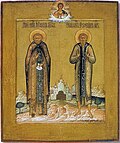 Simeon the Holy FoolFool-for-ChristJul 21
 Arbogast of StrasbourgSaint · Bishop of StrasbourgJul 21
 TryphineSaint · Breton saintJul 21
 Arsenia SebryakovaVenerable · Abbess of Ust-Medveditsa ConventJul 21
 Onuphrius the SilentVenerable · Monk of the Near CavesJul 21
 Gregory ZlatorunskyHieromartyr · PriestJul 21
 Meletios of KitrosHieromartyr · Bishop of KitrosJul 21
- AcaciusMartyrJul 21
- Curcach of Cill CurcaigheVenerableJul 21
 Éterne of ÉvreuxSaintJul 21