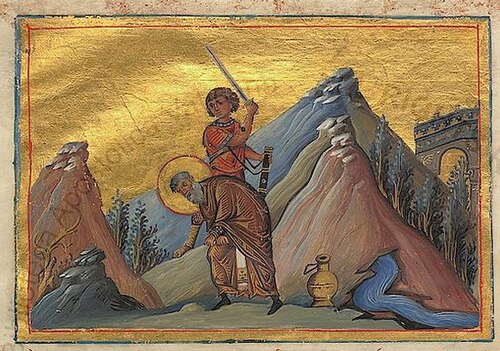
Hieromartyr
Julian of Galatia
A cleric of Galatia, who died a martyr for Christ.
- Feast
- September 12old style September 25
- Era
- 4th century
- Place
- Galatia
- Order
- Martyrs
Life
Holy Hieromartyr Julian of Galatia was a priest in the fourth century, near the ancient city of Ancyra, and received a martyr's death together with forty companions. The Church commemorates him on 25 and 26 September (new style).
The governor of the region of Galatia was told that in a cave the presbyter Julian was hiding with forty believers and conducting services there. Saint Julian was seized and asked to give up the other Christians, who had managed to hide, but he flatly refused. The pagans ordered him to sacrifice to their gods, and this too he would not do. Then they stripped him and set him on a red-hot iron grate. The martyr made the sign of the cross, and an angel of the Lord cooled the flames, and Julian remained unharmed. To the governor's question who he was and how he had put out the fire, he answered: "I am a servant of God." The tormentors brought the aged mother of the saint and threatened her that if she did not persuade her son to sacrifice to idols they would give her over to shame. The courageous woman answered that if her body were defiled against her will, this would not be counted a fault before God, but rather as a martyr's struggle. The shamed tormentors let her go, and Saint Julian they condemned to death.
In his prayer before death the saint earnestly thanked God and asked Him to strengthen him to bear the torments. He asked also a special grace from God: that to people who take earth from the place of his burial there be given forgiveness of sins and deliverance from passions, and that their fields not be attacked by harmful insects or birds. Saying "Lord, receive my spirit in peace," the martyr bowed his head to the sword. Then a voice was heard calling him into the Kingdom of heaven. The voice was heard also by the Christians who were hiding in the cave. Kindled with courage, they came to the place where Saint Julian had suffered, found him already dead, and all declared themselves Christians. They were bound and brought to the governor, who commanded that their heads too be cut off.
Commemorated the same day September 12
 AutonomusHieromartyr · Bishop in BithyniaSep 12
 EanswytheVenerable · Princess and abbess of KentSep 12
- George of ChkondidiSaint · Archbishop of ChkondidiSep 12
 Athanasius of VysotskVenerable · First abbot of Vysotsky MonasterySep 12
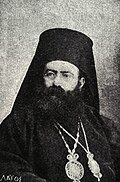 Gregory of KydoniesHieromartyr · Metropolitan of KydoniesSep 12
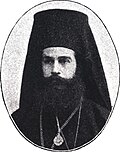 Ambrosios of MoschonisiaHieromartyr · Metropolitan of MoschonisiaSep 12
- Dositheus of TbilisiHieromartyr · Archbishop of TbilisiSep 12
- Felix and CyprianHoly Hieromartyrs · Bishops of AfricaSep 12
- Daniel of ThassosSaintSep 12
- Serapion of CataniaHieromartyrSep 12
- Vassian of TiksnaVenerableSep 12
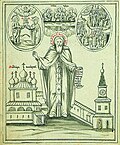 Athanasius the Younger of VysotskVenerable · Abbot of Vysotsky MonasterySep 12