Venerable
Juliana of Moscow
A venerable woman of Moscow, commemorated in the Russian calendar, who died in 1393.
- Feast
- May 3old style May 16
- Reposed
- 139314th century
- Order
- Venerables
Life
Holy Venerable Juliana of Moscow was abbess of a convent in Moscow, sister of Saint Alexis, metropolitan of Moscow, and died in 1393. The Church commemorates her on 16 May (3 May, old style) and on 5 September (a movable day), in the Synaxis of the Saints of Moscow.
The convent
The venerable Juliana and Euphrosyne were sisters of Holy Hierarch Alexis and came from a noble family of boyars of Chernigov. In the devout family of the holy hierarch's parents there were five sons and two daughters: Julia (in monastic tonsure Euphrosyne) and Ulyana (Juliana). Love for their eldest brother moved the sisters to build a convent in honour of Saint Alexis, the man of God, the patron of their brother in monasticism. At first the convent was built at Ostozhye (today on the territory of the Conception convent in Moscow). The place was then partly covered with forest, and most of it was meadows and hayfields, whence the name Ostozhye, Stozhenets, today Ostozhenka (from hay gathered in stacks). It was a solitary, quiet place, suitable for a convent. On one side flowed the river Ostozhenka, long gone, on the other, the Moscow river.
The first abbess of the convent was Juliana. The chronicle of the time says that she was "from the city of Yaroslavl, daughter of a rich and renowned father". Yet a widespread tradition says that the first abbess was one of the sisters of Saint Alexis. Filled with the spirit of Christian piety, she guided wisely the sisters entrusted to her, teaching them the monastic life not only by command and counsel but also by personal example. Like her brother, she scorned the pleasures of the world early, was taught monasticism through spiritual struggle and, in governing the convent, followed the experience of the ancient ascetics. Having a clear mind, she understood that she had to deal differently with each of the sisters and blessed novices to obediences fitted to the strength and character of each, succeeding by the wisdom of her rule in uniting people of different origins and habits into a spiritual family. Her qualities of soul won her the love of all, monastics and lay people alike.
A faithful helper to her was her sister, the nun Euphrosyne. They bore together all the labours of the convent. In the convent everything was done by the counsel and blessing of their elder brother, and by the south part of the wall a cell was built in which he often stayed. The sisters of Saint Alexis shone in an ascetic life. For their mercy and gentleness, spiritual wisdom and humility, they were honoured by the people as saints even in their lifetime. They had loving and compassionate hearts and were always ready to help the hungry, the poor and the unprotected who came under the roof of the convent. In times of trouble for the Russian land they were comforters, intercessors, nurturers and healers of all the suffering and sick.
Repose and veneration
The days of the earthly life of the founders came to an end. The abbess, beloved of all, died in 1393, on the fourth Saturday after Pascha, in the night to 3 May 1393, and was buried near the church. The death of the head of the community was noted by the chronicler of the time: "After the great day, in the fourth week, on Saturday night, the abbess of Alexeyevsky, Ulyana, daughter of a rich and renowned father, herself very God-fearing, who had been a nun for more than thirty years and abbess over ninety nuns, head of the women's common life, was beloved by all for her great virtue and honoured everywhere, and was laid near the church." A year later her sister, the nun Euphrosyne, also reposed.
Over the burial place of the venerable sisters a chapel was soon built. Later, in 1766, a church was built there in honour of the icon of the Mother of God "The Unburnt Bush", united in 1887 with the cathedral of the Nativity of the Mother of God and consecrated in honour of the Kazan icon of the Mother of God. After death the venerable women did not leave the convent they had created. The Lord granted them gifts of grace, shown by many miracles, worked by Juliana and Euphrosyne at the earnest prayer of all who called on them for help. By the end of the nineteenth century the documents for canonization were prepared, but the events of 1917 prevented its accomplishment. The glorification of the venerable Juliana and Euphrosyne took place in the year 2000.
Commemorated the same day May 3
 James the LessApostle · The ApostleMay 3
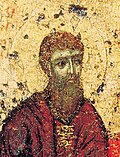 Theodosius of the CavesVenerable · Abbot of the Kiev Caves LavraMay 3
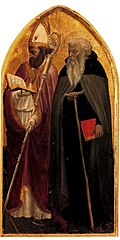 Juvenal of NarniHieromartyr · First Bishop of NarniMay 3
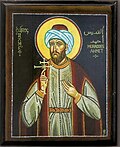 Ahmed the CalligrapherNew Martyr · Ottoman official of ConstantinopleMay 3
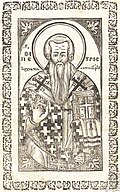 Peter of ArgosSaint · Bishop of ArgosMay 3
- Oecumenius of TriccaSaint · Bishop of TriccaMay 3
 Xenia of KalamataGreat MartyrMay 3
 Primianus of LarinoMartyrMay 3
- Gabriel the New MartyrNew MartyrMay 3
- 27 MartyrsHoly MartyrsMay 3
- AdalsindisVenerableMay 3
- Aethelwine of LindseySaint · Bishop of LindseyMay 3