Martyr
Khudion of Sebaste
Martyr of Sebaste, who suffered for Christ.
Life
Holy Martyr Khudion of Sebaste is one of the Forty Holy Martyrs of Sebaste in Armenia. The calendar shows him only by his name in the list of the forty, so we give here the story of the whole company.
After Constantine the Great gave in 313 the law of freedom of faith, to which his co-emperor Licinius also agreed, the latter remained nonetheless a convinced pagan and in his part of the empire wished to root out Christianity, even from the army, which he feared would betray him in the war against Constantine. About the year 320, in Sebaste in Armenia, a commander, Agricolaus, a fierce defender of paganism, had under him a company of forty Cappadocians, brave men who had come out victors from many battles. All were Christians. Because they refused to sacrifice to the gods, Agricolaus imprisoned them. They prayed earnestly and one night heard a voice: he who endures to the end will be saved. The next day Agricolaus used flattery, then ordered them put in chains, but the eldest of them, Kyrion, told him that the emperor had not given him the right to put them in irons, and the commander, embarrassed, led them to prison without chains. After seven days the official Lysias arrived in Sebaste and tried them. The saints answered firmly that he could take from them not only their military rank but their lives, for nothing was dearer to them than Christ God. Lysias ordered them stoned, but the stones flew to one side, and the one thrown by Lysias struck Agricolaus in the face. In prison the soldiers spent the night in prayer and again heard the voice of the Lord: he who believes in Me, even if he die, shall live; take courage and fear not, for you shall receive incorruptible crowns.
It was winter and a hard frost. The saints were stripped, led to a nearby lake and left under guard on the ice through the night, and on the shore a bath was heated to tempt them. About the first hour of the night, when the cold became unbearable, one of them ran toward the bath, but as soon as he crossed the threshold he fell dead. About the third hour the Lord sent them relief: light shone, the ice melted, the water of the lake grew warm. Of the guards only one was awake, Aglaius. Looking toward the lake, he saw above the head of each martyr a shining crown; he counted thirty-nine and understood that the one who fled had lost his crown. He woke his companions, threw off his clothes and said that he too was a Christian, then joined the martyrs and prayed: Lord God, I believe in You, in whom these soldiers believe; count me too with them, that I may suffer with Your servants.
In the morning the tormentors saw with amazement that the martyrs were alive and their guard Aglaius was glorifying Christ with them. They drew them out of the water, broke their shins and threw them into the fire. The mother of the youngest, Meliton, urged him to endure to the end. The bodies were placed on carts and taken to be burned. The young Meliton still breathed and was left on the ground; his mother lifted him and carried him on her shoulders behind the cart, and when he gave his last breath, she laid him beside the others. The burned bones were thrown into the water, so that Christians might not gather them. After three days the martyrs appeared in a dream to Blessed Peter, bishop of Sebaste, and commanded him to bury their remains; the bishop, with some clergy, gathered them by night and buried them with honour.
Their names have been preserved. The commemoration of the forty martyrs is among the most honoured feasts, and on 9 March on the old style (22 March on the new), their day, the strictness of Great Lent is relaxed and the Liturgy of the Presanctified Gifts is served.
Commemorated the same day March 9
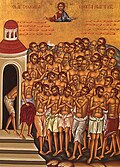 Forty Martyrs of SebasteHoly Martyrs · Soldiers of the Twelfth LegionMar 9
 Bruno of QuerfurtHieromartyr · Missionary ArchbishopMar 9
 Pacian of BarcelonaSaint · Bishop of BarcelonaMar 9
 Caesarius of NazianzusSaint · Brother of Gregory the TheologianMar 9
- Urpasianus of NicomediaMartyrMar 9
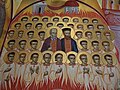 The 42 Martyrs of MomišićiHoly New MartyrsMar 9
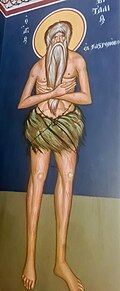 Vitalis of CastronovoVenerable · Hermit and abbot in southern ItalyMar 9
- Aetius of SebasteMartyrMar 9
- Aglaius of SebasteMartyrMar 9
- Alexander of SebasteMartyrMar 9
- Alexandra SamoylovaVenerable MartyrMar 9
- Alexis SmirnovHieromartyrMar 9