Martyr
Laodicius of Heraclea
A martyr of Heraclea, who died in 177.
Life
Holy Martyr Laodicius of Heraclea was the jailer of the holy martyr Glyceria and died a martyr's death with her around the year 177. The Azbyka page honours both, the virgin Glyceria and Laodicius, the prison guard.
Saint Glyceria suffered for the faith of Christ in the second century, in the persecution of the emperor Antoninus (138-161). She was of noble birth, and her father, Macarius, had been governor of the city of Rome and later moved to Trajanopolis in Thrace. She lost her father and mother early, drew near to the Christians, turned to the true faith and came to church daily. The governor of Trajanopolis, Sabinus, receiving the imperial command to force Christians to sacrifice to idols, appointed a day of general worship of the idol Zeus. Glyceria resolved firmly to suffer for Christ, told the Christians of her intention and asked them to pray that the Lord would give her strength. On the day of the feast of Zeus, signing her forehead with the sign of the Cross, she went into the shrine, stood on a raised place in the rays of the sun, took the veil from her head and showed all the holy cross traced on her forehead. She prayed fervently to God to enlighten the pagans and shatter the stone idol of Zeus. Suddenly thunder was heard, the statue of Zeus fell to the floor and broke into pieces.
In fury Sabinus and the priests ordered the people to stone her, but the stones did not touch her. They shut her in prison, where the Christian priest Philocrates came to her and strengthened her for the struggle before her. In the morning, when the tortures began, an angel suddenly appeared among the tormentors, who fell to the ground seized with terror. When the vision vanished, Sabinus, who had barely recovered his speech, ordered her taken again to prison, whose door he locked and sealed with his own ring, that none might reach her. All the time of her imprisonment angels of God brought Glyceria food and drink. After many days Sabinus came to the prison and broke the seal himself and, entering, was amazed to see her alive and well. Going to the city of Heraclea, he commanded that she be brought there too. The Christians of Heraclea came out to meet her, led by Bishop Dometius, who offered before all a prayer to the Lord to strengthen her in martyrdom. At Heraclea Glyceria was thrown into a furnace heated red-hot because she would not sacrifice to idols, but the fire went out at once. Then the governor, in mad fury, ordered the skin of her head flayed. Then the stripped martyr was thrown into prison on sharp stones; she prayed unceasingly, and at midnight an angel came and healed her wounds.
The jailer Laodicius, who came in the morning for her, did not recognise her at first and, thinking she had escaped, wished to kill himself for fear of punishment, but Saint Glyceria stopped him. Amazed at the miracle, Laodicius believed in the true God and asked her prayers, that he too might suffer and die for Christ with her. "Follow Christ and you will be saved", the glorious martyr answered him. Laodicius put on himself the bonds with which the saint had been bound and, at the trial, told the governor and all present of the wonderful healing of Glyceria by the angel and confessed himself a Christian. The new chosen one of God was at once beheaded. The Christians took his remains in secret and buried them with honour, and Glyceria was given to be torn by beasts. She went out to death with great joy, but the lioness let loose on her crept up humbly and, fawning, licked her feet. At last the saint prayed to the Lord to take her to Himself, and heard a voice from heaven calling her to heavenly blessedness. Then another lioness was loosed on her, which sprang on the martyr and killed her, but did not tear her. Bishop Dometius and the Christians of Heraclea buried Saint Glyceria with honour. She suffered for Christ around the year 177, and her holy relics became famed for the flowing of healing myrrh.
Saint Laodicius is commemorated on 26 May, in the new style. Their passion is also found in the Lives of the Saints by Saint Dimitry of Rostov.
Commemorated the same day May 13
 Servatius of MaastrichtSaint · Bishop of TongerenMay 13
 Euthymius the AthoniteVenerable · Georgian monk on Mount AthosMay 13
 Agnes of PoitiersVenerable · Abbess of the Holy Cross ConventMay 13
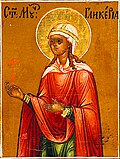 Glyceria of HeracleaMartyr · Virgin of HeracleaMay 13
 Macarius of KanivVenerable Martyr · Archimandrite of KanivMay 13
 MaelVenerable · Hermit on Bardsey IslandMay 13
 Pausicacus of SynadaSaint · Bishop of SynadaMay 13
 Macarius TeleginVenerable Martyr · Hieromonk of Chudov MonasteryMay 13
 Gabriel the IberianVenerable · Monk of Iviron MonasteryMay 13
 Glykeria of NovgorodRighteous · Righteous virginMay 13
 Macarius of GlushitsaVenerableMay 13
- Natalis of MilanSaint · Archbishop of MilanMay 13