Martyr
Laurus of Illyria
Stonemason of Illyria
A stonemason of Illyria, martyred together with his brother Florus for the Christian faith.
Life
Holy Martyr Laurus of Illyria was the brother in flesh and spirit of the holy martyr Florus. The two lived in the second century, at Byzantium, and then moved to Illyria. They were stonemasons by trade, taught by the Christians Proclus and Maximus, from whom they also learned a life pleasing to God.
The governor of Illyria, Lycaon, sent them to a neighbouring region to work on a pagan temple under construction. The saints worked on the building, giving the money they earned to the poor, while they kept a strict fast and prayed unceasingly. Once the son of the local pagan priest, Mamertinus, came carelessly near the building site and a chip of stone struck his eye, injuring it badly. Florus and Laurus reassured the angry father, telling him his son would be healed. They took the young man to themselves and taught him faith in Christ. After the youth confessed Jesus Christ the true God, the brothers prayed for him and the eye was healed. Seeing the miracle, the youth's father too believed in Christ.
When the building of the temple was finished, the brothers gathered the Christians who had helped with the building, shattered the idols and set the holy cross in the eastern part of the temple. All night they spent in prayer, lit by heavenly light. Learning of it, the head of the region sentenced to burning the former priest Mamertinus, his son and three hundred Christians. The martyrs Florus and Laurus, sent to the governor Lycaon, were thrown into an empty well and covered with earth.
After many years the holy relics of the martyrs Florus and Laurus were found incorrupt and moved to Constantinople. In 1200 the Novgorod pilgrim Anthony saw them; around 1350 Stephen of Novgorod saw the heads of the martyrs in the monastery of the Pantocrator. The Menaion for August says that in Russia the holy martyrs Florus and Laurus are honoured as protectors of domestic cattle; this veneration arose in ancient times, and their day was celebrated solemnly throughout the land. According to an oral tradition kept in the Novgorod land, when their relics were found the dying of cattle ceased, and then began their veneration as protectors of horses. This perhaps came from the Balkans, the homeland of the holy brothers, where the tradition arose that Florus and Laurus were taught by the archangel Michael to handle horses. Old Russian icon-painters' manuals say that Florus and Laurus must be painted with the horses they protect, and to this day beautiful icons of them with horses have survived in many churches and museums, in which the subject "The Miracle of Florus and Laurus" is most widespread.
Saint Laurus is commemorated on 31 August, in the new style. The passion of the two brothers is also found in the Lives of the Saints by Saint Dimitry of Rostov.
Commemorated the same day August 18
 Sixtus IIISaint · Bishop of RomeAug 18
 George I of ConstantinopleSaint · Patriarch of ConstantinopleAug 18
 Agapitus of PraenesteMartyr · Martyr of PraenesteAug 18
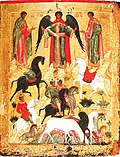 Florus and LaurusHoly MartyrsAug 18
 Sophrony of EssexVenerable · Archimandrite, disciple of SilouanAug 18
- John V of ConstantinopleSaint · Patriarch of ConstantinopleAug 18
 Inan of IrvineSaintAug 18
- Agapius of GalatistaHieromartyr · HieromonkAug 18
- Christopher of TrebizondVenerable · Abbot of Soumela MonasteryAug 18
- Daig of InniskeenSaint · Bishop of Inis-Caoin-DeaghaAug 18
- Aeonius of ArlesSaint · Bishop of ArlesAug 18
- AgonSaintAug 18