Hieromartyr
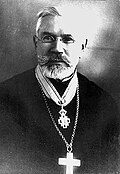
Leo Ershov
A hieromartyr of the Russian Church, who died in 1918.
Life
Holy Hieromartyr Leo Ershov, a priest (1867-1918), was born on 12 February 1867 in the town of Krasnoufimsk, Perm province, in a family of Old Believer merchants. His full name was Leo Evfimievich Ershov. In 1881 he finished the two-class town school and began to trade. Besides this, he had great knowledge of the teaching of the schismatics and enjoyed respect among them, being a learned reader in the Fedoseevan sect. But serious spiritual searching and a desire to find the truth gradually brought him to the conviction that it was precisely the Russian Orthodox Church that preserved apostolic teaching pure. At the age of twenty-seven, on the feast of the Meeting of the Lord, "from sincere personal conviction of the truth, holiness and Orthodoxy of the Greek-Russian Orthodox Church and by his own wish", he was united to the Orthodox Church by the holy mystery of Chrismation.
Two years later, in 1896, Leo Evfimievich was ordained priest and appointed to serve at the Holy Trinity cathedral in Krasnoufimsk. Not long before, he had married Nadezhda Mikhailovna, and between 1897 and 1902 they had three children: a son, Sergius, and daughters Lydia and Helen. In 1901 Father Leo received, "for merits in the church field", the epigonation. Besides his pastoral duties he began to work also in the missionary field: first he became an anti-schism missionary in the Krasnoufimsk and Kungur districts, and in 1904 was appointed diocesan missionary. Being well acquainted with the ideas of the Old Believers and consciously united to Orthodoxy, he carried on missionary work so successfully that he was rewarded with the violet velvet skufia. The general assembly of the Perm diocesan brotherhood of Saint Stephen also offered him "deep thanks for outstanding activity in the missionary field". In 1914, "in view of outstanding missionary activity", he was elected an honorary member of the brotherhood of Saint Stephen and his holy successors Gerasimus, Pitirim and Jonah.
Father Leo's work as a teacher was no less active and successful: for more than ten years he was director of the church school in Krasnoufimsk, for which in 1905 he received an archpastoral blessing with a diploma "for donations to the needs of the Krasnoufimsk church school". For some time he taught religion in this school, in the Cyril and Methodius school of Krasnoufimsk and in the schools of two neighbouring villages. In 1910-1914 he also taught religion at the two-class girls' school in Krasnoufimsk. In 1911 he was appointed a member of the district section of the diocesan school council. In 1910-1913 he was twice elected candidate deputy to the diocesan school congresses. He also held a silver medal on the double Vladimir and Alexander ribbon, in memory of twenty-five years of church schools. Besides his exceptional gifts for mission and teaching, the priest was probably marked by spiritual discernment, for which the clergy of the Perm diocese repeatedly chose him confessor: in 1904 of the first deanery, and in 1910 unanimously of the deanery of Krasnoufimsk. At the wish of the clergy, in the same year he was confirmed a member of the audit commission, and three years later a deputy to the diocesan clergy congresses. For his many-sided activity he received the kamilavka.
The year 1917 came, a turning point in Russian history. At that time Father Leo was a fifty-year-old pastor, known for his activity as a confessor and missionary, his successful teaching and his public work. He had many awards and enjoyed the respect of the clergy and flock of the Perm diocese. Who knows how much benefit this priest might still have brought to the Church of Christ, but within a year his life was cut off: he received a martyr's death at the hands of the Bolsheviks, in the troubled time of the civil war.
In the summer of 1918, besides the fighting in many towns and settlements of the Urals, mass peasant risings against Bolshevik power began in almost all its regions, caused both by the plundering of the peasants by the requisition detachments and the bans on free trade, and by forced mobilisation into units of the Red Army. The Krasnoufimsk district also was not left out of these disturbances, the attitude toward the Bolsheviks there being sharply negative. In the first days of July 1918 the Reds announced the mobilisation of young men born in 1894-1898 in the Krasnoufimsk, Kungur and Osa districts. All the peasants of these districts, except some villages of the Shlyapnikov volost, refused to give soldiers, and in reply an order was issued to shoot mercilessly all who would not obey. In the Krasnoufimsk district mass disturbances began. In the village of Bolshie Klyuchi a military staff was set up and the formation of a People's Army began; in the village of Achit, the political and economic centre of the peasant part of the district, the mobilisation of all men up to forty-five into the People's Army also took place. After Achit, within a few days the rising spread to many other peasant and factory volosts, in essence the whole district. The insurgents moved toward Krasnoufimsk, and six versts from it their first, successful, battle took place. But they lacked weapons, and soon were forced to retreat to Achit, and then to leave it too, the retreat going toward Yekaterinburg.
After the suppression of the rising a wave of reprisals followed. The clergy could not escape arrest either, being usually accused by the Reds of counter-revolutionary agitation for their sermons and talks with parishioners. Father Leo at that time spoke fearlessly against the mass arrests and shootings carried out by the Bolsheviks, and for just this he was arrested. One Sunday, during the service, Red soldiers burst into the church and fired in disorder. They went up to the altar, pushing the worshippers aside. Father Leo promised the soldiers to go with them but asked to be allowed to finish the service. Manfully he completed the last Liturgy of his life and, after the parishioners had kissed the holy cross, set out for the exit. One Red soldier began tearing his pectoral cross from him, another pulling at his beard and beating him. The priest was literally dragged out of the church.
On the porch Father Leo saw the priest of the village of Verkh-Suksun, Alexander Malinovsky, surrounded by Red soldiers. The priests wished to embrace, but this angered the soldiers, who began to strike them on the head with rifle butts. Father Leo and Father Alexander were put in the Krasnoufimsk prison. There survive the memories of a prisoner who was in the same cell with Father Leo and Father Alexander: "I was taken to the local prison... The days went by in the usual prison order: dull, slow and monotonous. Thanks to the courtesy of the prison administration, we enjoyed all possible privileges. Later the head of the prison paid for it all: a few days before my release he was removed and put in with us. In the other 'counter-revolutionary' cells sat the rebel peasants, who lost several of their brethren almost every night. By 1 September these cells were empty. But on the night of 1 September (new style) the Bolshevik haul brought in several dozen men at once, and the cells hummed again. On the night of 2 September, besides [the Socialist-Revolutionary] Vereshchinin and Novgorodtsev, the following men from our cell were also shot: the officers Skornyakov, Vasev and Nikiforov, and two priests, Malinovsky and Ershov. Father Ershov died honourably at his post, having raised his voice against the mass arrests and shootings. On the morning of 2 September we already knew the details of the execution. It turned out that, bringing the condemned out of the cell, they chained them together by twos and threes and shot them outside the town, in the so-called Cold Ravine".
On 24 September, after units of the White Army entered Krasnoufimsk, the two slain priests, Father Leo Ershov and Father Alexander Malinovsky, were buried with honour in the Holy Trinity cathedral, in one wide coffin beside its apse. In 2000 the holy hieromartyr Leo was glorified in the Synaxis of the New Martyrs and Confessors of Russia of the Perm diocese. In 2002 his honourable relics were found, which rested by the north wall of the crypt beside the altar of the Krasnoufimsk cathedral. The priest was of middle height; the wrist joint of his left hand was crushed, his chest and right temple injured, apparently Father Leo was beaten or even tortured before death. There survived locks of grey hair and beard, pieces of vestments gone green from the oxidation of copper threads, a Gospel, a wooden inlaid pectoral cross and a small silver cross worn on the body. Since 5 December 2002 the relics of Father Leo have rested openly in the Holy Trinity cathedral, where a record is kept of the miraculous events and healings that take place through prayers to him and to the holy hieromartyrs Alexander Malinovsky and Alexis Budrin.
Saint Leo is commemorated on 2 September, the day of his death, on 7 February, with the Synaxis of the New Martyrs and Confessors of Russia, on 11 February, with the Synaxis of the Saints of Yekaterinburg, and on 14 February, with the Synaxis of the Saints of the Perm Metropolis (the date moves), in the new style.
Commemorated the same day August 20
 Stephen I of HungaryRight-Believing · King of HungaryAug 20
 SamuelProphet · Prophet and JudgeAug 20
 AmadourVenerable · Hermit of RocamadourAug 20
 Theocharis of NeapolisNew Martyr · New martyr of NeapolisAug 20
 Peter PähkelConfessor · Bishop of Petseri and TartuAug 20
- Heliodorus of Bet ZabdaiHieromartyr · Bishop of Bet ZabdaiAug 20
- 37 Martyrs of PlovdivHoly MartyrsAug 20
- 37 Venerable Martyrs of BizyeHoly Venerable MartyrsAug 20
- Achilles of ThraceMartyrAug 20
- Agathon of ThraceMartyrAug 20
- Alexander GadalinNew MartyrAug 20
- Alexander MalinovskyHieromartyrAug 20