Saint
Leucius of Brindisi
Bishop of Brindisi
Bishop of Brindisi, a native of Alexandria, venerated in both East and West.
Life
Holy Hierarch Leucius of Brindisi, also called Leucius the Confessor, was bishop of Alexandria and of Brundisium (Brindisi) and lived in the fifth century. He was an Alexandrian ascetic raised in the monastery of Saint Hermes. At twenty-five, though he refused out of humility, he was made abbot and received from God the gift of working miracles. He turned three thousand pagans to Christ, driving out a demon in the form of a serpent. Chosen bishop of Alexandria, he escaped a murder plotted by the prefect Saturninus. At God's command he left for Italy, where he baptized the tribune Armaleon with sixty-seven soldiers. At Brundisium, at his prayer a two-year drought ended, which led to the baptism of twenty-seven thousand townspeople. Before death he foretold his end, and his relics became famed for miracles.
Leucius was born in Alexandria of devout parents, Eudicius and Euphrosyne, who gave him the name Eutropius. His mother died when the boy was eleven, and his father received monastic tonsure in the monastery of Saint Hermes and took him with him to the monastery. The boy grew under the spiritual guidance of the abbot Nikitas and the experienced elders of the monastery. He proved very gifted and learned Holy Scripture well. Eutropius grew into a quiet, gentle and obedient boy. When he was eighteen, the abbot Nikitas died. The brethren of the monastery unanimously chose Eutropius abbot, though he had not yet been tonsured a monk. Thinking himself unworthy to guide anyone, Eutropius refused. For seven years the monastery of Saint Hermes remained without an abbot. In those years Eutropius, labouring in monastic struggles, reached a high degree of spiritual life. Once Eudicius with his twenty-five-year-old son Eutropius went to the feast of the Dormition of the Mother of God at the Dormition church, honoured by all, near Alexandria. At the feast was Helius, bishop of Heliopolis, with his clergy, who also visited the monastery governed by the abbot Theodore. In the same monastery the father and son lodged. In the night Eudicius received a revelation of his coming death and that his son would be a bishop and would enlighten with the light of the faith of Christ the city and land of Brundisium in Italy. In this vision Eutropius was foretold a new name, Leucius, which means "The Spirit of the Lord has come upon him". On the day of the feast, in the church of the Mother of God, Bishop Helius heard a voice from heaven blessing Leucius for the archpastoral struggle, commanded the archdeacon to ask those praying who bore this name, and then lovingly blessed Saint Leucius and his father.
The monks of the monastery of Saint Hermes insistently asked the bishop to set Saint Leucius as abbot of the monastery. Though the ascetic, thinking himself unworthy out of humility, refused, in obedience to the bishop he was ordained and made abbot. From that time Saint Leucius intensified his struggles and was granted by God the grace of working miracles and casting out demons. Once a demon, taking the form of a huge serpent, killed many people in a nearby village. The holy ascetic hastened to help the inhabitants and freed them from the devil's power. Seeing this, about three thousand pagans of the region received Baptism.
At that time Philip, bishop of Alexandria, died a martyr's death, and Saint Leucius was chosen in his place. Seeing that Bishop Leucius turned many pagans to Christianity, the prefect Saturninus resolved to kill him. Wishing to defend their archpastor, some Christians wanted to kill the prefect. Learning of it, the hierarch forbade them to do any harm to the prefect. Saint Leucius announced to the flock that the Lord commanded him to go to a pagan land and enlighten with the light of the Christian faith the city of Brundisium and the surrounding country. The holy archpastor set in his place a worthy bishop, took with him the deacons Eusebius and Dionysius and five disciples and hastened to a ship sailing for Italy. On the way the presbyters Leo and Sabinus joined him, and on the road to Brundisium he met the tribune Armaleon with sixty-seven soldiers, whom he turned to Christianity. In the city he began to preach to the people about Jesus Christ. The head of the city, Antiochus, learning that the tribune Armaleon had turned to faith in Christ, summoned him and questioned him at length about the teaching of the Christians. Learning of the hierarch Leucius, the governor wished to see him. At the meeting the governor said: "If you want us to believe in the God you preach, ask Him to send rain on our land, which we have not seen for two years". The saint, gathering the clergy and all the newly baptized Christians, made an earnest prayer, after which abundant rain fell and watered the dry earth. Seeing the miracle, Antiochus and the whole city of Brundisium (twenty-seven thousand people) received holy Baptism. In memory of this event a church in honour of the Mother of God was built in the city, and at the place where the people were baptized, another, dedicated to Saint John the Baptist.
Soon the hierarch fell ill and it was revealed to him that the illness was mortal. Summoning his spiritual son Antiochus, Saint Leucius left a command that he be buried in the place where the ship that brought him from Alexandria had landed. Antiochus fulfilled the archpastor's command and built at that place a church dedicated to Saint Leucius. There the relics of the reposed hierarch were moved, from which many miracles began to be wrought. Saint Leucius is commemorated on 3 July, in the new style. His life is also found in the Lives of the Saints by Saint Dimitry of Rostov.
Commemorated the same day June 20
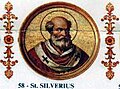 Silverius of RomeSaint · Bishop of RomeJun 20
 Naum of OhridVenerable · Disciple of Cyril and MethodiusJun 20
 Nicholas CabasilasRighteous · Byzantine theologian and mysticJun 20
 Methodius of OlympusHieromartyr · Bishop of OlympusJun 20
 Adalbert of MagdeburgSaint · Archbishop of MagdeburgJun 20
 Callistus I of ConstantinopleSaint · Patriarch of ConstantinopleJun 20
 Florentina of CartagenaVenerableJun 20
 Latuinus of SéesSaint · First bishop of SéesJun 20
 Gleb of VladimirRight-Believing · Prince of VladimirJun 20
 Mina of PolotskSaint · Bishop of PolotskJun 20
 Kallistos AngelikoudesVenerable · Abbot of Katafygi MonasteryJun 20
- HectorSaintJun 20