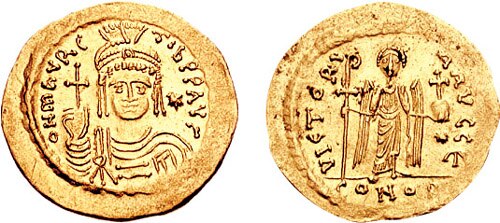
Right-Believing
Maurice
Byzantine Emperor
Byzantine emperor from 582 to 602, a capable general, killed after an army revolt.
- Feast
- November 28old style December 11
- Reposed
- 6027th century
- Place
- Harbor of Eutropius
Life
Maurice was emperor of Byzantium from 582 to 602, the last of the dynasty of Justinian. A capable general, he brought the war with Persia to a victorious peace and fought hard campaigns in the Balkans. He was overthrown by an army revolt and killed on 27 November 602, together with his five younger sons, before his eyes. The Orthodox Church honours him as a martyr, according to a Russian encyclopedia that gives the commemoration on 28 November, but he does not appear on 27 and 28 November in the Greek synaxarion consulted.
Beginnings
He was born in 539 at Arabissus in Cappadocia, the son of Paul, a man of rank in the senate. He had a brother, Peter, and two sisters, Theoctista and Gordia. The sources do not agree on his people: some take him for a Cappadocian Greek, others for an Italian, others for an Armenian. He came to Constantinople as a notary and served under Tiberius, the future emperor Tiberius II. In late 577, with little experience of war, he was named commander of the army of the East and received the rank of patrician.
On the Persian front he crossed the Tigris, took fortresses and launched a great expedition toward Ctesiphon, the Persian capital, which did not reach its goal. In 582 Tiberius II, on his deathbed, named him caesar and then crowned him emperor on 13 August. Tiberius died on 14 August, and Maurice, who married his daughter Constantina in the autumn, remained sole emperor.
His reign
He inherited an empire without money, with war in the East, a heavy tribute of 80,000 gold solidi a year paid to the Avars, and Slavs laying waste the Balkan provinces. In the East his troops won at Solachon in 586 and at Martyropolis in 588. In 590 the Persians overthrew their king Hormizd IV, and his son Khosrow II fled to Byzantium. Maurice, though the Senate advised against it, helped him with an army and set him on the throne, and in 591 the Byzantine and Persian army defeated the usurper Bahram. In return, Khosrow gave Byzantium part of Armenia with large cities, and Byzantium no longer paid tribute to the Persians, for the first time in nearly two centuries. Some sources say that the bishops failed to bring Khosrow to Christianity.
From 591 Maurice turned to the Balkans. In 592 Singidunum (modern Belgrade) was retaken, and in 593 the general Priscus defeated Slavs, Avars and Gepids south of the Danube. The Byzantine army crossed the Danube into the lands of present-day Wallachia, something not seen in an emperor for more than two centuries. Further victories followed in 599 and 601, and in 602 the Slavs were crushed in Wallachia, so that the Danube could again be held as a frontier.
In the West he founded the exarchates, provinces with wide freedom of action, each ruled by an exarch, the emperor's man: the Exarchate of Italy in 584, to halt the advance of the Lombards, and the Exarchate of Africa in 591. In 597, ill, he wrote his will, laying out that his sons should rule parts of the empire. In matters of faith he upheld the Council of Chalcedon but was tolerant toward the Monophysites. He is also said to have quarrelled with Pope Gregory I over the defence of Rome against the Lombards. The military manual Strategikon is attributed to him by tradition, though some historians credit his brother or another general.
The fall
Money troubles made him unpopular. In 588 he announced a cut of a quarter in soldiers' pay, which caused a serious mutiny, and in 599 or 600 he refused to pay a small ransom for 12,000 soldiers taken by the Avars, who were then killed. In the autumn of 602 he ordered the army on the Danube to winter across the river, on Slav land. The exhausted soldiers rebelled and raised an officer, Phocas, as leader, then marched on Constantinople, demanding that Maurice stand down and that his son Theodosius or Germanus take his place.
On the night of 22 November Maurice fled with his family on a warship toward Nicomedia. Phocas was crowned on 23 November and entered the city with everyone's support. Maurice was seized and brought to the harbour of Eutropius at Chalcedon. He was forced to watch his five younger sons executed, and then he was beheaded, on 27 November 602. His brother and relatives perished with him. His wife Constantina and their three daughters were sent to a monastery and, a few years later, killed in the same harbour. The whole family was buried at the monastery of Saint Mamas, founded by his sister Gordia.
Veneration
The oldest legendary account of his end is in the chronicle of Theophanes the Confessor, in the ninth century: Christ is said to have given him the choice between a long reign and death with reception into the Kingdom of heaven, and Maurice chose the second. A Syriac account says that the emperor asked in prayer to receive his punishment in this world and his full reward in heaven. The Syriac account was later adopted by the Orthodox Church, according to one source. A Russian encyclopedia says that the Orthodox Church canonized him as a martyr, with commemoration on 28 November (old style). Since this is a single source, we state it with due caution.
His death opened a time of disaster: the war with Persia, which lasted twenty-six years, exhausted both empires before the Arab conquest.
Commemorated the same day November 28
 Gregory III of RomeSaint · Bishop of RomeNov 28
 SosthenesApostle · Ruler of the synagogue at CorinthNov 28
 Arsenie BocaVenerableNov 28
 Seraphim ChichagovHieromartyr · Metropolitan of the Russian ChurchNov 28
 Stephen the YoungerVenerable Martyr · Confessor of the holy iconsNov 28
 Theodore of SimonovSaint · Archbishop of RostovNov 28
 Fifteen Martyrs of TiberiopolisMartyrNov 28
 Nikolai KrylovHieromartyr · ArchpriestNov 28
- Alexis SenkevichHieromartyrNov 28
- Alexis SmirnovHieromartyrNov 28
- Anisia MaslanovaMartyrNov 28
- AnnaMartyrNov 28