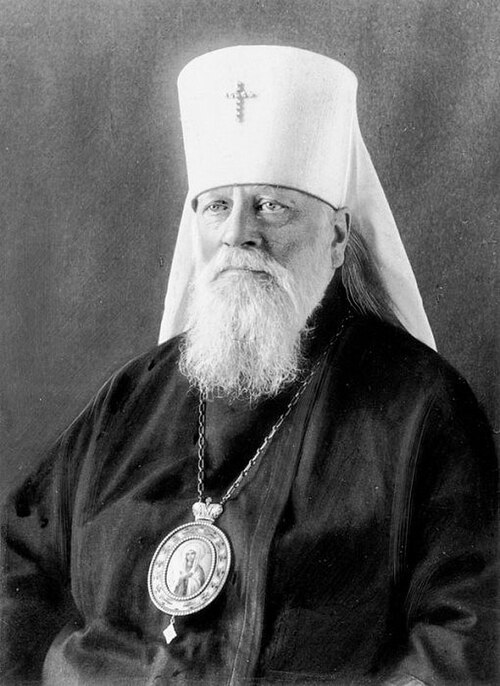
Hieromartyr
Seraphim Chichagov
Metropolitan of the Russian Church
Metropolitan of the Russian Church, born Leonid Chichagov, shot at Butovo in 1937 and later canonized.
- Feast
- November 28old style December 11
- Reposed
- 193720th century
- Place
- Butovo firing range
- Order
- Martyrs
Life
Saint Seraphim, hieromartyr (in the world Leonid Mikhailovich Chichagov), born on 9 June (according to other sources 9 January) 1856 in Saint Petersburg, was a metropolitan of the Russian Orthodox Church, shot on 11 December 1937 at the Butovo firing range near Moscow. He was rehabilitated after death and canonized by the Russian Church in 1997 as a New Martyr. He is commemorated on 28 November (11 December), as well as in the Synaxis of the New Martyrs of Butovo and in the Synaxis of the Saints of Diveyevo.
Family and officer He was born in the family of an artillery colonel (according to another source major general), Mikhail Nikiforovich Chichagov, and Maria Nikolaevna, from a minor but well-known noble family from the Kostroma area with a strong military background. His great-grandfather took part in a study of the Arctic Ocean under Catherine II, and his grandfather, Admiral Paul Chichagov, fought in defense of Russia during the French invasion. One source says he never forgot his nobility and placed it at least as high as his archbishopric. He was baptized on 20 October 1856 in the Church of Saint Alexander Nevsky at the Mikhailovsky military school. He finished the gymnasium in 1870 and the Corps of Pages in 1875, with honours, and in 1875 received the rank of sublieutenant. He was assigned to the artillery and fought in the Russo-Turkish War of 1877 to 1878, receiving the Cross of Saint George for courage at the siege of Plevna, the orders of Saint Anna and Saint Stanislaus for battles and the crossing of the Balkan mountains, and a sabre with an inscription from the emperor. He was then lieutenant in the guards, from 1881 staff captain.
After the war of 1878 he returned to Saint Petersburg, where he met John of Kronstadt, a well-known and highly respected minister, who became his spiritual guide. On 8 April 1879 he married Natalia Dokhturova, daughter of General Dmitry Dokhturov, and they had four daughters: Vera, Natalia, Leonida and Ekaterina. In 1881 he was sent to France, to the manoeuvres of the French army, and studied French artillery, receiving the Legion of Honour. He also received the Romanian Iron Cross, the Bulgarian Order of Saint Alexander and the Montenegrin Order of Prince Danilo I, took part in arming the fortresses on the western border and in equipping the Bulgarian army and published memoirs of the stay of Emperor Alexander II in the Danube army. The war marked him deeply: he studied medicine at graduate level, to care better for the wounded, and did pioneering research on treating wounds with substances from plants, writing the work "Medical Conversations". He began to be interested in theology and studied on his own, then decided to leave his career and devote his life to the Church. His wife did not at first accept the decision, but was persuaded after a long conversation with John of Kronstadt.
The priest He submitted his resignation from the army on 15 April 1890 or 1891 and moved with his family to Moscow, where he began his church studies. He was ordained deacon on 26 February 1893 in the Church of the Twelve Apostles in the Kremlin and two days later priest. He restored the dilapidated church at his own expense, 15,000 rubles, for which Metropolitan Sergius of Moscow gave him the right to wear the nabedrennik and the skufia. His wife died after a serious illness in 1895. In 1896 he was appointed military chaplain for the artillery troops of the Moscow garrison, at the church of Saint Nicholas in Vagankovo, which had stood closed for thirty years and which he also restored with his own means. For his war memoirs he was rewarded with the Bulgarian Order of Saint Alexander and the Greek Order of the Saviour.
He made several pilgrimages to Diveyevo and to Sarov. There he wrote a history of the Sarov monastery and a life of the monk Seraphim of Sarov, from the accounts of nuns who had known him, a work which helped the canonization of Saint Seraphim in 1903. The Chronicle of the Seraphim-Diveyevo Monastery appeared in its first edition in 1896. Natalia Chichagova was buried at Diveyevo, beside an empty grave intended for Father Chichagov.
After his wife's death he became a monk at the Trinity Lavra of Saint Sergius and received the name Seraphim. He was then abbot and archimandrite of the Monastery of Saint Euthymius at Suzdal, then of the New Jerusalem Monastery near Moscow. In 1905 he was appointed bishop of Sukhumi, then, according to Ukrainian sources, of Orel and Sevsk, of Tver and Kashin and of Kishinev and Khotin. In 1928 he became metropolitan of Petrograd (Leningrad), until 1933, when he retired because of age and health.
Kishinev In 1908 to 1914 he was bishop of Kishinev and Khotin. He began several church building projects and promoted religious education. His activity in Bessarabia was also a cause of controversy, tied to the Russification policy of the tsarist authorities: according to the Romanian source, he took repressive measures against Romanian manifestations, burning in the courtyard of the diocesan palace the library of hieromonk Gurie Grosu, who edited the review "Luminătorul", forbade services in Romanian, dismissed or moved outside the governorate Romanian priests and supported the idea that Moldovans are a people distinct from Romanians. These policies had unwelcome effects on the national identity of the Bessarabian Romanians. The same source says he was supported by the Bessarabian branch of the Black Hundreds; in 1909 he was elected honorary president of the Akkerman district branch of the Union of the Russian People. He was a member of the commission for building the monument to Alexander I at Kishinev, in 1911.
Arrest and death In 1937, four years after his retirement, he was arrested and charged with monarchist propaganda. He was sentenced to death by firing squad and executed on 11 December 1937 at the Butovo firing range. The Russian Church canonized him in 1997 as a New Martyr.
Commemorated the same day November 28
 Gregory III of RomeSaint · Bishop of RomeNov 28
 MauriceRight-Believing · Byzantine EmperorNov 28
 SosthenesApostle · Ruler of the synagogue at CorinthNov 28
 Arsenie BocaVenerableNov 28
 Stephen the YoungerVenerable Martyr · Confessor of the holy iconsNov 28
 Theodore of SimonovSaint · Archbishop of RostovNov 28
 Fifteen Martyrs of TiberiopolisMartyrNov 28
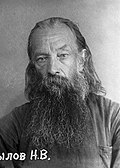 Nikolai KrylovHieromartyr · ArchpriestNov 28
- Alexis SenkevichHieromartyrNov 28
- Alexis SmirnovHieromartyrNov 28
- Anisia MaslanovaMartyrNov 28
- AnnaMartyrNov 28