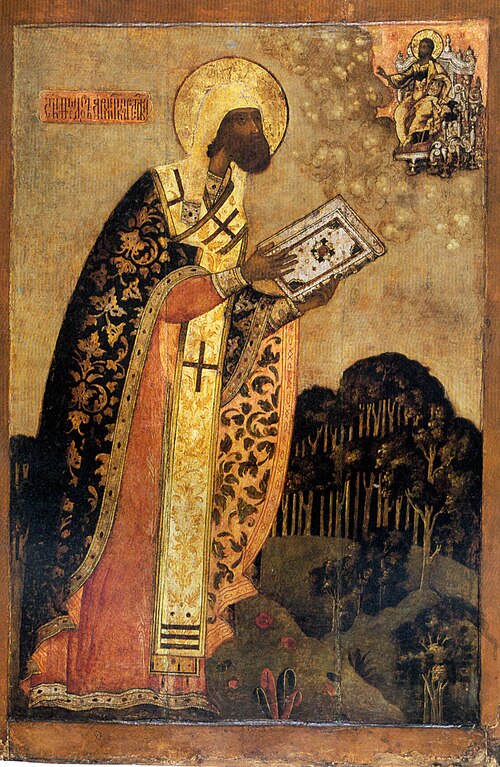
Saint
Theodore of Simonov
Archbishop of Rostov
Disciple of Saint Sergius, founder of the Simonov Monastery and later Archbishop of Rostov, who died in 1394.
- Feast
- November 28old style December 11
- Reposed
- 139414th century
- Order
- Hierarchs
Life
Saint Theodore of Simonov, Hierarch, was a disciple of Venerable Sergius of Radonezh, founder and first abbot of the Simonov monastery in Moscow and later Archbishop of Rostov. Born around 1340, he fell asleep on 28 November 1394. A man of letters, translator and icon painter, he is venerated in the synaxes of the saints of Moscow, of Radonezh and of Rostov. He is commemorated on 28 November.
Childhood and calling
He was born into the family of Stephen, elder brother of Saint Sergius of Radonezh, of the boyars of Rostov; his grandfather was an influential man at the court of Prince Andrei of Radonezh, and his father was confessor of Grand Prince Simeon the Proud. Losing his mother early, John was raised by his uncle Sergius, and at twelve, coming with his father, by then a monk, on a visit to Sergius, he was tonsured by him a monk with the name Theodore on 20 April, the day of Saint Theodore Trichinas; by the custom of the time a monk received the name of the saint of the day of tonsure. He began the monastic life at the Trinity-Sergius Lavra, under Sergius's guidance, living in abstinence, purity and prayer, at services, reading Scripture, and he learned Greek, practised icon painting and read much. After ordination as priest, it is said that, as he was serving the Liturgy with Sergius and Fr Stephen, some monks saw an angel of God serving with them.
Abbot of Simonov
He often prayed at night, and in one of his prayers he heard a voice: "Theodore, go into the wilderness; you will found a monastery, you will gather in it many ascetics and you will have great reward in heaven." With the blessing of Sergius and Metropolitan Alexis, in 1370 he founded a monastery dedicated to the Nativity of the Mother of God in the village of Simonovo near Moscow, on land given by the boyar Stephen Vasilievich Khovrin, who became a monk and received the name Simon, hence the monastery was called Simonov. Gathering many monks, he established a strict communal life, and Metropolitan Alexis named him abbot. Since the highway passed by the monastery and guests disturbed the quiet, in 1379 Theodore moved the monastery to a more suitable place, called New Simonov, dedicated to the Dormition of the Mother of God. There Venerable Cyril and Ferapont of Beloozero were tonsured.
In 1374 he met Cyprian, envoy of Patriarch Philotheus of Constantinople, a future metropolitan of Russia, with whom he stayed, like his teacher Sergius, a friend. In the political struggle around the metropolitan throne he steadily supported Cyprian, to whom he and Sergius wrote in the time of his unsuccessful attempts to reach Moscow. After the battle of Kulikovo he became confessor of Grand Prince Dimitry, in place of Mityai, Cyprian's opponent. In February 1381 he left at the head of an embassy to Kyiv, to call his friend Cyprian, driven out of Moscow in 1378, to the metropolis of Russia. Cyprian was driven out a second time in autumn 1382, and his place was taken by Pimen, placed at Constantinople in place of Mityai. Theodore, with Bishop Dionysius of Nizhny Novgorod, began the struggle against Pimen, with whom the grand prince too was dissatisfied, and in June 1383 he left with Dionysius for Constantinople, with a letter of condemnation of Pimen. Dionysius returned with patriarchal support, and Theodore stayed at Constantinople until the end of 1384; he returned with the rank of archimandrite and "first presbyter", and his monastery became a patriarchal stauropegion, that is, directly subordinate to the patriarch.
The troubles continued: Dionysius was detained at Kyiv by Prince Vladimir Olgerdovich and died there, and Pimen left again for Constantinople. In 1387 Theodore went there to testify against Pimen, hoping to find Cyprian; but he was in Lithuania, and the trial dragged on. The former enemies, Theodore and Pimen, came to terms and fled the capital by a long road, through Asia held by the Turks; the synod condemned both in absentia. On this journey, returning to Russia in 1388, Pimen made Theodore Archbishop of Rostov, thus raising the rank of the diocese. Learning in 1389 of the death of Patriarch Nilus, who had deposed him, Pimen set out again, and in Russia bishops met him; three of them, among them Theodore, accompanied him. At Tana the Genoese demanded from Pimen a debt and took a large sum, practically robbing the embassy, and at Caffa, through Pimen's intrigues, Theodore was robbed and thrown into prison. Released, he reached Constantinople and there, with Cyprian, testified against Pimen. Pimen was finally deposed, and Cyprian was restored. On 6 March 1390 Cyprian and the bishops with him, among them Theodore of Rostov, reached Moscow and were received solemnly by Grand Prince Vasily Dimitrievich.
Archbishop of Rostov
Returning from his third journey to Constantinople, he retired to his diocese, very extensive. His short episcopate left a bright memory, and his early canonization, in the fifteenth century, shows the wide veneration he enjoyed at Rostov. There is sure testimony that for a time he was deprived of episcopal rank: at one canon translated by him is written that it was rendered into Russian by one "cast out of the Church, from the episcopal person, named Theodore, though unworthy, a presbyter". It is supposed that this refers to his deposition by Pimen after the conflict on the road to Constantinople; no other documents are known. At Rostov he founded the convent of the Nativity of the Mother of God and painted the icon of the Mother of God for it himself. According to some sources, the archbishop was consecrated at Constantinople in 1387, and at his death his diocese included Rostov, Yaroslavl, Beloozero, Veliky Ustyug, Uglich and Mologa.
He fell asleep on 28 November 1394 and was buried in the Dormition cathedral at Rostov, in the south-west corner, where his relics lie. He was venerated as hierarch already in the fifteenth century, but in the nineteenth century his veneration throughout the Church ceased, for unknown reasons, and was resumed only in 1912. His first life has not survived; Epiphanius the Wise intended to write it, but it is not known whether he did. The oldest known life is of 1723.
Works
No original texts of his have been found, but he certainly wrote letters to Cyprian and took part in composing the condemnation of Pimen. His work as translator, on the other hand, is proved by many copies of canons translated by him, above all by Philotheus Kokkinos: the canon to the Mother of God for drought, with acrostic, the canon of the Dormition, the canon for famine, a prayer for drought and Philotheus's prayers "at baptism", as well as the order of the lesser blessing of water and the supplicatory canon to the Mother of God of John of Euchaita. He was also a notable icon painter: known are the icons "Deesis at Bolvanovka" and the image of Venerable Sergius of Radonezh.
Commemorated the same day November 28
 Gregory III of RomeSaint · Bishop of RomeNov 28
 MauriceRight-Believing · Byzantine EmperorNov 28
 SosthenesApostle · Ruler of the synagogue at CorinthNov 28
 Arsenie BocaVenerableNov 28
 Seraphim ChichagovHieromartyr · Metropolitan of the Russian ChurchNov 28
 Stephen the YoungerVenerable Martyr · Confessor of the holy iconsNov 28
 Fifteen Martyrs of TiberiopolisMartyrNov 28
 Nikolai KrylovHieromartyr · ArchpriestNov 28
- Alexis SenkevichHieromartyrNov 28
- Alexis SmirnovHieromartyrNov 28
- Anisia MaslanovaMartyrNov 28
- AnnaMartyrNov 28