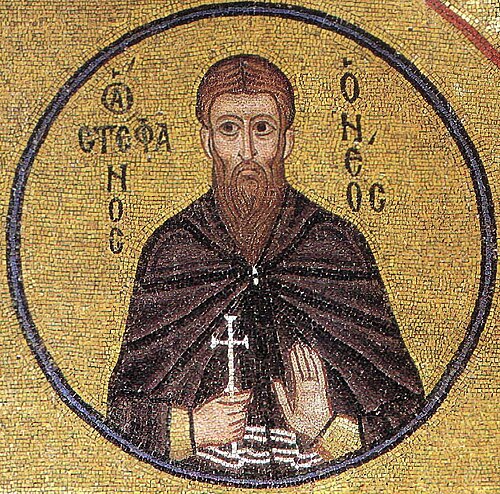
Venerable Martyr
Stephen the Younger
Confessor of the holy icons
Monk of Constantinople, a leading opponent of the iconoclast policy, died in 764 or 765.
- Feast
- November 28old style December 11
- Reposed
- 7648th century
- Place
- Constantinople
- Order
- Martyrs
Life
Saint Stephen the Younger was a monk from Constantinople, an ascetic on Mount Auxentius in Bithynia, and the chief defender of the holy icons in the time of the iconoclast emperor Constantine V. He was killed in 764 or 765 and is the most prominent martyr of the iconodules. His life, written by a disciple, is an important historical source. He is commemorated on 28 November.
Childhood and monastic life
He was born in Constantinople in 713 or, according to his Life, shortly after 11 August 715. His father, Gregory, was a craftsman, his mother was called Anna, and he had two older sisters, Theodote and another, unnamed. His parents were pious and loved the poor, and before his birth they had promised the Mother of God to dedicate him to God's service. On Holy Saturday 716 he was baptized in Hagia Sophia by Patriarch Germanus himself. The parents wished to flee the city because of persecution, but waited for their son to grow. In his sixteenth year, around 731, they brought him to Mount Auxentius in Bithynia, where he became a monk. After his father's death he came to Constantinople and brought his mother and sisters to the convent on the mountain. In his thirty-first year (743 or 746) his mentor, John, died, and he succeeded him, founding a monastery. In his forty-second year (754 or 757) he retired as a hermit into a cave. Many Orthodox Christians fled persecution to Mount Auxentius and took refuge with him, and he comforted them and taught them to stand firm in the faith, not fearing to shed their blood for the icons.
Resistance to iconoclasm
In 754 the emperor Constantine V, called by the insulting name Copronymus, gathered an iconoclast council at Hieria, near Constantinople, with 338 bishops and no patriarch. Stephen refused to accept the council's decisions. His persecution, however, began only around 760: he was accused of shameful relations with his mother and of the illegal tonsure of George Synkletos, a favourite of the emperor. Some modern scholars do not accept the usual story that the persecution of monks came from their defending the icons, and suppose that the emperor's policy against monasticism had military and financial reasons, since monasteries paid no taxes and monks were exempt from military service. For this reason the persecution of Stephen may have had more to do with his popularity and his strong advocacy of monasticism.
Constantine sent soldiers who arrested him and took him to a monastery in Chrysopolis, where again he refused to accept the decisions of Hieria. He was exiled to the island of Prokonnesos, and in the second year of his exile (around 764) he was brought to the Phiale prison in Constantinople and questioned by the emperor himself. After almost a year in prison, in the praetorium, he was condemned to death and dragged by soldiers through the streets, where he was clubbed to death. His body was dragged through the streets, while his skull, rescued by a disciple, was taken to the Dius Monastery. One of our sources says that he suffered on 28 November, in his fifty-third year.
Relics and veneration
His relics are attested in various churches and monasteries of Constantinople in the thirteenth to fifteenth centuries: the body at the Lips Monastery (according to Russian travellers) or in the martyrion of Saint Stephen the Protomartyr, the right hand at the Pantokrator, and the skull, which was the object of a procession on his feast day, was in the fourteenth century at the Peribleptos Monastery and is said today to be at Saint Panteleimon Monastery on Mount Athos. He is depicted holding an icon or a diptych with Christ and the Mother of God, and is among the witnesses in the icon of the Triumph of Orthodoxy.
Commemorated the same day November 28
 Gregory III of RomeSaint · Bishop of RomeNov 28
 MauriceRight-Believing · Byzantine EmperorNov 28
 SosthenesApostle · Ruler of the synagogue at CorinthNov 28
 Arsenie BocaVenerableNov 28
 Seraphim ChichagovHieromartyr · Metropolitan of the Russian ChurchNov 28
 Theodore of SimonovSaint · Archbishop of RostovNov 28
 Fifteen Martyrs of TiberiopolisMartyrNov 28
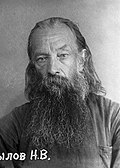 Nikolai KrylovHieromartyr · ArchpriestNov 28
- Alexis SenkevichHieromartyrNov 28
- Alexis SmirnovHieromartyrNov 28
- Anisia MaslanovaMartyrNov 28
- AnnaMartyrNov 28