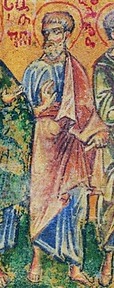
Apostle
Sosthenes
Ruler of the synagogue at Corinth
Ruler of the synagogue at Corinth, beaten by the mob before Gallio, counted among the Seventy Apostles.
- Feast
- November 28old style December 11
- Reposed
- 1001st century
- Place
- Seventy
- Order
- Apostles
Life
Saint Sosthenes the Apostle was, according to the Acts of the Apostles, the ruler of the synagogue at Corinth, and in the tradition of the Church he is counted among the Seventy Apostles of the Lord. Paul calls him brother and names him together with himself in the greeting of the First Epistle to the Corinthians. According to tradition he became bishop of the city of Colophon in Asia Minor. His name means safe in strength.
In the Acts of the Apostles Paul came to Corinth on his second missionary journey and lived first with Aquila and Priscilla, then with a God-fearing man named Justus, whose house was next to the synagogue. Crispus, the ruler of the synagogue, believed in the Lord with all his house, and many Corinthians believed and were baptized. Paul remained in the city a year and a half. When the Jews brought him before the judgment seat of the proconsul Gallio, who refused to rule in a quarrel about teaching and law, the crowd seized Sosthenes, the ruler of the synagogue, and beat him in front of the tribunal, and Gallio paid no attention to it.
The reason for the blows is not given. Some manuscripts say the crowd was made up of Greeks, others of Jews. Commentators give different explanations: some think the pagans vented on him their anger against the Jews, since he had led the Jews to the proconsul; others, among them Saint John Chrysostom, Theodoret and Oecumenius, believe that the Jews themselves beat him, suspecting him of being a secret friend of Paul.
Companion of Paul Some historians, beginning with Eusebius of Caesarea, identify the Sosthenes of Acts with Sosthenes the brother, a convert to the Christian faith and co-author of the First Epistle to the Corinthians. Many commentators, among them Theodoret, accept this identification, others reject it, and the name was very common. It has also been suggested that Sosthenes was a later name of Crispus, but that has no support. According to some sources, when Paul left Corinth Sosthenes followed him, fearing new insults, and lived with him at Ephesus, from where the apostle wrote the first epistle to the Corinthians, about the year 55.
Bishop and veneration His name appears in the lists of the Seventy, in Pseudo-Dorotheus and in the Menaion of Saint Demetrius of Rostov, where it is said that, turned to the faith by Paul, he became bishop at Colophon. Eusebius writes that he was one of the Seventy, but it is unlikely that a disciple chosen by the Lord himself would, twenty years or more later, be ruler of a synagogue; for this reason some think that the Sosthenes mentioned by Eusebius was a different person. It is not known when or how he departed this life. A considerable part of his relics is at the Russian monastery of Saint Panteleimon on Mount Athos.
The Orthodox Church commemorates him on 8 December, together with Saint Apollos and others, and on 4 January, in the Synaxis of the Seventy Apostles. The Roman Catholic Church commemorates him on 28 November.
Commemorated the same day November 28
 Gregory III of RomeSaint · Bishop of RomeNov 28
 MauriceRight-Believing · Byzantine EmperorNov 28
 Arsenie BocaVenerableNov 28
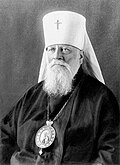 Seraphim ChichagovHieromartyr · Metropolitan of the Russian ChurchNov 28
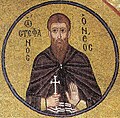 Stephen the YoungerVenerable Martyr · Confessor of the holy iconsNov 28
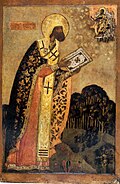 Theodore of SimonovSaint · Archbishop of RostovNov 28
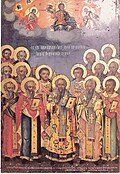 Fifteen Martyrs of TiberiopolisMartyrNov 28
 Nikolai KrylovHieromartyr · ArchpriestNov 28
- Alexis SenkevichHieromartyrNov 28
- Alexis SmirnovHieromartyrNov 28
- Anisia MaslanovaMartyrNov 28
- AnnaMartyrNov 28