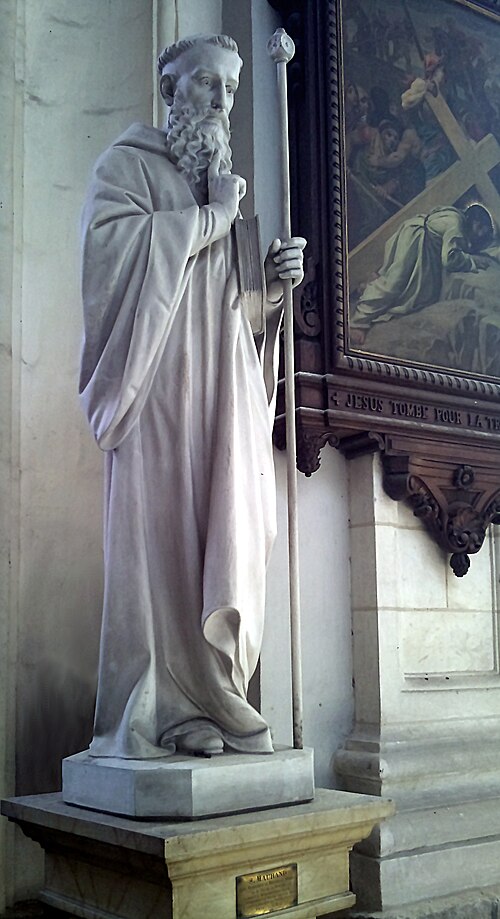
Venerable
Maurontius of Douai
An abbot at Douai, son of Saints Adalbald and Rictrude, reposed in 701.
- Feast
- May 5old style May 18
- Reposed
- 7018th century
- Place
- Douai
- Order
- Venerables
Life
Saint Maurontius of Douai (Maurontus, Mauront) was a nobleman and Benedictine abbot, the son of Saints Adalbald and Rictrude, and reposed on 5 May 701 or 702. He is the patron of the city of Douai and is commemorated on 5 May.
He was born in 634 and baptized by the hermit Richarius, a friend of the family. As the eldest son of Adalbald of Ostrevent he spent his youth at the court of King Clovis II. After his father's death in 652 he became lord of Douai and of other large estates. He had come back to Flanders to settle his affairs and to marry a rich young woman, but a sermon of Saint Amandus, abbot of Elnon, on the vanity and dangers of the world, made him reconsider. He entered the monastery of Marchiennes, founded by his parents, and received the tonsure from Abbot Amandus. After some years he was made deacon and prior of Hamage, a house founded by his relative Gertrude. He then built himself a new monastery, Breuil, on his estate of Merville, and was chosen its first abbot. Amandus resigned his abbacy of Marchiennes to him, and Maurontius lived under his obedience, but had to resume the charge at the holy bishop's death in 690. His sister Clotsinda was abbess of the nuns in the same double monastery. He died in the seventy-second year of his age.
Toward the end of the ninth century, after Merville had been plundered by the Danes or Normans, King Charles the Simple moved the community to the church of Our Lady at Douai, founded by Archenald, Maurontius's uncle. His body, together with that of Saint Amandus, was brought there and is enshrined in the church of Saint Amatus. Maurontius is styled sometimes deacon and sometimes abbot, which suggests he was never ordained priest. His skull is kept in the abbey of Saint-Ghislain in Hainaut, and particles of his relics are shown at Arras and in other churches. What we know of him comes from the Life of Rictrude, written in 907 by Hucbald.
Commemorated the same day May 5
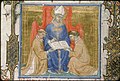 Hilary of ArlesSaint · Bishop of ArlesMay 5
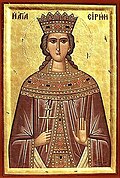 Irene of MacedoniaGreat Martyr · Great Martyr of MacedoniaMay 5
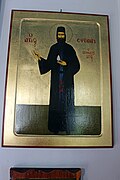 Ephraim of Nea MakriVenerable Martyr · Monk martyr of AtticaMay 5
 Irene of ThessalonicaMartyr · Martyr of ThessalonicaMay 5
- Maximus III of JerusalemSaint · Bishop of JerusalemMay 5
 Adrian of MonzaVenerable · Founder of the Monza River monasteryMay 5
- LannoMartyrMay 5
- Matrona of HureziVenerable · Abbess of Hurezi MonasteryMay 5
- Gideon of SerpukhovVenerable · MonkMay 5
- Euthymius of MadytosSaint · Bishop of MadytosMay 5
- Amador, Pedro and Luis of MartosHoly MartyrsMay 5
- Amator of CórdobaHieromartyrMay 5