Hieromartyr
Michael Voskresensky
Cleric martyred for the faith of Christ.
Life
Holy Hieromartyr Michael Voskresensky, a priest, was born in 1883 in the village of Teply Stan, to the police officer Grigory Dmitrievich Voskresensky. His grandfather had been rector in the village of Poretskoe and a teacher of religion; the future father-in-law of Father Michael, Ivan Danilovich, had studied with him. After his death the grandfather appeared to him, and Ivan Danilovich took this as a special sign, so that years later, when the grandson, Michael, asked for his daughter Maria as wife, he agreed without hesitation. Father Michael served in the village of Bortsurmany from 1910. The parishioners loved him for his goodness, piety and flawless fulfilment of his pastoral duties.
Then came the year 1917, the beginning of open persecution of the Church. In half a year of their cruel rule the Bolsheviks turned the population of the country against them, and uprisings arose everywhere. In the summer of 1918 a group of Kolchak's troops was retreating along the river Sura, and the inhabitants of the town of Kurmysh rose, either to free themselves from Bolshevik captivity or to join the retreating troops. The uprising was led by the director of the local bank, Soverin. The townsfolk disarmed the company of Red soldiers stationed in the town. The punitive detachment sent to suppress the resistance consisted almost wholly of Latvians, headed by a certain Garin, of a noble family of Nizhny Novgorod province. Wherever he passed, priests were tortured and killed.
A rumour ran through Bortsurmany that the punishers would destroy everyone. The voice of the bell spread like a summons, like a funeral knell: it was rung by a peasant nicknamed Yelenya, who knew how and loved to ring. The bell was a special one, a peasants' bell, cast with their money, brought by themselves, harnessing themselves to the traces so as not to entrust the church's work to dumb beasts. Father Michael was not in the village then; he had gone to Kozlovka to give Communion to an old man. The punishers settled on a hill facing the village and turned a gun toward it, intending to burn it. So it would probably have happened, had the postman not fallen into their hands, who said there were no entrenchments. They sent two scouts, who learned from a peasant ploughing peacefully who lived where, and made a whole list. The same night the punishers entered the village and began the arrests.
Late at night Father Michael was returning home. At the edge of the village the punishers barred his way. "Who goes?" "A priest," answered Father Michael. "Let us kill him," he heard. "There is time," answered another, and they let him pass. At the same time other punishers had come to his house to arrest him and, not finding him, had left. Entering the house, the priest understood what lot awaited him, but did not flee. Soon they came to arrest him. The matushka went after them to give him a sheepskin coat for warmth. "He will be warm enough without a coat," they answered. The decision had been taken: all the arrested were to be killed; all night they were beaten, and Father Michael was tortured with special cruelty. He had no guilt, and the tormentors accused him of having ordered the bell rung and of awaiting with joy Kolchak's detachment.
With the priest was arrested the reader Evlampy Pavlovich Nikolaev, a relative of Father Michael, whom he had invited to Bortsurmany, and who now shared with him the martyr's end. Among the peasants Nikolai Migunov and Nikolai Nebasov were arrested. To avoid arousing the inhabitants' anger, the executioners announced that all would be sent to Kurmysh for trial. But the sufferers knew the fate awaiting them and prepared for death, repenting and confessing. On 27 August/9 September, before noon, a column of thirty people, accompanied by the punishers, set out along the Kurmysh road. Father Michael walked in front and sang funeral hymns aloud, and with him the parishioners. They walked five kilometres to a ravine place called Stepanikha. Here all were told to line up in a row, and the executioners stood opposite. Father Michael knelt and prayed to God with hands raised. Not one of the sixteen bullets that struck him could end his life, which was a clear sign of a miracle, and one of the executioners came up and stabbed him in the heart with a bayonet. Of the thirty only Ivan Petrovich Kurepin remained alive, who told the details of the martyr's death of the priest, the reader and the twenty-seven peasants.
After the killing the punishers sent a local man to Bortsurmany to say that they should take the bodies or bury them there. The peasants came with carts and took all of them, and at the place of the killing they set up a cross with an inscription. In the evening all the slain were buried in five common graves. Three of them, the priest Michael, the reader Evlampy and the volost clerk, had no relatives in the village and no coffins had been made for them in time. The holy hieromartyr had for coffin those of his parishioners, on which he was laid and by which he was surrounded. The priest's house was plundered. Soon after her husband's death the matushka wrote to the authorities in Moscow, asking why her husband had been killed, and from Moscow came the answer that he had suffered innocently.
Michael Voskresensky is commemorated on 6 September, in the new style, with the Synaxis of the New Martyrs and Confessors of the Russian Church (a movable day) and, on 12 September, with the Synaxis of the Saints of Nizhny Novgorod (a movable day).
Commemorated the same day August 24
 Ouen of RouenSaint · Bishop of RouenAug 24
 Kosmas the AetolianVenerable Martyr · Missionary and teacher of the GreeksAug 24
 Peter of MoscowSaint · Metropolitan of Kyiv and MoscowAug 24
 Aurea of OstiaMartyr · Patron of OstiaAug 24
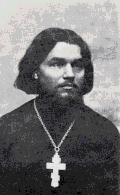 Maxim of GorliceHieromartyr · Priest of GorliceAug 24
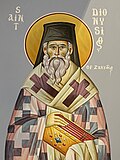 Dionysios of ZakynthosSaint · Archbishop of AeginaAug 24
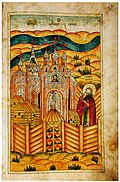 Arsenius of KomelVenerable · Founder of Arseniev Monastery at KomelAug 24
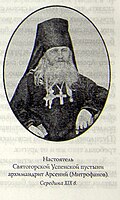 Arsenius of SviatohirskVenerable · Abbot of Sviatohirsk MonasteryAug 24
 Herman of SviatohirskVenerable · Abbot of Sviatohirsk MonasteryAug 24
 Seraphim ShakhmutHieromartyr · ArchimandriteAug 24
 Ptolemaeus of NepiHoly Hieromartyrs · Bishop of NepiAug 24
- Serapion the WonderworkerVenerableAug 24