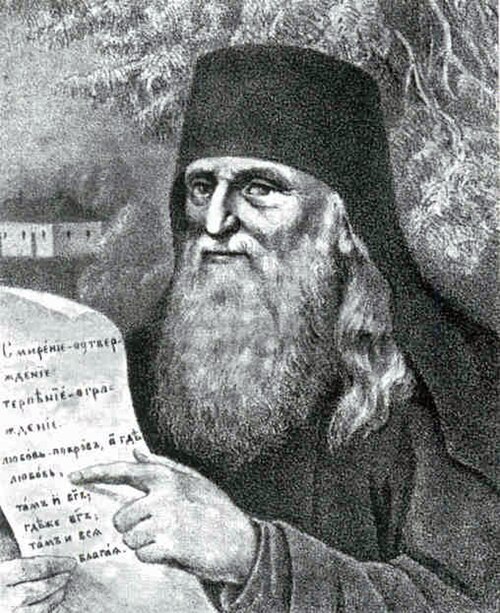
Venerable
Nazarius of Valaam
Venerable monk connected with Valaam and Sarov, venerated as a wonderworker in the Orthodox calendar.
- Feast
- July 28old style August 10
- Reposed
- 180919th century
- Place
- Valaam Monastery
- Order
- Venerables
Life
Venerable Nazarius of Valaam (Kondratiev, and of Sarov), wonderworker, abbot (1735-1809), was born in the world Nikolai Kondratiev in 1735 in the village of Anosovo, Temnikov district, to a family of a sacristan of the church of the Archangel Michael (now Yermish). In 1752 he came to the Sarov Hermitage, in the time of the fifth builder, the hieromonk Isaac, and stayed there three years. His elder was the schema-hieromonk Barlaam, who was in retirement. Seeing the young novice, eager for prayerful solitude and for mastering the monastic way of life, Hegumen Barlaam advised him to go to Father Methodius (1700-1776), archimandrite of the Transfiguration monastery in Astrakhan, known for his struggles and later bishop of Astrakhan. There, at Astrakhan, Nikolai came to maturity both as monk and as future guide. Not without his intermediation close ties were established between the Sarov Hermitage and the monasteries of Astrakhan. On 22 September 1760 the novice Nikolai was tonsured a monk, receiving his name in honour of the martyr Nazarius the Roman; the tonsure was performed in the Protection monastery attached to the bishop's house in Astrakhan by the hieromonk Nikephoros, in the presence of Bishop Methodius. On 22 October of the same year he was ordained hierodeacon by Bishop Methodius. On 8 September 1764 he passed to the Sarov Hermitage.
In 1773 he bore the obedience of priestly service in the church, of the choir and of sewing kamilavkas for the brethren. In 1776 he was ordained hieromonk by Bishop Jerome of Vladimir. In the register it was noted that he performed priestly service, and that because of infirmity he temporarily did the obedience of knitting prayer ropes for the brethren, being unable for other labours. Strict keeping of the monastic rule was always his care. His whole life was a struggle. His soul was so penetrated by thought of divine things that the only subject of his talk was the benefit of the soul. Of the affairs of the world he did not even know how to speak. But if he opened his mouth to speak of struggles against the passions, of love of virtue, his talk was an inexhaustible source of sweetness. His words were straight, direct and sharp; he did not like to begin a conversation without the Word of God as its foundation, and so he taught others, that counsels profitable for the soul should be founded not on their own reason, but on the Word of God. Stern and seemingly unapproachable in look, by his words he drew the hearts of all to love and obedience toward him. Humble himself, he taught humility first of all to everyone who asked for instruction. He passed his life unchanging in fasting and non-possession, in clothes that were hardly more than rags.
On 5 December 1780 "Father Nazarius with companions set out for Moscow", as Bishop Jerome of Vladimir (Formakovsky) wrote. It seems that it was just then that they visited the Solovki monastery. Seeing the desolation of the Anzer skete, Father Nazarius sent the Holy Synod a report in which he described the conditions of life of the Anzer skete and the Solovki monastery and their desolation. At the beginning of 1781, in a letter to the builder of the Sarov Hermitage, the hieromonk Pachomius, Metropolitan Gabriel (Petrov) of Saint Petersburg asked that the hieromonk Nazarius be sent to restore the Valaam monastery and to introduce in it the rule of Sarov. Father Pachomius agreed without great willingness, pointing out among other things the lack of learning of the brethren, and presenting Father Nazarius as a man of little mind and inexperienced in spiritual life. His Grace Gabriel penetrated the secret of Nazarius's humility: "I have plenty of clever ones," he answered. "Send me your fool." So Father Pachomius was forced to let the humble ascetic go. In the same year, 1781, by decree of the Holy Synod, Father Nazarius was summoned to Saint Petersburg, where, at the urging of Metropolitan Gabriel, he was appointed builder of the Valaam monastery to establish in it common life and order by the rule of the Sarov Hermitage.
He introduced the common-life rules at once, on his appointment. In the time of Father Nazarius there arose within the monastery a quadrangle consisting of the stone cathedral, two churches, a sacristy, a refectory and cells. The monastery was put among the monasteries on the state list, and the staff was set at thirty persons; the builder was raised to the rank of hegumen; the emperor Paul granted the monastery the Kyumen fisheries, its chief source of support. By will of Metropolitan Gabriel, Father Nazarius introduced at Valaam the common rule of the Sarov Hermitage and established three kinds of life: coenobitic, schema and desert. The fame of Valaam spread through the Orthodox world; even Athonite monks who came to it looked upon it with wonder, saying that by inner order it stood above the monasteries of Athos.
Father Nazarius had great zeal for the publication of chosen works of the holy Fathers. His companion, Archimandrite Theophanes, had told him much about the great elder Paisius and his translations of the holy Fathers. Later the hieromonk Philaret, a pupil of Sarov, joined them. After Hegumen Nazarius and Father Theophanes were transferred to the diocese of Saint Petersburg in 1781, they made known their plans to Metropolitan Gabriel, who took the warmest part in the work. To obtain the translations of the holy Fathers they wrote in 1780-1782 a letter to Elder Paisius, through Archimandrite Theodosius. When the translation from Greek of the great ascetic book, the Philokalia, was undertaken, Metropolitan Gabriel ordered the learned translators to consult in everything the spiritual elders and pointed first to Father Nazarius. "From experience they understand spiritual truths better than you," said the metropolitan.
In 1801 Father Nazarius asked to be released to rest. At first he withdrew at Valaam to his hermit's cell, to which he had gone earlier too, occupying himself with prayer and handiwork. But circumstances forced him to leave Valaam. On 25 January 1804 Hegumen Nazarius was dismissed from the Valaam monastery at his own request, in which he wrote that he intended to move to the Tambov diocese, to the Sarov monastery. Leaving Valaam, he wished to visit some desert monasteries; meanwhile some acquaintances had praised places suitable and convenient for monastic life near the stanitsas of the Black Sea Cossacks. Over the muddy roads Hegumen Nazarius came to Tikhvin, from where he set out by water, accompanied by the hieromonk Hilarion and the monk Simon. On 12 May 1805 Hegumen Nazarius was at the Nikolaev Black Sea Hermitage.
Returned to Sarov, where he had begun his monastic life, Father Nazarius made himself a hermit's cell in the forest, by the river Sarovka. When he had the strength, at night he walked in the forest reciting twelve psalms from memory and returned to his cell toward dawn. More than once he met bears, which did not touch him and which he did not fear. Many hermits entrusted their thoughts to him. In the Tambov and Nizhny Novgorod region there arose under his guidance many communities of women. Having the gift of foresight, Father Nazarius saw the thoughts and sins of people laid bare. Being a labourer of the prayer of the mind, the elder wrote thus of it: "Let us pray with the spirit, let us pray with the mind also. Enter into the words of the Apostle Paul: 'I would rather speak five words with my mind than ten thousand with a tongue.' I cannot describe how blessed we are that we were found worthy to say these five words. What joy. Lord Jesus Christ, have mercy on me a sinner. Imagine: Lord, Whom am I calling? The Maker, the Creator of all, before Whom all the heavenly powers tremble. Mind and heart to be gathered into one, the eyes to be closed, the eyes of the mind to be raised to the Lord. O sweetest and dearest Lord Jesus Christ, Son of God."
He reposed on 23 February 1809, after the sixth hour in the afternoon, in his cell, on the bank of the river Sarovka. The brethren found him alive, but he could not say a word. His body was buried beside the altar of the warm church, near his spiritual father, the schema-hieromonk Barlaam. In the time of Patriarch Pimen the name of Hegumen Nazarius was entered in the Synaxis of the Saints of Tambov, and by decision of the Holy Synod of 11 May 2004 it was entered in the Synaxis of the Saints of Valaam. He is commemorated on 10 August, with the Synaxis of the Saints of Tambov, on 22 August, with the Synaxis of the Saints of Valaam (a movable day), and on 12 September, with the Synaxis of the Saints of Nizhny Novgorod (a movable day), in the new style.
Commemorated the same day July 28
 Victor ISaint · Bishop of RomeJul 28
 ProchorusApostle · One of the Seven DeaconsJul 28
- ParmenasApostle · One of the Seven DeaconsJul 28
 Irene of ChrysobalantonVenerable · Abbess of Chrysobalanton MonasteryJul 28
- Nicolas the DeaconApostle · One of the Seven DeaconsJul 28
 Paul of XeropotamouVenerable · Athonite asceticJul 28
- Acacius the YoungerMartyrJul 28
 Pitirim of TambovSaint · Bishop of TambovJul 28
- Ardwyne of CepranoSaintJul 28
- Acatius of MiletusMartyr · Martyr of MiletusJul 28
- Anastasia KamaevaVenerable MartyrJul 28
- Anthimus of SaraiHieromartyrJul 28