Hieromartyr
Nicholas Benevolensky
Cleric martyred for the faith of Christ.
Life
Holy Hieromartyr Nicholas Benevolensky was an archpriest at Zagorsk (Sergiev Posad), the nephew of Elder Alexis of Zosima, and he died in the Karaganda camp on 16 May 1941.
Family and calling
He was born on 30 March 1877 in Moscow, in the family of the priest Vladimir Pavlovich Benevolensky and Ekaterina Alexeevna. His father served at the church of Saint Symeon the Stylite, where he had succeeded his father-in-law, the priest Alexei Petrovich Soloviev, father of the future elder, the hieroschemamonk Alexis. Nicholas was the elder's favourite nephew and, while studying at the Moscow Theological Academy, he visited him almost every Sunday. In the summer of 1897 he went with him to choose a place for monastic life; the elder later remembered the quiet of the forest and the Paraclete hermitage on the way, but Providence led him to the Zosima Hermitage in Smolensk. Nicholas kept his love for his uncle, and after the elder's death in 1928 many of his spiritual children came to Father Nicholas.
He finished the theological school in 1892, the Moscow seminary in 1898, and entered the Academy. In 1901 he asked, in a letter full of warmth, to be tonsured a monk, and Metropolitan Vladimir blessed the tonsure. Then he doubted that this path was within his strength and gave it up, though the vows in his heart remained with him. He finished the Academy in 1902 and was sent as a teacher of theology to the seminary in Oryol. In 1909 he married Agnia, the daughter of a Moscow priest, and in the same year was ordained priest for the church of Saint Nicholas in Novaya Sloboda. He understood the priestly vocation above all as service to the believing people, helped the poor materially and asked no payment for services from those in need. From 1917 he was rector of the church of Saint Symeon the Stylite, where his grandfather and father had served, until it was closed; several times he served there with Patriarch Tikhon. He received the pectoral cross in 1921, the rank of archpriest in 1923, the jewelled cross in 1926 and the palitsa in 1929.
Persecution
In 1929 the church of Saint Symeon was closed, and he moved to the church of the Protection of the Mother of God. His family, squeezed into two rooms of an apartment, was taken to court by a worker neighbour and ordered to move out in ten days, so Father Nicholas went to Sergiev Posad, where he found lodging hard, since he walked about in a cassock. In 1932 the family was searched by the OGPU; their daughter Vera went to Moscow to warn her father, who stayed there a week. In 1933 he moved to the Ascension church in Sergiev Posad, and in 1934 he received the mitre. He preached always, paying little heed to the hostility of the authorities, though his wife asked him to refrain. Once, late at night, two strangers asked him to give Communion to a dying woman, and he hesitated, fearing a trap; his wife told him to go, since he carried the Holy Gifts, and he went and gave her Communion.
In 1939 the archpriest Theodore Kazansky, an NKVD informer, was named honorary rector and sent reports on "Alexeevism", a "sect" derived from the elder, and on his nephew. In August 1939 Father Nicholas was summoned to the NKVD and, under the threat of taxes and prison, yielded for a moment and signed a pledge to give information. Going out, he understood fully what he had done, and after a week, with his belongings for prison packed, he went to the meeting place and said he would give no information. He was not arrested then. In October 1939 he moved to the church of Saint Elijah, but Theodore Kazansky kept visiting him and reporting. On 9 January 1940 the arrest warrant was issued.
Arrest and the camp
On 11 January 1940, at six in the morning, NKVD agents came to the house. Father Nicholas was at the service; they let him finish the Liturgy and a funeral service for his children's teacher, and after the search, at three in the afternoon, he blessed those at home with icons and left. He was taken to Moscow, then to the Taganka prison. At the interrogations, which began in the afternoon and ended at night, he admitted regretting the tsar's rule and having criticised Soviet policy on the war with Finland, on schools without religion, and on the closing of churches, but he denied having spoken of overthrowing the authorities. The file was sent to the Special Council because of informers who could not be exposed in court. On 3 June 1940 it sentenced him to five years in a labour camp. He was sent to Kazakhstan, to Karlag, then to the Spassk section, a camp for invalids.
From the camp he wrote ten letters to his family, rare and full of gentleness: about work on the dam and at the vegetable store, about his hunger for the services and his need for salt, onions and a comb, asking everyone's forgiveness. In the last, of 19 April 1941, he wished them a happy Pascha from the hospital. He died on 16 May 1941 in the Spassk section of the Karaganda camp and was buried in an unknown place.
He is remembered on 16 May, on 7 February (a movable day) in the Synaxis of the New Martyrs and Confessors, on 5 September (a movable day) in the Synaxis of the Saints of Moscow, and on 10 December in the Synaxis of the New Martyrs of Radonezh, in the new style.
Commemorated the same day May 3
 James the LessApostle · The ApostleMay 3
 Theodosius of the CavesVenerable · Abbot of the Kiev Caves LavraMay 3
 Juvenal of NarniHieromartyr · First Bishop of NarniMay 3
 Ahmed the CalligrapherNew Martyr · Ottoman official of ConstantinopleMay 3
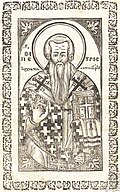 Peter of ArgosSaint · Bishop of ArgosMay 3
- Oecumenius of TriccaSaint · Bishop of TriccaMay 3
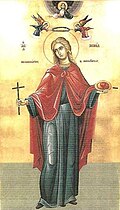 Xenia of KalamataGreat MartyrMay 3
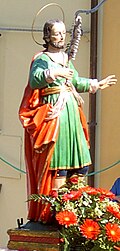 Primianus of LarinoMartyrMay 3
- Gabriel the New MartyrNew MartyrMay 3
- 27 MartyrsHoly MartyrsMay 3
- AdalsindisVenerableMay 3
- Aethelwine of LindseySaint · Bishop of LindseyMay 3