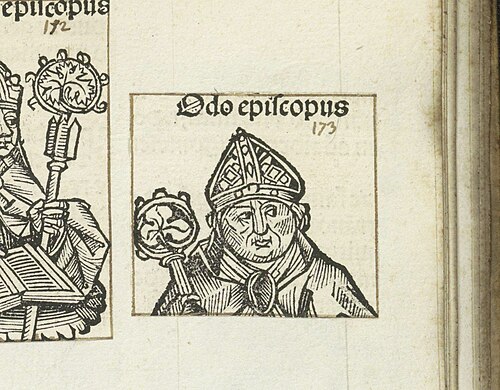
Saint
Oda the Good
Archbishop of Canterbury
Archbishop of Canterbury, reposed in 958.
Life
Early life
Saint Oda the Good was Archbishop of Canterbury in the tenth century and reposed on 2 June 958. His parents were Danes; his father is said to have come to England in 865 with the Viking army of Ubba and Ivar, and Oda was probably born in East Anglia. His nephew Oswald later became Archbishop of York.
The biographies relate that he joined the household of a pious nobleman, Æthelhelm, whom he accompanied on pilgrimage to Rome and whom he is said to have healed of an illness. Other accounts show him fighting under King Edward the Elder, but scholars regard these stories as unlikely. He was consecrated Bishop of Ramsbury between 909 and 927, and from 928 his name appears on royal charters. According to tradition, he accompanied King Æthelstan at the battle of Brunanburh in 937. In 940 he arranged a truce between Olaf, king of Dublin and York, and King Edmund.
After the death of Wulfhelm on 12 February 941, Oda was raised to the see of Canterbury. He helped King Edmund draw up the new laws of the kingdom, some of which concerned the Church. He gave his clergy the Constitutions of Oda, the earliest surviving rules of a tenth-century English church reformer. They treat the relations between laity and clergy, the duties of bishops, canonical marriage, the keeping of fasts and the payment of tithes.
He supported the monastic reform of Dunstan, re-roofed Canterbury Cathedral after raising its walls higher, and worked on the arrangement of the dioceses of his province. In 948 he took the relics of Saint Wilfrid from Ripon, and he also acquired those of Saint Ouen. In 956 he crowned King Eadwig, and early in 958 he annulled the king's marriage to Ælfgifu because of their kinship.
His contemporaries called him "the Good", and later he was also called "the Severe". After his death miracles were told of him, among them a king's sword miraculously set right and a Eucharist that dripped blood. No evidence survives that he was venerated in his own time, and the first Life of him was written by Eadmer between 1093 and 1125. He is honoured as a saint with a commemoration on 4 July; other lists keep him on 2 June or 29 May. The Orthodox calendar counts him among the saints of the West before the Great Schism (a saint of the undivided Church) and commemorates him on 2 June, by the New Calendar.
Commemorated the same day June 2
 Eugene I of RomeSaint · Bishop of RomeJun 2
 Nikephoros the ConfessorSaint · Patriarch of ConstantinopleJun 2
 BlandinaMartyrJun 2
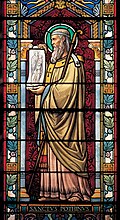 Pothinus of LyonHieromartyr · Bishop of LyonJun 2
 Nectarius of ConstantinopleSaint · Archbishop of ConstantinopleJun 2
 Nicholas the PilgrimVenerable · Greek pilgrim in southern ItalyJun 2
 John the New of SuceavaGreat Martyr · Martyr of Cetatea AlbăJun 2
- Plato of ElisavetgradHieromartyrJun 2
- 38 MartyrsHoly MartyrsJun 2
- AdalgisVenerableJun 2
- Aedhan of Cluain DomhuilSaintJun 2
- Aemilia of LyonMartyrJun 2