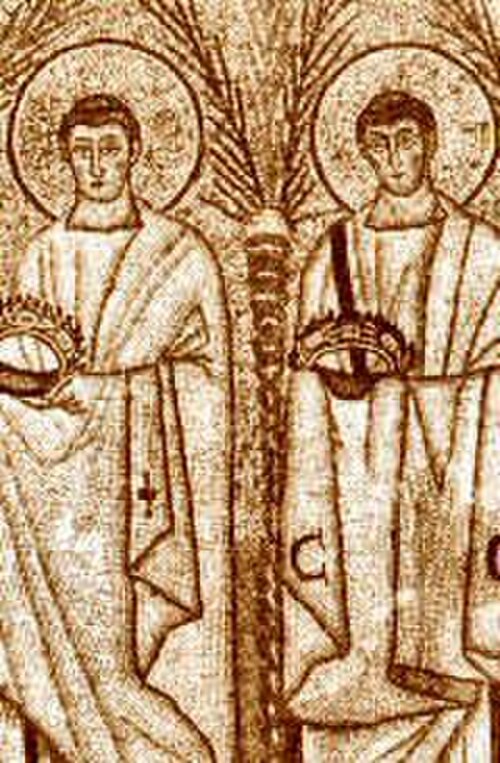
Holy Martyrs
Protus and Hyacinth
Martyrs of Rome
Roman martyrs put to death in the persecution of Emperor Valerian, between 257 and 259.
- Feast
- September 11old style September 24
- Reposed
- 2503rd century
- Place
- Rome
- Order
- Martyrs
Life
The Holy Martyrs Protus and Hyacinth were two martyrs of Rome, put to death in the persecution of Emperor Valerian, between 257 and 259. Their annual commemoration, on 11 September, is mentioned in the Depositio Martyrum of the Chronograph of 354. The Serbian Orthodox Church commemorates them on 24 December by the old calendar.
The earliest account of their lives is the Passion of the Holy Martyrs Protus and Hyacinth, written in Latin, in Italy, between 450 and 499, in the manner of a novel. It says they were eunuchs and attendants of Saint Eugenia and were baptized with her by Helenus, bishop of Heliopolis. They helped her dress as a man and enter a men's monastery, where they too became monks. They devoted themselves zealously to the study of Holy Scripture, lived with the hermits of Egypt and then accompanied Eugenia to Rome, where they brought many young people to Christianity. There they were seized for Christianity, and, led into a temple to worship the god Zeus, according to tradition, as they entered his statue fell and broke in pieces. The prefect of Rome, Nicetius, ordered their heads cut off, thinking they had overthrown the god by magic. Refusing to renounce their faith, they were first scourged and then beheaded on 11 September 258, or 262 according to other sources. Scholars now think this Passion a novelistic work made to give a life to saints who had none and to link them to Eugenia, thought fictitious. Pope Damasus I wrote an epitaph in honour of the two martyrs, part of which survives, in which he calls them "brothers".
The Chronograph of 354 says they were buried together in the coemeterium of Basilla on the Via Salaria, later the Catacomb of Sant'Ermete. When Pope Leo IV (847 to 855) moved the bones of many Roman martyrs to the churches of Rome, probably because of the devastation of the chamber, only Protus's grave was found then, and his remains were carried to San Salvatore on the Palatine hill. In 1845 Father Giuseppe Marchi discovered Hyacinth's still undisturbed grave, in a crypt of the same catacomb: a small square niche, with the ashes and pieces of burned bone, wrapped in costly cloths, since many martyrdoms of the time were by fire. The niche was closed by a marble slab with the original Latin inscription, which confirmed the date in the old Roman Martyrology: "Buried on the third day before the Ides of September, Hyacinthus, martyr." In the same chamber fragments of an architrave were found with the words "grave of the martyr Protus", which showed that both had been buried in the same crypt. In June 1933 Hyacinth's remains were placed in the chapel of the Propaganda College. In England the church of Saint Protus and Hyacinth at Blisland in Cornwall is called locally "St Pratts".
Commemorated the same day September 11
 Paphnutius the ConfessorConfessor · Bishop in the Upper ThebaidSep 11
 Silouan the AthoniteVenerable · Monk of Saint Panteleimon MonasterySep 11
 Theodora of AlexandriaVenerable · Of AlexandriaSep 11
 Deiniol of BangorSaint · First Bishop of BangorSep 11
 Herman of ValaamVenerable · Co-founder of Valaam MonasterySep 11
 Sacerdos of LyonSaint · Archbishop of LyonSep 11
 Three Hundred AragviansHoly Martyrs · Georgian soldiers of the Aragvi valleySep 11
 Ia of PersiaMartyr · Martyr of PersiaSep 11
 Euphrosynus the CookVenerable · Monk and cook of PalestineSep 11
- Leudinus Bodo of ToulSaint · Bishop of ToulSep 11
- Wilbert of CologneSaint · Archbishop of CologneSep 11
 Joel of OzeryanyConfessor · ArchimandriteSep 11