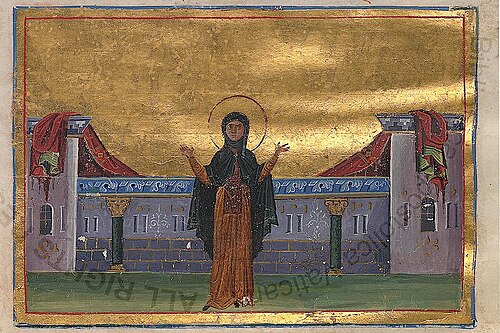
Venerable
Theodora of Alexandria
Of Alexandria
Woman of Alexandria in the time of Emperor Zeno who lived as a monk in the Thebaid in the fifth century.
- Feast
- September 11old style September 24
- Reposed
- 4905th century
- Place
- Thebaid
- Order
- Venerables
Life
The Venerable Theodora of Alexandria was, according to the story of her Life, a woman of Alexandria in the time of the emperor Zeno who, after a fall, lived as a monk, in male guise, in a monastery of the Thebaid, in the fifth century. Her feast is on 11 September. The story is held to be partly legendary; Sabine Baring-Gould thinks her Life was put together from the lives of other saints, such as Marina the Monk.
According to the story, Theodora was beautiful, a Christian, and lived happily with her wealthy husband, Gregory (according to another source, Paphnutius), prefect of Egypt, when she fell into the sin of adultery. Seized with remorse, and so that her husband should not find her, she cut her hair, put on men's clothes, called herself Theodore and, as a eunuch, went to a men's monastery in the Thebaid, where she lived for the rest of her life. She laboured, did menial work and prayed fervently to be forgiven. It is told that, after eight years, she was sent by the abbot to Alexandria to buy bread; on the way back she was to spend the night at a nearby monastery. At the inn there was the abbot's daughter, who had come to see her father, who had sinned with a man and borne a child; when her father asked her to account, she put the blame on Theodora, whom she took for a man. Theodora took the child and was driven with disgrace from the monastery; she accepted this trial too as atonement for her former sin, lived seven years in a hut, in utter poverty, with the infant whom shepherds fed with milk, while she ate wild herbs, and raised the child as her own. All this time she would not defend herself nor reveal her nature. At last the monks asked the abbot to take her back, with the child. The Life mentions a miracle: in a drought, through her prayer, water appeared again in a dry well. When she felt she was dying she sent for her husband, but he arrived after her death. At her death the monks learned that she was a woman and that the accusation had been unjust. Her husband came to the funeral, gave his goods to the poor and moved into the monastery.
Commemorated the same day September 11
 Paphnutius the ConfessorConfessor · Bishop in the Upper ThebaidSep 11
 Silouan the AthoniteVenerable · Monk of Saint Panteleimon MonasterySep 11
 Deiniol of BangorSaint · First Bishop of BangorSep 11
 Protus and HyacinthHoly Martyrs · Martyrs of RomeSep 11
 Herman of ValaamVenerable · Co-founder of Valaam MonasterySep 11
 Sacerdos of LyonSaint · Archbishop of LyonSep 11
 Three Hundred AragviansHoly Martyrs · Georgian soldiers of the Aragvi valleySep 11
 Ia of PersiaMartyr · Martyr of PersiaSep 11
 Euphrosynus the CookVenerable · Monk and cook of PalestineSep 11
- Leudinus Bodo of ToulSaint · Bishop of ToulSep 11
- Wilbert of CologneSaint · Archbishop of CologneSep 11
 Joel of OzeryanyConfessor · ArchimandriteSep 11