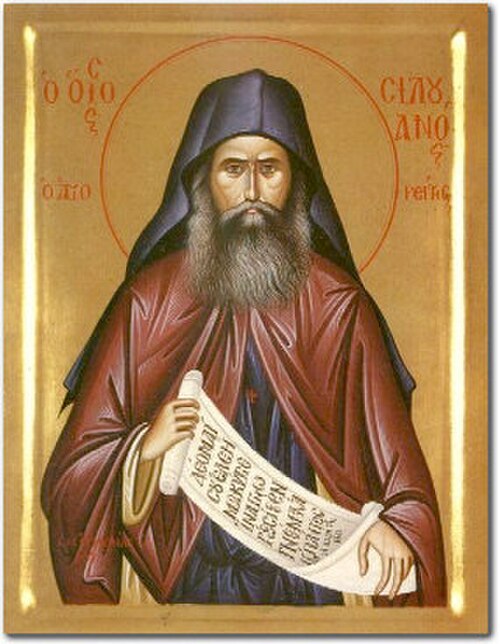
Venerable
Silouan the Athonite
Monk of Saint Panteleimon Monastery
Russian monk of Saint Panteleimon Monastery on Athos, spiritual teacher and writer, who died in 1938.
- Feast
- September 11old style September 24
- Reposed
- 193820th century
- Place
- Agiou Panteleimonos monastery
- Order
- Venerables
Life
Venerable Silouan the Athonite was a Russian monk of the Saint Panteleimon Monastery on Mount Athos, a spiritual father and writer, born on 17 January 1866 and fallen asleep in the Lord on 24 September 1938 (11 September by the old calendar). With little schooling, he became a teacher of prayer, humility and love of enemies, and his writings, preserved by his disciple, made his life known to the world. The Church honors him as one of the Holy Fathers of our own times.
Youth
He was born Semyon Ivanovich Antonov, in a devout peasant family from the village of Shovskoye in the Tambov province, near the place where the recluse John of Sezenovo had lived. He had little learning, only two years of primary school, and unusual bodily strength: by report he could lift a hot cast-iron pot from the stove with his bare hand or break a thick plank with his fist. In his youth he worked as a carpenter in his brother's workshop. His father was unlearned but humble, and Silouan later said of him, "I have not reached the measure of my father."
His heart was set on fire with love for God after he heard of the miracles at the tomb of Saint John of Sezenovo. At nineteen he wished to enter the Kiev Caves Lavra, but his father urged him to do military service first. Under the influence of his companions he led a dissolute life for a time, until he heard in a dream the voice of the Mother of God: "I do not like what you are doing now." He served in the sapper battalion in Saint Petersburg, always conscious of his own sinfulness, and attended the services of Protopriest John of Kronstadt, whose power in prayer impressed him.
On Mount Athos
In the autumn of 1892, after finishing his military service and spending one week at home, he left for Athos and entered the Russian monastery of Saint Panteleimon, called the Rossikon, which, like all Athonite monasteries, is under the jurisdiction of the Patriarchate of Constantinople. His first obedience was at the monastery mill. He was tonsured a monk in 1896, and in 1911 he received the great schema, with the name Silouan, the Russian version of the biblical name Silvanus. He worked at the mill, at the metochion of Kalamareia, at Old Russikon and then as the monastery's steward. During the Russo-Japanese War he had to leave Athos and return to his native village, where he awaited the call to arms; being a monk, he could not live with his family and built himself a small hut nearby. He spent his nights in prayer; it is said that he liked to pray on an oblong stone at the side of a mountain path, which still bears the name "Saint Silouan's Bench."
From his first years as a monk he received, as has been said, the prayer of the mind and heart, and the rest of his life was a struggle to keep the grace he had received. He passed through long trials, between despair at having been abandoned and the sense of his own sinfulness, until in prayer he heard the word of Christ to him: "Keep your mind in hell and do not despair." In this way he gained deep humility and inward stillness. He prayed and wept for the whole world as for himself and valued love of enemies above all.
Teaching and writings
His disciple and biographer, Archimandrite Sophrony (Sakharov), describes him as a man of rare will but without stubbornness, simple, free and fearless but gentle, humble without servility, "an image and likeness of God." Although he could barely write, many pilgrims sought him out for his wise counsel.
Silouan entrusted his notes to his disciple Father Sophrony, then still a deacon, who a few years later went to Paris to publish them; they appeared first in Slavonic, in 1952, and were soon translated into French, English and many other languages. Many monks call them a "new Philokalia." Among them "Adam's Lament" is a poem by Silouan, from which the Estonian composer Arvo Pärt made a choral work. The theologian John Zizioulas saw in his humility and love of enemies an identification with all humanity in its fallen state.
Veneration
The Ecumenical Patriarchate canonized him on 26 November 1987, and the Moscow Patriarchate entered him in its calendar in 1992, with the blessing of Patriarch Alexy II. The Church commemorates him on 24 September (11 September by the old calendar). In his home village, on the place where he built his hut, stands since 1995 a chapel of pink brick.
Commemorated the same day September 11
 Paphnutius the ConfessorConfessor · Bishop in the Upper ThebaidSep 11
 Theodora of AlexandriaVenerable · Of AlexandriaSep 11
 Deiniol of BangorSaint · First Bishop of BangorSep 11
 Protus and HyacinthHoly Martyrs · Martyrs of RomeSep 11
 Herman of ValaamVenerable · Co-founder of Valaam MonasterySep 11
 Sacerdos of LyonSaint · Archbishop of LyonSep 11
 Three Hundred AragviansHoly Martyrs · Georgian soldiers of the Aragvi valleySep 11
 Ia of PersiaMartyr · Martyr of PersiaSep 11
 Euphrosynus the CookVenerable · Monk and cook of PalestineSep 11
- Leudinus Bodo of ToulSaint · Bishop of ToulSep 11
- Wilbert of CologneSaint · Archbishop of CologneSep 11
 Joel of OzeryanyConfessor · ArchimandriteSep 11