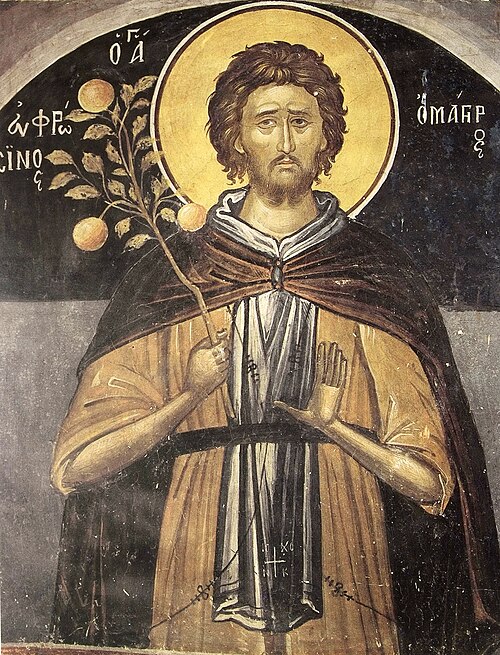
Venerable
Euphrosynus the Cook
Monk and cook of Palestine
Monk and cook in Palestine in the 9th century, whose life is told in the Synaxarion of Nicodemus the Hagiorite.
- Feast
- September 11old style September 24
- Reposed
- 9009th century
- Place
- Palestine
- Order
- Venerables
Life
Saint Euphrosynus the Cook (Euphrosynus of Palestine) the venerable was a monk and cook in a monastery in Palestine, who according to the Synaxarion of Saint Nicodemus the Hagiorite lived in the ninth century; other sources cannot say when he lived. He is regarded as the patron of cooks. He is commemorated on 11 September (24 September in the new style). A church in his honour stands at Nedousa in Messenia.
His life
Nothing is known of his life before monasticism, except that he came from a peasant family and was unlettered. Later monastic life drew him and, leaving his house, he went to a coenobitic monastery in Palestine, where he was tonsured and received the obedience of cook. According to his Life, since he was not of noble birth, he suffered from the brethren many troubles, insults, mockery and frequent annoyances; it seems he was laughed at also because he did not manage very well in the kitchen. Yet he bore all with manliness, prudence and calm, without being disturbed. Working day and night at his obedience, he never gave up prayer and fasting. Lighting the material fire in the kitchen, the saint was kindled with the spiritual fire of love for God, and his heart burned for Him.
The priest's dream
A priest, who lived in the same monastery, asked God each night to show him the future good things prepared for those who love Him. One night he had a vision: it seemed to him that he stood in a cool garden, in a beautiful place, looking with fear and joy at its ineffable beauty: trees of many kinds, fragrant flowers, clear waters. And as he wondered whose this beautiful garden might be, he saw with amazement the cook of the monastery, Euphrosynus, rejoicing there in the unearthly beauty. The priest approached and asked him: "Euphrosynus, how did you come here? Whose is this garden? Is it paradise?" "Paradise," answered Euphrosynus, "is for those who love God." "And what do you do here?" "By the grace of God I dwell here, father, and I am the keeper of the garden." "Then give me something of all these good things." "Take what you want." The priest said: "I would like these apples," pointing to a branch with three large apples. Euphrosynus picked them and gave them to him.
The miracle
Then the semantron was heard for the service of Matins, and the priest woke from the dream. Rising, and still thinking of what had happened, he saw quite unexpectedly the three apples given by Euphrosynus, lying on his phelonion. After first thanking God, he set out for the monastery church. There he found the cook standing in his stall and called him aside to ask him where he had been all night. Euphrosynus said: "Forgive me, father, but I did not go anywhere all night." The priest insisted, saying that he must not hide the truth of God. Then Euphrosynus answered: "Father, I was where the good things are that those who love God will inherit, which you too asked long ago to see. I was where you saw me too, enjoying the good things of the garden. For the Lord, wishing to inform your holiness about the good things of the righteous that you asked for, did this wonder through me, the humble one." "And what did you give me?" asked the priest, wishing to make still more sure. "The beautiful and sweetly fragrant apples, which you put on your bed. But forgive me, father, for I am a worm and not a man." The priest made a prostration, kissed him and went to his place. After the dismissal of the service the priest brought the apples and called all the monks, to tell them his experience. All marvelled with compunction at what the priest told. They went to the kitchen to Euphrosynus to bow before the servant of God, but they no longer found him, for he fled human glory. The saint left the monastery and disappeared, keeping the place of his new dwelling secret. The apples of the venerable one were kept, divided into pieces and given for blessing and healing; the sick who tasted of them were cured of their illnesses.
Commemorated the same day September 11
 Paphnutius the ConfessorConfessor · Bishop in the Upper ThebaidSep 11
 Silouan the AthoniteVenerable · Monk of Saint Panteleimon MonasterySep 11
 Theodora of AlexandriaVenerable · Of AlexandriaSep 11
 Deiniol of BangorSaint · First Bishop of BangorSep 11
 Protus and HyacinthHoly Martyrs · Martyrs of RomeSep 11
 Herman of ValaamVenerable · Co-founder of Valaam MonasterySep 11
 Sacerdos of LyonSaint · Archbishop of LyonSep 11
 Three Hundred AragviansHoly Martyrs · Georgian soldiers of the Aragvi valleySep 11
 Ia of PersiaMartyr · Martyr of PersiaSep 11
- Leudinus Bodo of ToulSaint · Bishop of ToulSep 11
- Wilbert of CologneSaint · Archbishop of CologneSep 11
 Joel of OzeryanyConfessor · ArchimandriteSep 11