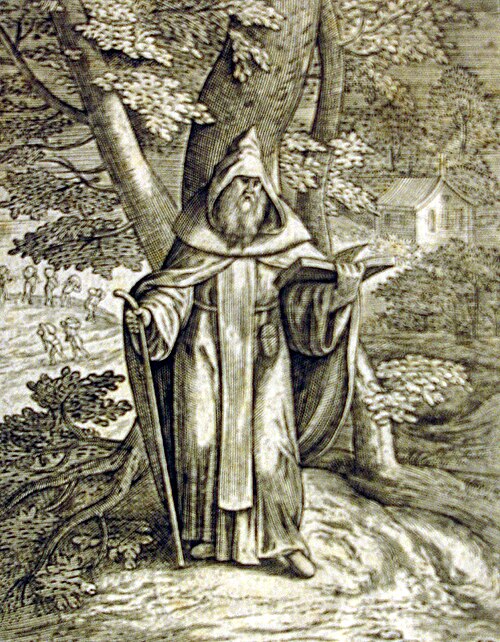
Confessor
Paphnutius the Confessor
Bishop in the Upper Thebaid
Disciple of Anthony the Great and bishop of a city in the Upper Thebaid in the fourth century.
- Feast
- September 11old style September 24
- Reposed
- 4004th century
- Place
- Egypt
- Order
- Confessors
Life
Saint Paphnutius the Confessor was a bishop of a city in the Upper Thebaid in Egypt, a disciple of Saint Anthony the Great, and a participant in the First Ecumenical Council of Nicaea in 325. The Church remembers him as a confessor who bore the marks of his faith in his body, and as a defender of right doctrine against Arius.
He was an Egyptian and, after living in the school of the great Anthony, became a bishop. Under the emperor Maximinus he was persecuted for his faith in Christ: his right eye was put out, his left leg was hamstrung, and he was then condemned to the mines. The name of his see is not known.
At Nicaea, according to the church historians, Saint Constantine the Great showed him great honour, and in one account kissed the eye that had been lost for the faith. When the council took up the matter of clerical celibacy, many bishops seemed ready to follow the rule of the council of Elvira and forbid those married before ordination to live with their wives. Paphnutius, who had himself kept chastity all his life, earnestly asked them not to lay this burden on the clergy. He proposed, in keeping with the ancient tradition of the Church, that only those unmarried at ordination should remain so, and that those already married should not be separated from the wife they had joined before they were ordained. His reputation and his blameless life gave weight to his word, and the council left it to married clergy to decide whether to continue or not their family life.
With Saint Athanasius the Great, Paphnutius stood firm against Arianism. In 335 he went with him to the synod at Tyre, together with Potamon of Heraclea and 47 other Egyptian bishops. The historian Socrates Scholasticus, the earliest source to speak of this saint, is at the centre of debate: some scholars have doubted that Paphnutius was at Nicaea, while others have defended the truth of the story.
He fell asleep in the Lord around the middle of the fourth century. The Orthodox Church celebrates him on 11 September.
Commemorated the same day September 11
 Silouan the AthoniteVenerable · Monk of Saint Panteleimon MonasterySep 11
 Theodora of AlexandriaVenerable · Of AlexandriaSep 11
 Deiniol of BangorSaint · First Bishop of BangorSep 11
 Protus and HyacinthHoly Martyrs · Martyrs of RomeSep 11
 Herman of ValaamVenerable · Co-founder of Valaam MonasterySep 11
 Sacerdos of LyonSaint · Archbishop of LyonSep 11
 Three Hundred AragviansHoly Martyrs · Georgian soldiers of the Aragvi valleySep 11
 Ia of PersiaMartyr · Martyr of PersiaSep 11
 Euphrosynus the CookVenerable · Monk and cook of PalestineSep 11
- Leudinus Bodo of ToulSaint · Bishop of ToulSep 11
- Wilbert of CologneSaint · Archbishop of CologneSep 11
 Joel of OzeryanyConfessor · ArchimandriteSep 11