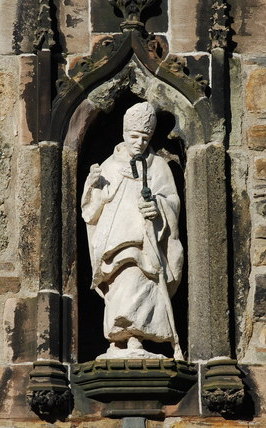
Saint
Deiniol of Bangor
First Bishop of Bangor
Traditionally the first bishop of Bangor in Gwynedd, where he founded a monastery; also honored in Brittany.
- Feast
- September 11old style September 24
- Reposed
- 5846th century
- Place
- Bardsey Island
- Order
- Hierarchs
Life
The Holy Hierarch Deiniol of Bangor (Deiniol, in Latin and English sometimes Daniel) is held, according to tradition, to be the first bishop of Bangor, in the kingdom of Gwynedd in Wales. He fell asleep in 584, according to the Annales Cambriae, or, more probably, in 572. His feast is on 11 September. In Brittany he is venerated as Saint Denoual.
Family and beginnings
According to a Latin Life of Deiniol, preserved in Peniarth MS 226 and transcribed in 1602 by Sir Thomas Williams of Trefriw, he was the son of Abbot (according to another source, of the king of the Northern Pennines) Dunod Fawr, son of Pabo Post Prydain. The family, having lost their land in the north of England, were given land by the king of Powys, Cyngen Glodrydd; Dunod, a very religious man, founded a monastery. Deiniol embraced the religious life and is said to have studied under Saint Cadoc of Llancarfan. Sir David Trevor describes him as one of the seven blessed cousins, who spent part of his early life as a hermit "on the arm of Pembrokeshire," but was called to be a bishop despite deficiencies in his formal education.
The monastery of Bangor
Soon he left Powys for Gwynedd, where he founded the monastery of Bangor, under the patronage of Maelgwn Gwynedd, who endowed it with lands and privileges, later raising it to the rank of the official seat of a bishop, sharing a common boundary with the principality of Gwynedd. He is said to have been consecrated to that see by Saint Dubricius in the year 516 (according to another source, at the synod of Llanddewi Brefi, by Saint David). He spent the rest of his days there as abbot and bishop. He attended the synod of Llanddewi Brefi, around 545, with Saint David, when the subject of rules for penance was being discussed. According to the Annales Cambriae, Deiniol died in 584 and was buried on Bardsey Island. It is possible that this date, like the dates given for the deaths of David and Kentigern, is twelve years later than it should be, in which case the correct date is 572.
Veneration
His cult in North Wales was quite extensive and several churches are dedicated to him, among them at Worthenbury near Wrexham, at Hawarden in Flintshire (and other churches in Flintshire), at Llangarron, Llanfor, Llanuwchllyn, Eyton and Itton; near Cardigan Bay lies the village of Llanddeiniol, "parish of Saint Deiniol," which was once the name of Itton. The church of Marchwiel is dedicated to him, and Itton in Monmouthshire and Llangarron in Herefordshire also have dedications. The Cathedral Church of Saint Deiniol in Bangor, now of the Church in Wales, is dedicated to his name and is said to stand on the site of his monastery. In 1896 William Ewart Gladstone dedicated to Saint Deiniol a library, at Hawarden, in Flintshire. In the Roman Catholic liturgical calendar for Wales and that of the Anglican Church in Wales he is commemorated on the traditional date of 11 September. His name may be referenced in the name of the hymn tune St. Denio ("Immortal, invisible").
Commemorated the same day September 11
 Paphnutius the ConfessorConfessor · Bishop in the Upper ThebaidSep 11
 Silouan the AthoniteVenerable · Monk of Saint Panteleimon MonasterySep 11
 Theodora of AlexandriaVenerable · Of AlexandriaSep 11
 Protus and HyacinthHoly Martyrs · Martyrs of RomeSep 11
 Herman of ValaamVenerable · Co-founder of Valaam MonasterySep 11
 Sacerdos of LyonSaint · Archbishop of LyonSep 11
 Three Hundred AragviansHoly Martyrs · Georgian soldiers of the Aragvi valleySep 11
 Ia of PersiaMartyr · Martyr of PersiaSep 11
 Euphrosynus the CookVenerable · Monk and cook of PalestineSep 11
- Leudinus Bodo of ToulSaint · Bishop of ToulSep 11
- Wilbert of CologneSaint · Archbishop of CologneSep 11
 Joel of OzeryanyConfessor · ArchimandriteSep 11