Venerable Martyr
Seraphim Vavilov
Monk martyred for the faith of Christ in 1919, during the Soviet persecution.
- Feast
- February 4old style February 17
- Reposed
- 193820th century
- Order
- Martyrs
Life
Holy Venerable Martyr Seraphim Vavilov, an archdeacon, was born on 27 July 1899 at Yaroslavl, was a monk of the Alexander Nevsky Lavra in Petrograd and was shot on 17 February 1938 at the Butovo range near Moscow.
In the world he was called Vladimir and was the son of the merchant Alexander Vasilievich Vavilov and Paraskeva Ivanovna. The family soon moved to St Petersburg. He was educated at home, then in a gymnasium, and in 1917 he asked to be received at the conservatory, for piano, and in 1918 at the law faculty of the university. At Petrograd he was a parishioner of the Alexander Nevsky Lavra, and his spiritual father was the hieroschemamonk Seraphim (Bogatov), who had begun his ascetic life at Sarov and from 1882 was in the Lavra. He died on 2 October 1919, and the next day Vladimir asked Metropolitan Benjamin of Petrograd to receive him into the Lavra and tonsure him a monk, writing that it was his old wish, approved by the reposed hieroschemamonk, who left him his klobuk and paramand like a testament. The metropolitan received him as a novice and named him sacristan; he also kept vigil at the relics of St Alexander Nevsky, and from December 1919 was also a watchman at the Nikolo-Kladbishchenskaya church. On 26 February 1920 he was tonsured a monk with the name Seraphim, and on 29 February ordained hierodeacon.
Having a good musical and artistic education, Seraphim painted icons; the best known is the full-length icon of St Alexander Nevsky, now kept in the St Vladimir cathedral in St Petersburg. In the summer of 1922, with the Renovationist schism supported by Soviet power, the churches of the Lavra were taken by the Renovationists. The brothers divided; those who did not wish to join the betrayers of the Church had to leave, among them Seraphim, who asked for unlimited leave and was named psalmist at the church of St Catherine on Vasilievsky Island. In 1923 this too was taken by the Renovationists, and from 12 April 1923 he served at the Nikiforovsky metochion; on 25 December 1924 Patriarch Tikhon rewarded him with a certificate. On 12 April 1928 he returned to the Lavra, whose vicar was Bishop Gregory (Lebedev), and in 1929 he was raised to archdeacon.
On 27 November 1935 the city authorities decided to close all the churches of the Lavra. After the closure, in January 1936, of the last church, that of the Descent of the Holy Spirit, Father Seraphim was called to the NKVD as a witness and attempts were made to force him to false testimony against others. He categorically refused, and the investigator, in revenge, took from him a pledge that he would leave the city within three days. He moved to Klin, near Moscow, and served at the church of Joy of All Who Sorrow.
He was arrested on 26 January 1938 and imprisoned at Taganka. The witness on duty stated that the archdeacon had told a dean that the Bolsheviks, like good musicians, change their tune, that the new constitution was a trap and that one must be careful. The investigator asked if he had been a monk; he answered that he had been since 1919 and remained so, by his conviction, to the present day. He said that he did not admit guilt and that he had spoken of his expulsion from Leningrad but not against the authorities. On 8 February 1938 an NKVD troika sentenced him to death. He was shot on 17 February 1938 and buried in the unknown common grave at Butovo.
He is commemorated on 17 February, on 29 May (a movable date) in the Synaxis of the New Martyrs of Butovo, on 11 July (a movable date) in the Synaxis of the Saints of the St Petersburg Metropolis and on 5 September (a movable date) in the Synaxis of the Saints of Moscow, in the new style.
Commemorated the same day February 4
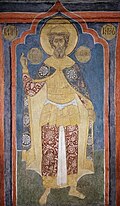 George of VladimirRight-Believing · Grand Prince of VladimirFeb 4
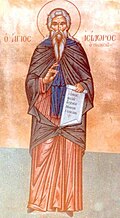 Isidore of PelusiumVenerable · Hermit near PelusiumFeb 4
 Theophilus of AdanaSaint · Steward of the Church of AdanaFeb 4
 Abraham of ArbelaSaint · Bishop of ArbelaFeb 4
 Nicholas the StuditeVenerable · Abbot of the Stoudios MonasteryFeb 4
 Cyril of NovoezerskVenerable · Founder of Novoezersk MonasteryFeb 4
 Alexei SharovHieromartyr · ArchpriestFeb 4
 Catherine of SimbirskVenerable Martyr · Nun at SimbirskFeb 4
 John TikhomirovHieromartyr · PriestFeb 4
- Anthony of SupraślVenerable MartyrFeb 4
 Nicholas PospelovHieromartyr · ArchpriestFeb 4
 Methodius KrasnoperovHieromartyr · Bishop of PetropavlovskFeb 4