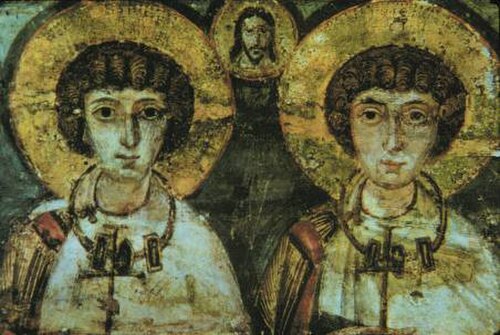
Martyr
Sergius
Martyr of Resafa
Roman officer martyred in Syria with Bacchus; his tomb at Resafa became a great place of pilgrimage.
Life
Holy Martyr Sergius was an officer in the guard of the Emperor Maximian and suffered around the year 303 together with his friend Bacchus. His tomb at Resafa in Syria became a great place of pilgrimage. He is commemorated on 7 October.
Maximian (284-305) appointed Sergius and Bacchus to high military posts, not knowing that they were Christians. Ill-wishers denounced them to the emperor, saying that the two commanders did not honour the pagan gods, which was considered a crime against the state. Wishing to be sure, the emperor ordered them to offer sacrifice to idols, but they answered that they worshipped only the one God. Maximian ordered the insignia of their military rank to be taken from them, had them dressed in women's clothes and led around the city with iron collars on their necks, to the mockery of the crowd. Then he summoned them again and advised them as a friend not to be seduced by Christian fables. The saints remained unmoved and were sent to Antiochus, the governor of the eastern part of Syria, a fierce enemy of Christians, who had obtained his post with their help. Antiochus said to them: "My fathers and benefactors, be merciful not only to yourselves but to me: I would not wish to give you over to torments." The saints answered that for them life is Christ and death for Him is gain.
Enraged, Antiochus ordered Bacchus flogged without mercy, and he passed to the Lord. Sergius was shod with iron boots studded with nails and taken for trial to another city, where he was beheaded by the sword, around the year 300. At Resafa, which received the name Sergiopolis, his tomb became a place of pilgrimage. In 547 the Emperor Justinian built in Constantinople the church called the Little Hagia Sophia in honour of the two martyrs. The head of Saint Sergius is kept at Curtea de Argeș Monastery in Romania, and fragments of his relics are at the Alexander Nevsky Lavra in Saint Petersburg.
Commemorated the same day October 7
 Mark of RomeSaint · Bishop of RomeOct 7
 Sergius and BacchusHoly MartyrsOct 7
 Caesarius of TerracinaHieromartyr · Deacon of TerracinaOct 7
 Jonah of HankouSaint · Bishop of HankouOct 7
 OsythVenerable · Mercian prioressOct 7
 Sergius of NuromVenerable · Founder of Nurom MonasteryOct 7
- Dubthach of ArmaghSaint · Bishop of ArmaghOct 7
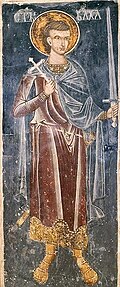 Bacchus of RomeMartyrOct 7
- Sergius the ObedientVenerableOct 7
- Adalgis of NovaraSaint · Bishop of NovaraOct 7
- Aetherius of LyonSaint · Bishop of LyonOct 7
 Aleksiy Mogilnitsky of LelchitsyHieromartyrOct 7