Venerable
Simeon Zhelnin
Venerable monk of the Pskov Caves Monastery, venerated in the Russian Orthodox calendar.
- Feast
- January 5old style January 18
- Reposed
- 196020th century
- Order
- Venerables
Life
Holy Venerable Simeon Zhelnin, hieroschemamonk of Pskov-Caves, was for many years a confessor and hermit in the caves of the monastery and fell asleep on the eve of Theophany, in January 1960. He was glorified among the saints on 1 April 2003.
Childhood and calling
He was born on 1 March 1869 in the village of Yakovlevskaya, Ostrov district, Pskov province, into a devout peasant family, that of John and Natalia, and at baptism received the name Basil. He grew up obedient to his parents. A monk of the Krypets Monastery, Cornelius, often passed by their house and, sleeping beside the boy, would tell him, "You will be a monk, you will be a great elder." At ten, hearing the life of Saint Seraphim of Sarov, he found a big stone in a field and prayed on it, wishing to imitate him. At twelve he went with his parents to the Pskov-Caves Monastery and wished to stay there for ever. At twenty he asked his father to let him go to the monastery, but his father said that he must be married, not made a monk. Basil held firm and told them that he would never marry. His father saw the seriousness of his will and let him build a small house in the yard, in which he lived and prayed in solitude until the age of twenty-five. A blessed old man named Simeon, who had come to the village, one day drove Basil out of the house, beyond the village, then returned to the house, lay on the bench and died. All understood that the blessed man had driven Basil toward the monastery, and his father yielded.
In the monastery
In 1896 Basil entered Pskov-Caves as a novice. Archimandrite Methodius (Kholmsky, † 1906), then vicar of the monastery, took him as cell attendant. He also worked at the community obediences, above all at the pilgrims' hostel, often from five in the morning until late at night, and in his scarce free time, when the young men rested on the Holy Hill, he withdrew to the carpenter's shop, where as a skilled joiner he made useful things. In 1900 he was tonsured a monk with the name Vassian, in 1901 ordained hierodeacon, and in 1903 hieromonk and named steward at the Snetogorsk monastery in Pskov, from which he returned after four years to Pechory and was sent to restore the farm of the Mustishchevo estate, twenty-five kilometres away. There he had to build a church of Saint John the Baptist, a church house and all that was needed, and set the land to bear. He spent the years in hardship: "I never got out of my bast shoes," he told. When the work went well he returned to his monastery at forty-six.
At the revolution the abbot, Bishop John (Bulin, † 1941), wished to make him vicar of the monastery, but out of humility he shrank from it and asked to be tonsured into the schema, feeling an "inward urging". On 3 February 1927 he was tonsured with the name Simeon and named confessor of the brotherhood and of the pilgrims. The abbot led him to a narrow, damp, dark cell, in fact a cave dug in the mountain beside the Dormition church, and said, "Here is your cell, here you will die." So it was.
The hermitage
Thus began the prayerful and eldership labour of Hieroschemamonk Simeon, which lasted thirty-three years. He prayed daily at the early Liturgy in the Dormition cave church, at the table of oblation, commemorating all his spiritual children; at night he kept the rule of the schemamonk, and by day he received the brethren and numerous pilgrims in his cell, working also in the carpenter's shop. He endured many temptations from demons: on the first night evil spirits filled the cell, fearsome, and began to shout at him, "Why have you come? Go away, we will not let you live here anyway." He told: "I thought I would not survive that torment; I could not even make the sign of the cross, but only said, Lord, receive my spirit." The temptations recurred, but less terribly, and with God's help he learned to repel them by the power of the cross and prayer. For his great love of God and of people and for his humility, rare gifts were revealed in him: the gift of healing souls, of foresight and of curing spiritual and bodily ills; many written testimonies of those healed by his prayers survive. Out of humility he hid his foresight: "I am no seer; age helps me, I entered the house earlier than the others and I know its ways better," he would say, feigning. In his written life he left a note: "Hard is the monastic road, but harder that of the schema, if we walk as our Lord Jesus Christ showed us. By the visitation of His Most Holy Spirit all can be overcome and borne." Sixty-four years of ascetic labour made him a vessel of grace, which shone in his eyes and his whole bearing.
His repose and veneration
In his last days he grew very weak, but still received people. Asked by his spiritual children whom he was leaving them to, he answered, "To the Mother of God." He urged them to love one another and to forgive every offence, since hatred of even one person leads to mortal sin. Out of humility and obedience he gave a last lesson: following a revelation, he expected his end on 15 January 1960 (2 January in the old style), on the feast of Saint Seraphim of Sarov. But the vicar of the monastery, Archimandrite Alypius (Voronov, † 1975), visiting him, feared he might die on the feast of Theophany and asked him to beg God for a postponement. "Very well," the elder answered, "you are the vicar, I am a novice, let it be as you say." So it was: he fell asleep on the eve of Theophany, on 5 (18) January, and was buried after the feast. Many spiritual children came to the funeral; the service was performed by Archimandrite Alypius with forty priests, and the coffin with the holy relics was placed in the caves of the monastery, in the place he had shown in his life. On 1 April 2003 he was glorified among the saints of Pskov-Caves, and his relics rest in the Presentation church of the monastery. Through his prayers he gives help to those who come with faith, and many find peace of soul and healing from sickness.
He is commemorated on 18 January and on 1 April (the Glorification), and, in the new style, on 11 July (a movable date) in the Synaxis of the Saints of Pskov, on 18 July (a movable date) in the Synaxis of the Venerable Fathers of Pskov-Caves and on 1 December in the Synaxis of the Saints of Estonia.
Commemorated the same day January 5
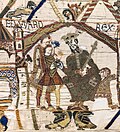 Edward the ConfessorRight-Believing · King of EnglandJan 5
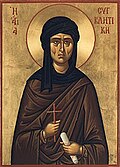 Syncletica of AlexandriaVenerableJan 5
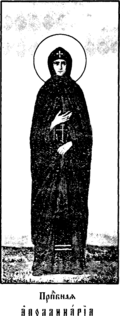 Apollinaria SyncleticaVenerable · Hermit of EgyptJan 5
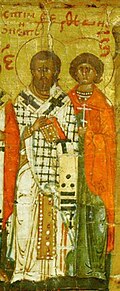 Theopemptus and TheonasHoly Martyrs · Martyrs of NicomediaJan 5
 Rusticianus of BresciaSaint · Bishop of BresciaJan 5
 Theopemptus of NicomediaHieromartyr · Bishop of NicomediaJan 5
 Andrew ZiminHieromartyr · ArchpriestJan 5
- Acutus of AfricaSaintJan 5
- Amelia of GironaMartyrJan 5
- Astolfus of MainzSaint · Archbishop of MainzJan 5
- CiaraSaintJan 5
- Ciaran son of AedhSaintJan 5